NASA Astronauts Study Cancer and Cartilage Research on ISS
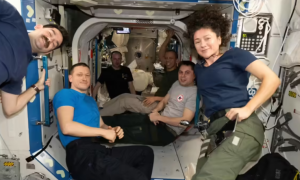
NASA astronauts aboard the International Space Station (ISS) conducted biomedical experiments in May 2026 on cancer therapeutics, cartilage tissue growth, heart stem cells, and DNA-inspired nanomaterials. The work took place during Expedition 74 and used the Japanese Kibo laboratory module and its Life Science Glovebox for space-based life science research.
Space Cancer Therapeutics in Microgravity
NASA Flight Engineer Chris Williams set up Space Cancer Therapeutics hardware inside the Kibo laboratory module in May 2026. The experiment examined the effect of microgravity on an anti-cancer drug and its molecular mechanisms. The research focused on pancreatic cancer therapies and drug behaviour in space conditions.
Cartilage Tissue Engineering in Space
NASA Flight Engineer Jessica Meir studied methods to grow cartilage tissue in space using specialised hardware in Kibo’s Life Science Glovebox in May 2026. Cartilage is a connective tissue found in joints, the nose, the ear, and the rib cage. Space-based cartilage research is used to study three-dimensional tissue formation under microgravity.
Related Biomedical Experiments on the ISS
On 23 April 2026, Jessica Meir processed heart stem cells and pneumonia-causing bacteria for studies linked to heart-condition treatments. On the same date, NASA Flight Engineer Jack Hathaway and ESA astronaut Sophie Adenot manufactured DNA-inspired nanomaterials in the Kibo laboratory module for cancer and chronic disease treatments. These materials are studied for use in immunotherapies and chemotherapies.
Important Facts for Exams
- The International Space Station is a low-Earth orbit laboratory used for microgravity research in biology, medicine, and materials science.
- Kibo is the Japanese Experiment Module on the ISS and includes facilities for life science experiments.
- Pembrolizumab is a cancer medicine developed by Merck and received United States Food and Drug Administration approval in September 2025 for an injectable formulation.
- Microgravity can help cancer cells form three-dimensional tumour models, including tumour spheroids and organoids, for drug testing.
Microgravity Research and Cancer Models
In July 2024, the ISS National Laboratory and NASA selected five projects under the Igniting Innovation solicitation for cancer research. One project at the University of California, San Diego, led by Catriona Jamieson, studied accelerated cancer development in microgravity using patient-derived tumour organoids. In December 2024, tumour spheroids at the Sanford Stem Cell Institute of the University of California San Diego tripled in size in 10 days in microgravity.
Space-Based Organoids and Drug Testing
As of June 2025, Cedars-Sinai cell biologists led by Arun Sharma used pluripotent stem cells to create heart organoids in space. The study examined the impact of cancer drugs on the heart and used microgravity to maintain three-dimensional structures. Encapsulate also used a tumour-on-a-chip system to study chemotherapy drugs in space-based cancer models.
| Related | |
|---|---|