Major Groups of Marine Invertebrates and Their Characteristics
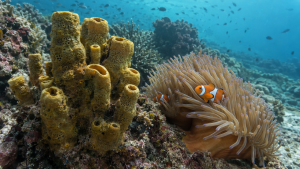
Marine invertebrates lack a backbone and include animals with very different body plans, from simple filter-feeders to active predators. Their characteristics—such as symmetry, body cavity, skeleton and feeding structures—help distinguish major groups and are useful for comparing marine biodiversity.
Porifera and Cnidaria
Porifera (sponges) have a cellular level of organisation, without true tissues or organs. The name means “pore-bearing”: water enters through small openings called ostia and leaves through larger openings called oscula. Most are marine and sessile as adults, attached to a surface. Water passes through a central cavity, the spongocoel, where choanocytes, or collar cells, generate currents and capture microscopic food particles. Their internal support consists of calcareous or siliceous spicules, flexible spongin fibres, or both. Sponges reproduce sexually and asexually and have strong regenerative abilities. Examples include Sycon and Euplectella. Cnidaria are predominantly marine and generally show radial or biradial symmetry. They are diploblastic, with two embryonic layers. Their defining feature is the cnidocyte, a specialised stinging cell containing a nematocyst used in prey capture and defence. Cnidarians occur as sessile polyps, such as corals and sea anemones, or free-swimming medusae, such as jellyfish. They have a simple nerve net but lack respiratory, circulatory and excretory systems. Corals secrete calcareous skeletons that build reef structures and provide important marine habitat.
Annelida and Mollusca
Annelida are bilaterally symmetrical, coelomate worms with bodies divided into repeated segments, or metameres. Most marine annelids belong to the class Polychaeta. Many have chitinous bristles called setae, often carried on paired appendages known as parapodia. These assist movement and may also support respiration. Annelids have a well-developed digestive system and a closed circulatory system; gas exchange often takes place across the moist body surface. They occur in a wide range of habitats, including marine environments. Mollusca includes more than 85,000 described species and is predominantly marine. Molluscs are soft-bodied, triploblastic and bilaterally symmetrical coelomates. Their characteristic body plan includes a muscular foot, a visceral mass containing internal organs and a mantle. The mantle often secretes a calcareous shell, although it is reduced or absent in some forms, including octopuses and slugs. Most molluscs have a radula, a rasping feeding organ; bivalves lack one. They have a well-developed digestive system and generally an open circulatory system. Respiration occurs through gills or, in some forms, a pulmonary sac. Major classes include Gastropoda (snails and slugs), Bivalvia (clams, oysters and mussels) and Cephalopoda (octopuses and squids).
Arthropoda and Echinodermata
Arthropoda is the largest animal phylum. Marine arthropods are represented chiefly by crustaceans, including crabs, lobsters, shrimp, krill and barnacles. They have a segmented body, jointed appendages and a hard chitinous exoskeleton. Because this rigid covering cannot expand continuously, crustaceans grow by molting, or shedding it. They typically have two pairs of antennae and specialised mouth appendages that function as jaws. Most are aquatic and breathe through gills. Crustaceans are ecologically important as food sources and detritivores. Echinodermata consists exclusively of marine animals. Adults typically have pentaradial, or five-part, symmetry, while their larvae are bilaterally symmetrical. A calcareous endoskeleton made of ossicles lies beneath the skin. The group’s distinctive water vascular system is a network of canals operating tube feet. It supports locomotion, feeding, respiration and sensory perception. Sea stars, brittle stars, sea urchins, sand dollars and sea cucumbers are examples. Many echinoderms also have notable regenerative abilities.
Other Marine Invertebrate Groups
Platyhelminthes are triploblastic, bilaterally symmetrical and acoelomate. Their bodies are dorsoventrally flattened, and their digestive cavity has a single opening serving as both mouth and anus. Many flatworms are parasitic, but free-living marine forms also occur. Nematoda are triploblastic, bilaterally symmetrical and pseudocoelomate. They have cylindrical, unsegmented bodies covered by a thick collagenous cuticle. Many marine nematodes are free-living. Invertebrate chordates include tunicates, or sea squirts, and lancelets. Although they lack a backbone, they possess a notochord at some stage of life. Tunicates are mostly sessile as adults, while lancelets are fish-like filter-feeders found in shallow marine habitats.
Key Prelims Takeaways
- Porifera: Cellular organisation; ostia, oscula, choanocytes and spicules or spongin.
- Cnidaria: Diploblastic body plan; cnidocytes with nematocysts; polyp and medusa forms.
- Annelida: Segmented, coelomate body; marine polychaetes may have setae and parapodia.
- Mollusca: Mantle, visceral mass and muscular foot; radula is absent in bivalves.
- Crustaceans: Chitinous exoskeleton, jointed appendages and growth by molting; most breathe through gills.
- Echinodermata: Exclusively marine; adults are usually pentaradial, larvae bilateral, and tube feet operate through a water vascular system.
Recent Context
Two tardigrade species discovered on Senghor Seamount were described in ZooKeys in late October and November 2026. Samples came from a 2009 expedition; researchers recorded 20 taxa at 100–130 metres, compared with two at a nearby 3,300-metre site, highlighting the seamount’s biodiversity.
| Related | |
|---|---|