Earthquake Seismic Zones and Resilient Construction in India
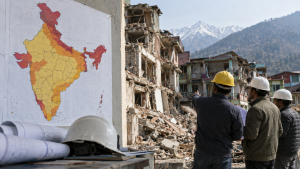
India faces significant earthquake risk because of its active plate boundary, varied geology and growing exposure in densely populated areas. Seismic zoning, compliance with building codes and stronger disaster-response capacity are central to reducing casualties and damage.
India’s Seismic Zonation
The Bureau of Indian Standards (BIS) classifies India into four seismic zones according to expected earthquake intensity and damage risk. The map guides building design and preparedness, but a zone classification does not eliminate local variation in ground conditions or exposure. India’s seismic zonation map was first published in 1962 and revised in 1967, 1970 and 2002.
- Zone V: The highest-risk zone. It includes all of Northeastern India, parts of Jammu and Kashmir and Ladakh, Himachal Pradesh and Uttarakhand, the Rann of Kutch, portions of North Bihar, and the Andaman and Nicobar Islands.
- Zone IV: A high-damage-risk zone covering remaining parts of Jammu and Kashmir, Himachal Pradesh and Uttarakhand; parts of Sikkim; northern Uttar Pradesh, Bihar and West Bengal; Delhi; and parts of Maharashtra near the west coast.
- Zone III: A moderate-damage-risk zone that includes Kerala, Goa and Lakshadweep, as well as areas across the remaining parts of several states, including Uttar Pradesh, Gujarat, Punjab, Rajasthan, Maharashtra, Odisha, Karnataka and Tamil Nadu.
- Zone II: A low-damage-risk zone covering large parts of peninsular India not included in Zones III, IV or V.
Factors Shaping Seismic Vulnerability
The continuing northward movement of the Indian Plate and its collision with the Eurasian Plate generate stress along the Himalayan front and adjoining regions. The resulting seismic hazard is influenced by both geological conditions and human exposure. Active Himalayan structures, including the Main Boundary Thrust (MBT) and Main Central Thrust (MCT), contribute to earthquake risk. In the Gangetic plains, soft alluvial soils can amplify shaking and may liquefy, increasing damage even during moderate earthquakes. The effects depend on local soil conditions as well as the strength and design of buildings. Rapid, unplanned urbanisation and the prevalence of non-engineered or poorly constructed buildings raise the risk to life and property. High population density in seismically active areas further increases the potential consequences. Risk reduction therefore requires attention not only to hazard maps but also to land use, construction quality and the vulnerability of existing settlements.
Seismic Design Codes and Construction
BIS develops standards for earthquake-resistant design and construction. Their use in new construction, together with effective enforcement by state governments and local urban bodies, is essential to reducing structural failure.
- IS 1893 (Part 1): Criteria for earthquake-resistant design of structures, including seismic forces and design methods. It divides India into four seismic zones.
- IS 4326: Code of practice for earthquake-resistant design and construction of buildings, providing general construction guidance.
- IS 13920: Code of practice for ductile detailing of reinforced-concrete structures subjected to seismic forces. Ductility allows structures to deform without sudden collapse.
- IS 13828: Guidelines for improving earthquake resistance in earthen buildings, including non-engineered construction common in rural areas.
- National Building Code of India (NBC): A comprehensive BIS document for regulating building construction that incorporates seismic provisions from relevant IS codes.
Disaster Management and Technical Institutions
The Disaster Management Act, 2005 provides India’s legal and institutional framework for disaster management and led to the creation of the National Disaster Management Authority (NDMA). The system combines policy and planning with emergency response, training and scientific monitoring.
- NDMA: The apex disaster-management body, chaired by the Prime Minister, which lays down policies, plans and guidelines and coordinates their implementation.
- National Disaster Response Force (NDRF): A specialised response force trained for emergencies including collapsed-structure search and rescue. Each battalion can deploy 18 self-contained specialist teams.
- National Institute of Disaster Management (NIDM): Provides training and capacity building for government officials, emergency responders and communities.
- India Meteorological Department (IMD): Operates seismological observatories and serves as the nodal agency for earthquake monitoring in India.
- National Centre for Seismology (NCS): An attached office of the Ministry of Earth Sciences responsible for seismic monitoring, hazard assessment and seismological research.
- Other technical institutions: The Geological Survey of India undertakes geological mapping and hazard assessment; the Central Building Research Institute and CSIR laboratories contribute to research on building materials and earthquake-resistant construction.
Risk Reduction and Urban Resilience
Seismic risk reduction depends on both safer new construction and measures to address vulnerable existing buildings. Retrofitting is particularly important for critical facilities such as hospitals and schools, whose continued operation is vital after an earthquake. School-safety efforts include vulnerability assessments and promotion of earthquake-resistant construction. Building-code compliance requires effective oversight during construction, not merely the existence of standards. Local authorities and state governments have an important enforcement role. In dense urban areas, resilience also depends on recognising local soil risks, limiting exposure through informed planning and improving preparedness for emergency response. India follows a multi-hazard approach that considers earthquakes alongside hazards such as floods, cyclones and tsunamis. Training, coordination among response agencies and community preparedness complement structural measures. These actions help translate seismic knowledge and building standards into reduced risk for people and essential services.
Key Prelims Takeaways
- India’s seismic zones are II, III, IV and V; Zone V has the highest risk.
- The zonation map was first published in 1962 and last revised in 2002.
- BIS standards include IS 1893, IS 4326, IS 13920 and IS 13828.
- The National Building Code incorporates relevant seismic provisions.
- The Disaster Management Act, 2005 provides the national disaster-management framework; NDMA is chaired by the Prime Minister.
- IMD is the nodal agency for earthquake monitoring; each NDRF battalion can deploy 18 specialist search-and-rescue teams.
Recent Context
The NDRF’s 12th Battalion Campus was inaugurated on November 22, 2026, at Hollongi near Itanagar. Designed as a response and training hub, it will train State Disaster Response Forces from all eight Northeastern states. Its buildings were constructed to earthquake-resistant standards.
| Related | |
|---|---|