Bioluminescence in Nature: Organisms and Mechanisms
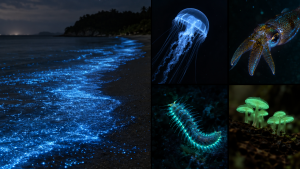
Bioluminescence is light produced by living organisms through chemical reactions. Found especially widely in marine ecosystems, it supports communication, feeding and defence. Its chemistry involves light-emitting molecules and, in many organisms, enzymes that control the reaction.
The Phenomenon of Bioluminescence
Bioluminescence is a form of chemiluminescence: chemical energy is converted into light energy through an exothermic reaction. It is often described as “cold light” because less than 20% of the energy generated is released as heat. Unlike fluorescence, it does not require an external light source; unlike phosphorescence, it is not simply the continued emission of absorbed light. The colour and intensity of bioluminescence vary among species. Blue and green are common in marine environments, while some terrestrial organisms produce yellow or red light. Light may be produced within an organism’s own cells or organs, or by luminous bacteria living in association with it. Many marine animals have specialised light-producing organs called photophores, which can regulate when and where light is emitted.
Chemical Basis of Light Production
In a typical bioluminescent reaction, a molecule called luciferin is oxidised, usually with oxygen. The enzyme luciferase catalyses the reaction. Some systems also require energy from adenosine triphosphate (ATP), while other cofactors may be involved. The chemical structures of luciferins and luciferases differ across groups of organisms.
- Luciferin: The light-emitting substrate that undergoes oxidation. Different organisms may use chemically distinct luciferins.
- Luciferase: An enzyme that catalyses the reaction; the properties of the enzyme influence the reaction’s efficiency and the light produced.
- Oxygen: Required for the oxidation process in many bioluminescent systems.
- ATP: In fireflies, ATP helps provide the energy needed for luciferin to produce light.
Marine organisms use several luciferins. Coelenterazine occurs in groups including jellyfish, copepods and some fish; ostracods and some fish use Vargula, or Cypridina, luciferin. Luminous bacteria have their own bacterial luciferin and may live in symbiosis with marine animals. In fireflies, luciferase-catalysed oxidation of luciferin uses oxygen and ATP to generate light. The reaction is highly efficient, with minimal heat loss. Firefly larvae also have a predatory role: many feed on small invertebrates such as snails and slugs, using digestive enzymes to break down prey before consuming it.
Organisms Exhibiting Bioluminescence
Bioluminescence occurs in a range of organisms, from microbes to larger animals, and is particularly widespread in the marine environment.
- Bacteria: Luminous marine bacteria, including species of Vibrio, may live in the light organs of fish and squid.
- Fungi: More than 100 species are known to produce light, a phenomenon commonly called foxfire. Examples include Mycena chlorophos and Panellus stipticus.
- Marine invertebrates: Examples include jellyfish, comb jellies (ctenophores), marine worms, copepods, ostracods, squid and some clams.
- Insects: Fireflies, in the family Lampyridae, are well-known terrestrial examples. Certain click beetles and glow-worm beetles are also luminous.
- Fish: Deep-sea species such as anglerfish, viperfish and hatchetfish use light, with some hosting symbiotic bacteria in photophores.
The jellyfish Aequorea victoria is bioluminescent and is associated with Green Fluorescent Protein (GFP). GFP fluoresces by absorbing light and re-emitting it; it is distinct from the chemical reaction that generates bioluminescence.
Ecological Functions of Bioluminescence
Light production supports survival and reproduction in several ways. Its function depends on the organism, its habitat and the circumstances in which it emits light.
- Communication: Fireflies use species-specific flash patterns to attract mates. Light may also help some organisms locate or maintain contact with others of their species.
- Attracting prey: Anglerfish use a luminous lure to draw prey within reach in the deep sea.
- Counter-illumination: Some marine animals emit light from their undersides, matching dim light from above and reducing their visibility to predators looking up.
- Distraction and escape: A sudden flash can startle or disorient a predator. Some squid and crustaceans release luminous material that distracts an attacker while they escape.
- Defence and warning: In a “burglar alarm” response, light from an attacked animal may attract a larger predator to its attacker. In some species, light also acts as a warning signal associated with toxicity or an unpleasant taste.
Research and Prelims Relevance
Bioluminescence links biological research with questions about animal behaviour, chemical processes and ecosystem interactions. Studying how organisms produce and use light can help explain adaptations to different habitats. Discoveries and rediscoveries also highlight the role of field surveys in documenting biodiversity and the value of clear science communication in presenting evidence and uncertainty.
Key Prelims Takeaways
- Bioluminescence is light generated by a chemical reaction in a living organism; it is distinct from fluorescence and phosphorescence.
- Luciferin is the substrate, luciferase the enzyme, and oxygen is commonly required; firefly light production also uses ATP.
- Photophores are specialised light-producing organs found in many marine animals.
- Bioluminescence serves functions including mating, prey attraction, counter-illumination and defence.
- Fireflies belong to the family Lampyridae; many firefly larvae prey on small invertebrates.
- Aequorea victoria is a bioluminescent jellyfish associated with GFP, which produces fluorescence.
Recent Context
In 2026, ecologist Christopher Heckscher of Delaware State University rediscovered Pyractomena similis in Delaware after no official North American record since 1983. He observed 8–12 individuals with amber flashes of 10–20 pulses; an earlier Virginia sighting was posted on iNaturalist. The rediscovery was detailed in the Journal of Lost Species; 28 other regional firefly species remain considered lost.
| Related | |
|---|---|