Global Snow Leopard and Ecosystem Protection Programme
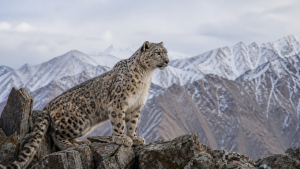
GSLEP is a cooperative framework for conserving snow leopards and the high-mountain ecosystems they inhabit. It brings together the 12 range countries, local communities and partner organisations to address shared conservation priorities across the species’ range.
Origins and Geographic Scope
The Global Snow Leopard and Ecosystem Protection Programme (GSLEP) was established in 2013 at the First Global Snow Leopard Conservation Forum in Bishkek. The Kyrgyz Republic initiated the programme, and all 12 snow leopard range countries adopted the Bishkek Declaration on the Conservation of the Snow Leopard at the forum. GSLEP’s initial objective, “Secure 20 by 2020,” aimed to identify and safeguard at least 20 critical snow leopard landscapes by 2020. The range countries have identified 23 landscapes for ongoing protection. This landscape-based approach provides a shared focus for participating countries while supporting conservation across the species’ range. The 12 range countries span Central and South Asia:
- Afghanistan
- Bhutan
- China
- India
- Kazakhstan
- Kyrgyz Republic
- Mongolia
- Nepal
- Pakistan
- Russian Federation
- Tajikistan
- Uzbekistan
Structure and Governance
GSLEP is an intergovernmental alliance steered by environment ministers from the 12 participating countries. A high-level Steering Committee guides implementation and monitors progress. Its Secretariat coordinates implementation from Bishkek, Kyrgyz Republic, and is hosted by the Ministry of Natural Resources, Ecology and Technical Supervision of the Kyrgyz Republic. The programme links country-level priorities with areas requiring broader cooperation through two sets of components:
- National Snow Leopard and Ecosystems Priorities (NSLEPs): Each participating country develops one, giving the programme 12 national priority frameworks.
- Global Support Components (GSCs): Five shared components complement the NSLEPs and address issues that require coordination across countries.
- Areas covered by the GSCs: Wildlife law enforcement, knowledge sharing, transboundary cooperation, industry engagement, and research and monitoring.
Together, the national priorities and global support components connect each country’s conservation work with shared programme-wide efforts. The framework therefore supports both country-level implementation and cooperation on cross-border or common challenges.
Conservation Priorities and Challenges
GSLEP links community-based conservation with broader climate adaptation strategies. Its approach recognises that conservation needs to address pressures on both mountain ecosystems and the communities that live in or depend on them. Community participation also supports efforts to manage human-wildlife conflict and promote coexistence. Scientific monitoring contributes to population estimates and helps identify areas facing threats. Camera traps and genetic sampling are among the methods used to gather information for conservation decisions. Research and monitoring are also included among the programme’s Global Support Components. Key pressures on snow leopards and their habitats include:
- Habitat fragmentation: Fragmentation is identified as a key conservation challenge across snow leopard landscapes.
- Human-wildlife conflict: Declining prey populations can contribute to conflict by bringing people and snow leopards into closer contact.
- Livestock pressures: Overgrazing and competition with domestic livestock can affect prey availability.
- Climate change: Glacier retreat, shifts in vegetation zones and unpredictable weather patterns pose risks to high-altitude ecosystems and snow leopard habitats.
These pressures are connected: changes in prey availability and habitat conditions can affect both wildlife and people. GSLEP’s combination of community-based conservation, monitoring and climate adaptation addresses these linked challenges without treating species protection and mountain livelihoods as separate concerns.
Policy Developments and Meetings
In 2020, GSLEP issued a policy brief on managing snow leopards in conflict situations and introduced a conservation education strategy. The GSLEP Resolution 2020 identified resource mobilisation, inclusive economic development, animal-human healthcare and disease surveillance as priority areas. The programme’s Steering Committee meetings and resolutions have continued to set out shared priorities:
- October 2022: The Seventh Steering Committee Meeting was held in Bishkek, where the 2022 Bishkek Resolution was endorsed.
- February 2024: The Eighth Steering Committee Meeting took place in Samarkand, Uzbekistan. It recognised the snow leopard as a representation of climate adaptation and mountain ecology.
- June 2025: Environment ministers and senior civil servants from participating countries convened in Cholpon-Ata, Kyrgyzstan.
- July 2025: The Ninth Steering Committee Meeting was held in Cholpon-Ata. “Guiding the Future of Linear Infrastructure Development in Snow Leopard Landscapes” was presented, setting out recommendations to reduce the impacts of infrastructure projects.
Community-led conservation efforts are strengthening coexistence, particularly in Kyrgyzstan, Mongolia and Nepal. China’s snow leopard population is estimated at around 5,000, approximately double its 2013 level. Its snow leopard habitat covers about 2.08 million square kilometres, accounting for more than 60% of global snow leopard habitat.
Key Prelims Takeaways
- Established: GSLEP was established in 2013 at the First Global Snow Leopard Conservation Forum in Bishkek.
- Declaration: The 12 range countries adopted the Bishkek Declaration on the Conservation of the Snow Leopard.
- Initial target: “Secure 20 by 2020” sought protection for at least 20 critical landscapes; 23 landscapes have been identified.
- Membership: The programme brings together 12 range countries across Central and South Asia.
- Framework: GSLEP is based on 12 NSLEPs and five GSCs; its Secretariat is in Bishkek.
- Recent programme decisions: The 2022 Bishkek Resolution was endorsed at the seventh meeting, while the ninth meeting presented recommendations on linear infrastructure in 2025.
Recent Context
The United Nations designated 23 October 2026 as the International Day of the Snow Leopard. The year 2026 is also recognised as the International Year of Rangelands and Pastoralists, drawing attention to snow leopard habitats and the communities living alongside them.
| Related | |
|---|---|