Rights and Inclusion of Persons with Disabilities in India
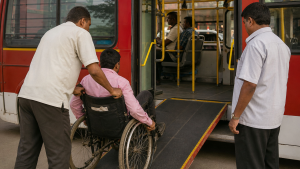
Persons with disabilities (PwDs) have equal rights to dignity, participation and access to public services. India’s framework combines constitutional principles, legislation and government programmes to advance inclusion. Its implementation is central to rights-based governance and social justice, particularly in education, employment, transport and access to information.
Constitutional and International Framework
India’s Constitution does not explicitly name persons with disabilities, but its guarantees and guiding principles support their equality and inclusion.
- Equality and dignity: The constitutional commitment to justice and equality of status and opportunity applies to all citizens. Article 21’s protection of life and personal liberty has been interpreted to include the right to live with dignity.
- Directive Principles: These guide the State in securing the right to work, education and public assistance in cases of disablement.
- UN Convention: India ratified the UN Convention on the Rights of Persons with Disabilities (UNCRPD) in 2007. It commits State Parties to promote and protect the full and equal enjoyment of human rights and fundamental freedoms by persons with disabilities, and to respect their inherent dignity.
Disability Rights Legislation
The Persons with Disabilities (Equal Opportunities, Protection of Rights and Full Participation) Act, 1995 was India’s first comprehensive law addressing disability rights. It provided for prevention and early detection, education, employment, non-discrimination, social security and research, and recognised seven categories of disability. The Rights of Persons with Disabilities Act, 2016 (RPwD Act) replaced the 1995 law and aligned Indian legislation with the UNCRPD.
- Expanded coverage: The Act increased the number of specified disabilities from seven to 21. It includes conditions such as acid attack-related disability, dwarfism, cerebral palsy, muscular dystrophy, specific learning disabilities, autism spectrum disorder, chronic neurological conditions, multiple sclerosis and blood disorders.
- Additional conditions: The Central Government may notify other conditions as disabilities.
- Reservation: The Act raised reservation for persons with benchmark disabilities in government employment from 3% to 4%. It also provides 5% reservation in government and government-aided higher educational institutions.
- Accessibility: It requires accessibility in public buildings, transport and information and communication technology.
- Support and enforcement: The Act provides for limited guardianship where required, establishes the Chief Commissioner and State Commissioners, and prescribes penalties for offences against persons with disabilities.
Disability Categories and Key Terms
The RPwD Act’s 21 specified disabilities cover a wider range of physical, sensory, intellectual and mental conditions than the 1995 law. Categories include locomotor disability; dwarfism; cerebral palsy; muscular dystrophy; leprosy-cured persons; visual, hearing, speech and language disabilities; intellectual disability; specific learning disabilities; autism spectrum disorder; and mental illness. The Act also covers specified chronic neurological conditions and blood disorders, including multiple sclerosis, Parkinson’s disease, haemophilia, thalassemia and sickle cell disease. Multiple disabilities are also covered. The expansion reflects a broader legal approach to disability, while entitlements under provisions such as reservation are tied to the statutory definition of a person with benchmark disability.
Government Schemes and Accessibility Measures
Government programmes address access to public spaces, assistive devices, rehabilitation, identification and education.
- Accessible India Campaign (Sugamya Bharat Abhiyan): Launched in 2015, it aims to improve universal accessibility through three pillars: the built environment, transport systems, and the information and communication ecosystem.
- DeenDayal Disabled Rehabilitation Scheme (DDRS): Provides financial assistance to NGOs for rehabilitation projects, including special schools, vocational training and community-based rehabilitation.
- ADIP Scheme: The Assistance to Disabled Persons for Purchase/Fitting of Aids and Appliances scheme supports the provision of durable, scientifically manufactured aids and appliances, free or at subsidised rates. These can support mobility and participation in daily and economic life.
- Unique Disability ID (UDID) Project: Seeks to create a national database and issue a Unique Disability ID card to each individual. It is intended to help people access government benefits and streamline disability certification.
- National Policy for Persons with Disabilities, 2006: Emphasises prevention, physical, educational and economic rehabilitation, and a barrier-free environment.
- Scholarships: Schemes including the National Overseas Scholarship and Post-matric Scholarship support students with disabilities in pursuing education.
Institutions and Inclusion
The Department of Empowerment of Persons with Disabilities (DEPwD), under the Ministry of Social Justice and Empowerment, is the nodal department for policies and programmes concerning PwDs.
- Chief Commissioner for Persons with Disabilities: The statutory office monitors implementation of the RPwD Act, inquires into complaints and may take suo motu notice of deprivation of rights.
- State Commissioners: These offices perform related functions at the state level.
- National institutions: Specialist institutions support research, training and rehabilitation. These include the Ali Yavar Jung National Institute of Speech and Hearing Disabilities and the Indian Sign Language Research and Training Centre.
Effective inclusion requires accessible public services and implementation of legal protections across education, employment, transport and communication. These are practical tests of rights-based governance and social justice, not only measures of welfare delivery.
Key Prelims Takeaways
- The RPwD Act, 2016 replaced the PwD Act, 1995.
- The number of specified disabilities rose from seven to 21.
- India ratified the UNCRPD in 2007.
- The RPwD Act provides 4% reservation in government employment and 5% in government and government-aided higher education for persons with benchmark disabilities.
- Sugamya Bharat Abhiyan focuses on built environments, transport, and information and communication accessibility.
- DEPwD is the nodal department; the Chief Commissioner monitors implementation of the RPwD Act.
Recent Context
The 5th Asian Para Games are being held in Nagoya, Japan, from October 18 to 24, 2026. On October 20, Indian swimmers Himanshu Nandal and Niranjan Mukundan won bronze medals in the men’s 400m freestyle S11 and 200m individual medley SM7 events, respectively. As of October 21, India had 47 medals and stood fifth.
| Related | |
|---|---|