Major High-Energy Cosmic Phenomena
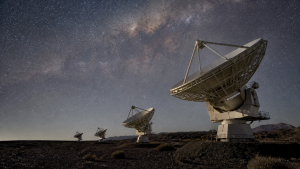
High-energy cosmic phenomena are the universe’s most violent events, producing X-rays, gamma rays, cosmic rays, neutrinos and gravitational waves. They reveal extreme conditions that cannot be reproduced in laboratories on Earth.
Gamma-Ray Bursts
Gamma-Ray Bursts (GRBs) are the most luminous electromagnetic events known, releasing in seconds as much energy as the Sun emits over its entire life.
Types of Gamma-Ray Bursts
- Short-duration Gamma-Ray Bursts: Last less than two seconds and usually arise from mergers of neutron stars or a neutron star with a black hole.
- Long-duration Gamma-Ray Bursts: Last longer than two seconds and are linked to the core collapse of massive, rapidly rotating stars.
Brightest of All Time (BOAT)
- GRB 221009A: Detected in October 2022, it is the brightest gamma-ray burst ever recorded. It occurred about 2.4 billion light-years away and produced photons up to 18 teraelectronvolts (TeV).
Active Galactic Nuclei and Quasars
An Active Galactic Nucleus (AGN) is a compact, highly luminous region at the center of a galaxy, powered by a supermassive black hole.
Accretion and Emission Mechanisms
- Gravitational Accretion: Matter spiraling into the black hole forms an accretion disk. Friction heats it to millions of degrees, producing radiation across the electromagnetic spectrum.
- Relativistic Jets: Magnetic fields channel some infalling matter into powerful jets that move at nearly the speed of light.
Classifications of Active Galaxies
- Quasars: The most luminous class of AGN, often outshining their host galaxies.
- Blazars: AGN whose relativistic jets point almost directly toward Earth, causing rapid and irregular brightness changes.
- Seyfert Galaxies: Lower-luminosity AGN in which the host galaxy remains visible, while the nucleus shows strong spectral emission lines.
Supernovae and Hypernovae
Supernovae are catastrophic stellar explosions at the end of a star’s life. They spread heavy elements into space and can trigger new star formation.
Categorization of Stellar Explosions
- Type Ia Supernovae: Occur in binary systems when a carbon-oxygen white dwarf accretes matter from a companion and exceeds the Chandrasekhar limit of 1.4 solar masses.
- Type II Supernovae: Occur when a massive star of at least eight solar masses exhausts its fuel and its core collapses.
- Hypernovae: Extremely energetic core-collapse supernovae with energies more than 100 times those of typical supernovae; they are linked to stellar-mass black holes and long-duration GRBs.
Extreme Neutron Stars: Pulsars and Magnetars
Neutron stars are the collapsed cores of massive stars, packing more mass than the Sun into a sphere only about 20 kilometers wide.
Pulsars and Magnetars
- Pulsars: Rapidly spinning neutron stars with strong magnetic fields that emit directional beams of radiation, producing regular pulses as they rotate.
- Magnetars: Neutron stars with magnetic fields up to 100 billion Tesla. Magnetic decay can trigger starquakes and intense X-ray and gamma-ray flares.
- Fast Radio Bursts (FRBs): Millisecond-long radio pulses from distant galaxies; some are linked to magnetar activity.
Cosmic Rays and Ultra-High-Energy Particles
Cosmic rays are highly energetic subatomic particles traveling through space at nearly the speed of light. They are mainly protons and helium nuclei, but can also include heavier nuclei up to iron.
Sources of Cosmic Rays
- Galactic Cosmic Rays: Lower-energy particles from within the Milky Way, accelerated by shockwaves from supernova remnants.
- Extragalactic Cosmic Rays: Extremely energetic particles from outside our galaxy. Their sources are still being studied, though AGN, GRBs and colliding galaxy clusters are likely candidates.
Record-Breaking Particles
- The Oh-My-God Particle: Detected in Utah in 1991, this proton carried an energy of 320 exa-electronvolts (EeV).
- The Amaterasu Particle: Detected in 2021 and analyzed in late 2023, it had an energy of 244 EeV and may have originated from the Local Void or nearby starburst galaxies such as Messier 82.
Gravitational Waves and Kilonovae
The discovery of gravitational waves opened the era of multi-messenger astronomy, which combines gravitational-wave and electromagnetic observations.
Core Concepts
- Gravitational Waves: Ripples in spacetime generated by accelerating massive objects such as merging black holes or neutron stars.
- Kilonovae: Transient explosions from the merger of two neutron stars, or a neutron star and a stellar-mass black hole, producing heavy elements through r-process nucleosynthesis.
- GW170817: The first cosmic merger detected through both gravitational waves and electromagnetic radiation, accompanied by a gamma-ray burst and a kilonova.
Comparison of High-Energy Cosmic Phenomena
| Phenomenon | Primary Energy Source | Primary Emission Type | Key Astronomical Example |
| Gamma-Ray Bursts (GRBs) | Core-collapse of massive stars or compact object mergers | Gamma-rays, X-rays | GRB 221009A |
| Quasars | Accretion of matter onto supermassive black holes | Broadband (Radio to Gamma-rays) | 3C 273 |
| Type Ia Supernovae | Thermonuclear runaway of a white dwarf | Optical, Ultraviolet, X-rays | SN 1572 (Tycho’s Supernova) |
| Hypernovae | Core collapse of extremely massive rotating stars | Optical, Gamma-rays | SN 1998bw |
| Magnetars | Decay of ultra-strong magnetic fields | X-rays, Gamma-rays | SGR 1806-20 |
| Kilonovae | Merger of binary neutron stars | Infrared, Optical, Gravitational Waves | GW170817 |
Recent Context
NASA’s Neil Gehrels Swift Observatory, launched on 20 November 2004, has detected about 1,800 cosmic explosions. A planned commercial rescue mission using the LINK spacecraft was called off in August 2026 after attitude-control failures.
Rare Facts for Prelims
- Swift’s role: The Neil Gehrels Swift Observatory was built for rapid follow-up of gamma-ray bursts, making it a key tool in transient astronomy.
- Multi-messenger clue: GW170817 provided the first direct link between gravitational waves, gamma rays and the formation of heavy elements.
- Magnetar strength: Magnetars can have magnetic fields trillions of times stronger than Earth’s magnetic field.
- Cosmic-ray rarity: Ultra-high-energy cosmic rays are so uncommon that even a tiny detector may wait years for a single event.
- Quasar power source: Quasars are powered by accretion, not nuclear fusion, unlike ordinary stars.
- GRB danger to atmosphere: Extremely nearby gamma-ray bursts could ionize Earth’s upper atmosphere, though no known burst has done so at a harmful level.
| Related | |
|---|---|