Types of Food Labelling and Traceability Rules
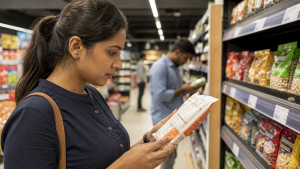
Food labelling and traceability are key tools for consumer safety, transparent choice, and supply chain accountability in India. FSSAI regulates these requirements under the Food Safety and Standards Act, 2006.
Mandatory Types of Food Labelling in India
The Food Safety and Standards (Labelling and Display) Regulations, 2020, require several essential declarations on packaged food labels.
1. Nutritional Information
Food packages must display nutritional values per 100 grams or 100 milliliters, or per single-serve pack. This declaration must include energy, protein, carbohydrates, fats, total sugars, added sugars, and sodium.
In 2024, rules were approved to require added sugar, salt (sodium), and saturated fat to be printed in bold letters with a larger font size.
2. Veg and Non-Veg Declarations
Indian law requires dietary origin symbols near the product name.
- Vegetarian Symbol: A green-filled circle inside a square with a green outline.
- Non-Vegetarian Symbol: A brown-filled triangle inside a square with a brown outline. This replaced the old brown circle in 2021 to help color-blind consumers distinguish the symbol by shape.
3. Allergen Declarations
Manufacturers must declare if a food contains any of the eight primary allergens.
- Cereals containing gluten: Such as wheat, rye, and barley.
- Crustaceans: Such as prawns and crabs.
- Eggs and egg products:
- Fish and fish products:
- Peanuts and tree nuts:
- Soybeans and soy products:
- Milk and milk products:
- Sulphite: In concentrations of 10 mg/kg or more.
4. Date Marking and Storage
Labels must state the date of manufacture and packaging, along with clear date and storage information.
- Best Before: The limit of optimum quality; the food may still be safe to eat after this date.
- Expiry or Use By Date: The end of safe shelf life; consumption after this date is unsafe.
- Storage Instructions: Temperature or light conditions needed to maintain safety.
5. Special Classification Logos
Certain foods require special logos to certify processing standards.
- Fortified Food Logo: A “+F” logo with the tag “Fortified with…” when vitamins or minerals are added to staples like milk, rice, and salt.
- Organic Food Logo: The “Jaivik Bharat” logo, certifying compliance with National Programme for Organic Production (NPOP) standards.
- Vegan Food Logo: A green V-shaped logo with a leaf, identifying products free of animal-derived ingredients.
| Category | Symbol Design | Intended Purpose |
| Vegetarian | Green circle inside a green square | Identifies lacto-vegetarian foods |
| Non-Vegetarian | Brown triangle inside a brown square | Identifies foods containing ingredients of animal origin |
| Vegan | Green V-label with a leaf and “Vegan” text | Identifies products with zero animal-derived ingredients |
| Fortified | “+F” logo with a blue outline | Identifies foods enriched with micronutrients |
| Organic | “Jaivik Bharat” green leaf and wave logo | Certifies organic production standards |
Front-of-Pack Labelling and Warning Labels
Front-of-Pack Labelling (FOPL) is designed to show simple health information on the front of packages. International examples include:
- Nutri-Score (Europe): A color-coded scale from A (green, healthiest) to E (red, least healthy).
- Warning Octagons (Chile): Black octagonal stop-signs stating “High in Sugar” or “High in Sodium”.
- Multiple Traffic Lights (UK): Red, amber, and green colour-coding for fat, saturated fat, sugar, and salt.
In India, the Supreme Court has directed the central government and FSSAI to finalise the FOPL policy, with a focus on foods high in fat, sugar, and salt (HFSS).
Key Changes in the FSSAI Labelling Amendment 2026
The Food Safety and Standards (Labelling and Display) First Amendment Regulations, 2026, were notified in March 2026 and are scheduled to take effect on July 1, 2027.
1. Relaxations for Infant Nutrition
Manufacturers of infant nutrition products no longer need to print the per-serve percentage contribution to the Recommended Dietary Allowance (RDA) or the exact number of servings per pack.
2. Defining Minimally Processed Foods
The amendment clarifies that minimally processed foods include whole grains, pulses, fruits, and vegetables undergoing basic processes that do not alter nutritional value.
- Cleaning and sorting
- Grinding and pasteurization
- Refrigeration, freezing, and vacuum packaging
3. Small Package Exemptions
Packaged food items with a total surface area of 100 square centimeters or less do not have to carry the FSSAI logo and license number, if this information is printed on the outer multi-unit package.
4. Non-Retail Sale Regulations
Bulk packages meant for non-retail transportation must carry basic identification details.
- Required details: Product name, FSSAI logo, license number, date marking, and lot number.
- Mandatory marking: “NON-RETAIL CONTAINER” or “NOT FOR DIRECT SALE TO CONSUMER”.
- Missing nutritional details: Must be provided in accompanying documents.
Food Traceability Rules and Frameworks
Food traceability means the ability to reconstruct the movement of a food item through the food chain. It is especially important during recalls of contaminated food.
1. The “One Step Forward, One Step Back” Principle
FSSAI requires all registered Food Business Operators (FBOs) to maintain records of the immediate supplier and immediate buyer.
- One Step Back: The immediate supplier of raw materials, ingredients, or primary packaging.
- One Step Forward: The immediate customer or distributor to whom the finished product was sold.
2. The 14-Digit FSSAI License Number
Every licensed food operator must print a 14-digit license number on packaging.
- Digit 1: Registration status of the business.
- Digits 2 and 3: State code of registration.
- Digits 4 and 5: Year of registration.
- Digits 6, 7, and 8: Enrolling master or registering authority code.
- Digits 9 to 14: Specific manufacturer’s license number.
3. Export Traceability Portals
APEDA manages dedicated online traceability portals for export quality and origin checks.
| Traceability Portal | Targeted Product Category | Primary Function |
| TraceNet | Organic Products | Tracks the organic product supply chain under NPOP standards |
| Hortinet | Fresh Fruits and Vegetables | Manages farm registration, laboratory tests, and export approvals |
| Peanut.Net | Peanuts and Peanut Products | Tracks quality certifications and checks for aflatoxin contamination |
| Basmati.Net | Basmati Rice | Verifies geographical authenticity and checks crop quality |
| Meat.Net | Meat and Poultry | Tracks abattoir hygiene standards and processing histories |
Recent Context
Himachal Pradesh banned the manufacture and sale of non-dairy analogue paneer on August 20, 2026. The order applies to FBOs and eateries, requires clear consumer declaration, and is valid for one year.
Rare Facts for Prelims
- FSSAI logo requirement: It helps consumers quickly identify that a packaged food is under the Indian food safety regulatory system.
- Traceability use: It speeds up food recalls by helping authorities locate affected batches quickly.
- Jaivik Bharat logo: It is used only for certified organic foods in India, not for all natural products.
- Non-retail containers: These are meant for movement within the supply chain, not for direct consumer sale.
- Colour-blind aid: The non-vegetarian symbol was changed to a triangle to improve shape-based recognition.
- HFSS foods: The term refers to foods high in fat, sugar, and salt, a major focus area in front-of-pack labelling policy.
| Related | |
|---|---|