Important Coral Reefs of the World
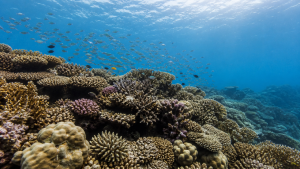
Coral reefs are underwater structures built by colonial marine invertebrates called coral polyps. These polyps secrete calcium carbonate to form a hard protective skeleton. Though they occupy less than 1% of the ocean floor, they support nearly 25% of all marine life. This rich biodiversity has earned them the name rainforests of the sea. The reef-building process depends on a symbiotic relationship. Coral polyps host photosynthetic algae called Zooxanthellae in their tissues. The algae provide food and oxygen to the polyps, while the polyps supply shelter and essential nutrients.
Environmental Conditions for Coral Growth
- Warm Water: Ideal water temperatures range from 20°C to 32°C. Cold ocean currents prevent reef formation.
- Sunlight and Depth: Corals need shallow waters, typically less than 50 meters. Zooxanthellae require sunlight to perform photosynthesis.
- Salinity: Corals thrive in saline water. The ideal salinity level is between 27 and 40 parts per thousand (ppt).
- Clear Water: High turbidity and sediment block sunlight. Silt can choke and kill coral polyps.
- Hard Substrate: Coral larvae require a firm, rocky surface to settle and grow.
Classification of Coral Reefs
- Fringing Reefs: These reefs grow directly from the shore of volcanic islands or continental coastlines. They do not have a deep lagoon separating them from the land.
- Barrier Reefs: These reefs run parallel to the coastline. A deep and wide lagoon separates them from the main shore.
- Atolls: These are circular or horseshoe-shaped reefs that enclose a central lagoon. They typically form on the rims of submerged volcanic islands.
- Patch Reefs: These are small, isolated reef structures. They grow from the sea floor of a continental shelf or lagoon.
Major Coral Reefs of the World
| Name of the Reef | Geographic Location | Approximate Size | Key Ecological Features |
| Great Barrier Reef | Coral Sea, Queensland, Australia | ~2,300 km long / 344,400 sq km | The largest coral reef system on Earth. It comprises 3,000 reefs and 900 islands. |
| Belize Barrier Reef | Caribbean Sea, Central America | ~300 km (190 miles) long | The largest barrier reef in the Western Hemisphere. It features the famous Great Blue Hole. |
| New Caledonia Barrier Reef | South Pacific Ocean | ~1,500 km long | The second-longest double-barrier reef system. It encloses a massive shallow lagoon. |
| Red Sea Coral Reef | Red Sea (Egypt, Saudi Arabia, Sudan) | ~1,900 km (1,200 miles) long | A highly resilient fringing reef system. It thrives in extreme salinity and temperature. |
| Mesoamerican Barrier Reef | Caribbean (Mexico, Belize, Guatemala, Honduras) | ~900 km (560 miles) long | A vast reef system spanning four nations. It supports a high diversity of marine fauna. |
| Andros Coral Reef | Bahamas, Caribbean Sea | ~200 km (124 miles) long | A massive continuous barrier reef. It sits adjacent to a deep oceanic trench. |
| Apo Reef | Mindoro Strait, Philippines | 34 sq km area | The largest contiguous coral reef system in the Philippines. It features two internal lagoons. |
| Tubbataha Reefs | Sulu Sea, Philippines | ~97,030 hectares (Marine Park) | A pristine atoll reef system. It is a UNESCO World Heritage Site with high marine biodiversity. |
Detailed Profiles of Global Reef Systems
Great Barrier Reef, Australia
- This is the largest living structure on Earth. It is visible from space.
- It stretches along the coast of Queensland.
- The system contains over 1,500 fish species, 400 types of hard coral, and several endangered species like the green sea turtle and dugong.
- Climate change is causing marine heatwaves. This results in severe bleaching events across the reef.
Belize Barrier Reef, Central America
- This reef system is a key part of the Mesoamerican Reef.
- It became a UNESCO World Heritage Site in 1996.
- Charles Darwin described it as the most remarkable reef in the West Indies.
- The Great Blue Hole, a massive underwater sinkhole, is its most famous feature.
New Caledonia Barrier Reef, South Pacific
- This reef surrounds Grande Terre, the largest island of New Caledonia.
- It is the second-longest double-barrier reef system on Earth.
- The enclosed lagoon has an average depth of 25 meters. It contains diverse marine habitats like mangroves and seagrass beds.
- It is a critical nesting site for green sea turtles and home to endangered dugongs.
Red Sea Coral Reef
- This fringing reef system runs along the coastlines of Egypt, Saudi Arabia, Sudan, and Eritrea.
- The corals here live in some of the warmest and saltiest ocean waters.
- Scientists observe that the northern portion in the Gulf of Aqaba possesses an exceptional tolerance to rising seawater temperatures.
- This high thermal threshold makes it a potential global refuge for marine species under climate stress.
Coral Reefs in India
- Andaman and Nicobar Islands: These islands hold the largest area of coral reefs in India. The reefs here are primarily of the fringing type. They exhibit high species richness due to their proximity to the Coral Triangle.
- Lakshadweep Islands: This region features the only atoll reefs in India. The islands consist of 36 islands and several submerged banks, entirely built of coral origin.
- Gulf of Mannar: Located off the coast of Tamil Nadu, this is a shallow bay with a chain of 21 islands. The reefs are fringing reefs. The area is part of the Gulf of Mannar Biosphere Reserve. It is home to sea cows (dugongs).
- Gulf of Kutch: Located in Gujarat, this region contains some of the northernmost coral reefs in the world. The reefs are highly patchy. They survive under extreme salinity and temperature fluctuations.
- Other Localities: Patchy coral growths exist along the western coast of India, including Malvan in Maharashtra and Netrani Island in Karnataka.
Threats to Coral Reef Ecosystems
- Coral Bleaching: Elevated sea surface temperatures cause corals to expel their symbiotic Zooxanthellae. This turns the coral white and exposes it to starvation and disease.
- Ocean Acidification: Increased absorption of atmospheric carbon dioxide by oceans lowers water pH. This reduces the availability of carbonate ions, making it difficult for corals to build calcium carbonate skeletons.
- Anthropogenic Pressures: Destructive fishing practices, coastal development, sewage runoff, and oil spills physically damage the reef structures.
- Siltation: Soil erosion from nearby land ends up in the sea. The suspended sediment blocks sunlight, halting the photosynthetic processes of Zooxanthellae.
Global Conservation Initiatives
- International Coral Reef Initiative (ICRI): An informal partnership among nations and organizations that strives to preserve coral reefs and related ecosystems.
- Global Coral Reef Monitoring Network (GCRMN): A global network that monitors coral reef health and provides scientific data on reef status.
- Coral Reef Alliance: A non-profit organization that works with local communities to reduce threat factors and build reef resilience.
- Coastal Regulation Zone (CRZ) Notification in India: Legal guidelines under the Environment (Protection) Act, 1986. They restrict development near ecologically sensitive marine areas, including coral reefs.
Recent Context
On August 11, 2026, the Australian Institute of Marine Science released its 2025/26 LTMP Annual Summary Report on the Great Barrier Reef. The report showed a rebound in hard coral cover in the Northern and Central regions, though the reef remains under pressure from bleaching, cyclones, and crown-of-thorns starfish outbreaks. The UNESCO World Heritage Committee decided in July 2026 not to place the Great Barrier Reef on the List of World Heritage in Danger.
Rare Facts for Prelims
- Great Blue Hole: This famous sinkhole in Belize is a giant marine cavern and one of the most recognized reef-linked formations in the world.
- Double-barrier reef: New Caledonia is notable for having one of the world’s rare double-barrier reef systems.
- Thermal refuge: Parts of the Gulf of Aqaba in the Red Sea are studied as potential refuges because corals there tolerate unusually high temperatures.
- Atoll origin: Lakshadweep’s coral islands are classic examples of atoll formation in India.
- Coral Triangle link: The Andaman and Nicobar Islands are biologically rich because of their proximity to the Coral Triangle, a global marine biodiversity hotspot.
- Monitoring metric: Hard coral cover is a standard scientific measure used to assess reef health and recovery over time.
| Related | |
|---|---|