Types of Seed Quality and Certification Systems
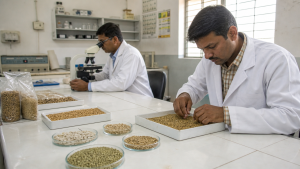
Seed quality and certification systems ensure that farmers receive genetically pure, physically clean, viable, and disease-free seeds. In India, seed classes, certification tags, and testing standards are regulated through a structured legal and administrative framework.
Understanding Seed Quality
Seed quality is a vital factor in agricultural productivity. It determines the genetic and physical characteristics of the crop. Four core parameters define seed quality:
- Genetic Purity: The percentage of true-to-type seeds in a seed lot. It ensures the crop exhibits the specific genetic traits of the developed variety.
- Physical Purity: The percentage of pure seed of the target crop. It excludes inert matter, sand, stones, weed seeds, and damaged seeds.
- Physiological Quality: The germination capacity and seed vigor. This parameter determines the ability of the seed to emerge and establish a healthy plant under field conditions.
- Seed Health: The absence of seed-borne pathogens, fungi, bacteria, viruses, and insects. It also includes maintaining correct moisture levels to prevent spoilage during storage.
Classification of Seeds and Certification Tags
The generation system of seed multiplication ensures that high-quality seeds reach farmers without losing genetic purity. India uses a multi-class generation system. Each class is distinguished by a specific tag color issued by certification authorities.
Nucleus Seed
- Handled directly by: The originating plant breeder.
- Purity: Maintained at 100% genetic and physical purity.
- Quantity: Produced in very small quantities.
- Tag: No certification tag is attached. It serves as the source for breeder seed.
Breeder Seed
- Origin: Progeny of nucleus seed.
- Produced under: Technical control of plant breeders at research institutes or state agricultural universities.
- Purity: Maintained at 100% genetic purity.
- Monitoring: Joint inspection team of scientists and representatives from certification agencies.
- Tag Color: Golden yellow.
Foundation Seed
- Origin: Progeny of breeder seed.
- Produced by: Public agencies like the National Seeds Corporation (NSC), State Seed Corporations (SSCs), or state agricultural farms.
- Purity: Genetic purity is maintained at 99.5% or above.
- Supervision: Field and seed standards are strictly monitored by State Seed Certification Agencies.
- Tag Color: White.
Registered Seed
- Origin: Progeny of foundation seed.
- Feature: Maintained with specific genetic identity and purity.
- Inspection: Undergoes rigorous field and seed inspections.
- Tag Color: Purple or opal.
- Note: In India, this stage is typically omitted. Certified seeds are produced directly from foundation seeds.
Certified Seed
- Origin: Progeny of foundation seed.
- Produced by: Registered seed growers under the supervision of State Seed Certification Agencies.
- Use: Sold commercially to farmers for crop production.
- Purity: Genetic purity must be 99% or higher.
- Tag Color: Azure blue (ISI No. 104 shade).
Truthfully Labelled (TFL) Seed
- Produced by: Private seed companies, research organizations, or progressive farmers.
- Testing: Restricted to physical purity and germination.
- Certification: Official agency certification is voluntary, but truthful labeling is compulsory under the Seeds Act for notified varieties offered for sale.
- Tag Color: Opal green.
Certified Seed vs. Truthfully Labelled (TFL) Seed
| Parameter | Certified Seed | Truthfully Labelled (TFL) Seed |
| Certification Status | Voluntary | Compulsory for notified kinds/varieties |
| Applicability | Limited to notified varieties only | Applicable to both notified and released varieties |
| Quality Parameters | Meets both field and seed standards | Tested primarily for physical purity and germination |
| Supervising Body | State Seed Certification Agency | Self-certified by the seed producer or company |
| Inspecting Officer | Seed Certification Officer and Seed Inspectors | Seed Inspectors only (for market quality checks) |
| Tag Color | Azure Blue | Opal Green |
Seed Certification System in India
The quality and distribution of seeds are governed by a specific legal and administrative framework.
- The Seeds Act, 1966: This legislation regulates the quality of seeds for sale. It provides for the establishment of seed certification agencies and seed laboratories.
- Central Seed Committee (CSC): This statutory body advises central and state governments on all matters arising from the administration of the Seeds Act. It is responsible for the notification of crop varieties.
- Central Seed Certification Board (CSCB): Formed to coordinate the functions of State Seed Certification Agencies. It assists in establishing uniform standards across the country.
- State Seed Certification Agencies (SSCA): These autonomous bodies conduct field inspections, draw samples, and issue certificates and tags for seeds that meet the Indian Minimum Seed Certification Standards (IMSCS).
- Seed Testing Laboratories: Establishments that analyze seed samples. The National Seed Research and Training Centre (NSRTC) located in Varanasi is the apex referral laboratory. State Seed Testing Laboratories analyze samples collected by seed inspectors.
International Seed Certification Frameworks
International frameworks help standardize seed trade and ensure quality control across national boundaries.
OECD Seed Schemes
- Established: In 1958 by the Organisation for Economic Co-operation and Development (OECD).
- Purpose: Standardize the terminology and procedures used in varietal seed certification.
- Significance: Facilitate international trade by ensuring certified seeds meet global standards for genetic identity and purity.
- India’s Membership: India joined the OECD Seed Schemes in 2008. The Ministry of Agriculture and Farmers Welfare serves as the National Designated Authority.
- Seed Classes: Under the OECD, seed classes are termed Pre-Basic, Basic, and Certified.
International Seed Testing Association (ISTA)
- Founded: In 1924, ISTA works to standardize seed testing methodologies worldwide.
- Publication: It publishes the International Rules for Seed Testing.
- Certificates Issued:
- Orange International Seed Lot Certificate (OIC): Issued when sampling and testing are done under the authority of an ISTA-accredited member laboratory.
- Blue International Seed Sample Certificate (BIC): Issued when testing is done on a sample submitted directly by the client, without official sampling under ISTA authority.
Recent Context
On August 13, 2026, ISMA and ICAR-Indian Sugarcane Research Institute signed an MoU to set up an Advanced Centre for Quality Sugarcane Seed Production in Lucknow. The proposed facility will focus on disease-free, genetically pure seed cane, with digital traceability and quality monitoring to strengthen input quality control and disease prevention.
Rare Facts for Prelims
- Golden yellow tag: Breeder seed is identified by a golden yellow tag, which is one of the most frequently asked tag-color facts in exams.
- Opal green tag: Truthfully Labelled seed uses opal green, not blue, which helps distinguish it from certified seed.
- NSRTC role: The National Seed Research and Training Centre in Varanasi functions as the apex referral laboratory for seed testing in India.
- OECD seed classes: The OECD system uses the terms Pre-Basic, Basic, and Certified, which differ from India’s seed class nomenclature.
- ISTA certificates: ISTA issues Orange certificates for lot-based official sampling and Blue certificates for client-submitted samples.
- Registered seed in India: Although included in the seed multiplication chain, the registered seed stage is generally omitted in India’s practical certification system.
| Related | |
|---|---|