Major Literary and Cultural Awards in India
India’s major literary and cultural awards highlight excellence in writing, performing arts, and cinema. For Prelims revision, the most useful facts are the award-making bodies, eligibility rules, prize components, and the latest award-related updates.
The Jnanpith Award
Established in 1961 by the Bharatiya Jnanpith, the Jnanpith Award is India’s highest literary honour. It is conferred on Indian citizens for outstanding contribution to literature in English and the 22 languages listed in the Eighth Schedule of the Constitution.
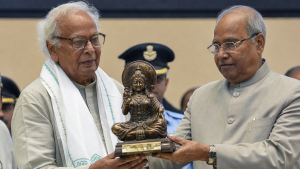
The award is not given posthumously. Winners receive a bronze replica of Vagdevi (Goddess Saraswati), a citation plaque, and a cash prize of ₹11 lakh.
Sahitya Akademi Awards
The Sahitya Akademi, India’s National Academy of Letters, was founded in 1954. It presents annual awards for books of literary merit in 24 languages — the 22 Eighth Schedule languages, English, and Rajasthani.
The award is regarded as the second-highest literary honour in the country. Each recipient gets an engraved copper plaque designed by filmmaker Satyajit Ray, a shawl, and a cash prize of ₹1,00,000.
Literary Honours by the K.K. Birla Foundation
The K.K. Birla Foundation, established in 1991, administers two important literary awards: the Saraswati Samman and the Vyas Samman.
- Saraswati Samman: Given for outstanding literary work in prose or poetry in any of the 22 Eighth Schedule languages.
- Eligibility for Saraswati Samman: The work must have been published in the past 10 years and the author must be a living Indian citizen.
- Saraswati Samman prize: ₹15 lakh, along with a citation and plaque.
- Vyas Samman: Recognises outstanding Hindi literary works published in the past 10 years by an Indian citizen.
- Vyas Samman prize: ₹4 lakh.
Dadasaheb Phalke Award
Introduced in 1969, the Dadasaheb Phalke Award is the highest recognition in Indian cinema. It is named after Dadasaheb Phalke, regarded as the father of Indian cinema.
Conferred annually at the National Film Awards ceremony, it honours lifetime contribution to the growth and development of Indian cinema. The award includes a Swarna Kamal (Golden Lotus) medallion, a shawl, and a cash prize of ₹15 lakh.
Sangeet Natak Akademi Fellowships and Awards
The Sangeet Natak Akademi, established in 1953, is the national academy for music, dance, and drama. It recognises performing artists through fellowships and annual awards.
- Sangeet Natak Akademi Fellowship (Akademi Ratna): The most prestigious honour of the Akademi.
- Limit on fellows: No more than 40 living fellows at any time.
- Fellowship prize: ₹3 lakh.
- Sangeet Natak Akademi Award (Akademi Puraskar): Given to outstanding performing artists, gurus, and scholars.
- Award prize: ₹1 lakh.
Important Exam Points
- Jnanpith Award: India’s highest literary honour; established in 1961; not awarded posthumously.
- Jnanpith eligibility: Open to Indian citizens writing in English and the 22 Eighth Schedule languages.
- Sahitya Akademi Awards: Cover 24 languages, including English and Rajasthani.
- Prize components: Sahitya Akademi awardees get a copper plaque, shawl, and ₹1,00,000.
- Foundation-linked awards: Saraswati Samman and Vyas Samman are administered by the K.K. Birla Foundation.
- Saraswati Samman: For works in Eighth Schedule languages published in the previous 10 years; prize is ₹15 lakh.
- Vyas Samman: For Hindi works published in the previous 10 years; prize is ₹4 lakh.
- Dadasaheb Phalke Award: Highest honour in Indian cinema; presented at the National Film Awards.
- Phalke prize: Includes a Swarna Kamal medallion, shawl, and ₹15 lakh.
- Sangeet Natak Akademi Fellowship: Capped at 40 living fellows and carries ₹3 lakh.
- Sangeet Natak Akademi Award: Given to performers, gurus, and scholars with ₹1 lakh.
- Satyajit Ray link: The Sahitya Akademi plaque design is by Satyajit Ray.
| Related | |
|---|---|