Indian Citizenship Laws and CAA 2019
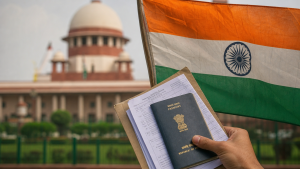
Indian citizenship is the legal bond between an individual and the State. In India, the Constitution sets out who became a citizen at its commencement, while the Citizenship Act, 1955 lays down the rules for acquiring, losing and regulating citizenship thereafter.
Constitutional Provisions on Citizenship
- Part II of the Constitution: Articles 5 to 11 govern citizenship in India.
- Articles 5 to 8: These determine citizenship at the commencement of the Constitution on January 26, 1950, covering persons by domicile, migration from Pakistan and persons of Indian origin residing abroad.
- Article 9: An Indian citizen who voluntarily acquires foreign citizenship ceases to be an Indian citizen. The Constitution does not permit dual citizenship in the full legal sense.
- Article 11: Parliament has the power to regulate the right of citizenship by law. This provision led to the enactment of the Citizenship Act, 1955.
Citizenship Act, 1955: Main Provisions
- Five modes of acquisition: Citizenship can be acquired by birth, descent, registration, naturalisation and incorporation of territory.
- Three modes of termination: The Act provides for renunciation, termination and deprivation of citizenship.
- Illegal migrant: A foreigner who enters India without valid travel documents or stays beyond the permitted visa period is treated as an illegal migrant.
- Restriction on citizenship: Illegal migrants are barred from acquiring Indian citizenship through registration or naturalisation.
- Legal significance: The Act is the principal statute governing citizenship after the Constitution came into force.
Citizenship (Amendment) Act, 2019
- Purpose: The CAA, 2019 modifies the definition of illegal migrant for specified communities and provides a faster path to citizenship.
- Eligible communities: Hindus, Sikhs, Buddhists, Jains, Parsis and Christians are covered under the amendment.
- Eligible countries: The benefit applies only to persons from Pakistan, Bangladesh and Afghanistan.
- Cut-off date: The person must have entered India on or before December 31, 2014.
- Residency relaxation: The residency requirement for naturalisation is reduced from 11 years to 5 years.
CAA 2019: It does not grant automatic citizenship. Each application is subject to verification under the prescribed legal process.
Exempted Areas and Regional Safeguards
- Sixth Schedule areas: The CAA does not apply to the tribal areas of Assam, Meghalaya, Mizoram and Tripura governed under the Sixth Schedule.
- Inner Line Permit regions: States protected by the ILP system under the Bengal Eastern Frontier Regulation, 1873 are exempted.
- ILP states: Arunachal Pradesh, Mizoram, Nagaland and Manipur are covered by the ILP regime.
- Constitutional balance: These exclusions preserve the special protections available to certain tribal and protected regions.
Recent Legal and Administrative Developments
- Immigration and Foreigners Act, 2025: This law came into force on September 1, 2025 and consolidated four older laws relating to entry, foreigners and carriers’ liability.
- Earlier laws replaced: The Act replaced the Passport (Entry into India) Act, 1920; the Registration of Foreigners Act, 1939; the Foreigners Act, 1946; and the Immigration (Carriers’ Liability) Act, 2000.
- New order: The Immigration and Foreigners Order, 2025 was notified to regulate visa compliance and foreigner registration.
- Superseded instruments: It superseded the Registration of Foreigners (Exemption) Order, 1957 and the Immigration (Carriers’ Liability) Order, 2007.
- Judicial position on CAA: The Supreme Court has declined interim stay on the implementation of the CAA and its Rules, keeping the framework operative.
- Verification remains essential: Applications under the CAA are subject to individual scrutiny; citizenship is not automatic on filing.
Key Prelims Takeaways
- Part II of the Constitution: Articles 5 to 11 deal with citizenship.
- Article 11: Parliament can make laws on citizenship.
- Citizenship Act, 1955: Provides acquisition by birth, descent, registration, naturalisation and incorporation of territory.
- Termination of citizenship: Includes renunciation, termination and deprivation.
- CAA 2019 coverage: Hindus, Sikhs, Buddhists, Jains, Parsis and Christians from Pakistan, Bangladesh and Afghanistan.
- Cut-off date: December 31, 2014.
- Exempt regions: Sixth Schedule tribal areas and ILP states.
Current General Studies comprises current-affairs-based, General Studies-rich study material on policies, laws, institutions, economy, science, environment, governance, international relations, and other varied but important topics for UPSC and State PSC Prelims examinations.
Fortnightly PDF compilations: Available here
Originally written on
February 8, 2026
and last modified on
September 4, 2026.
| Related | |
|---|---|