National Vulture Conservation Programme
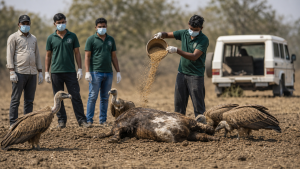
The National Vulture Conservation Programme is India’s targeted effort to reverse the steep decline in vulture populations. Implemented by the Ministry of Environment, Forest and Climate Change (MoEFCC), it combines habitat protection, drug regulation, captive breeding, and safe feeding measures.
Action Plan for Vulture Conservation
The Union government implements the programme through the Action Plan for Vulture Conservation in India (2020–2025). The plan has an estimated outlay of ₹207 crore and supports veterinary drug regulation, captive-breeding centres, rescue centres, and the creation of Vulture Safe Zones.
- Core objective: Arrest population decline and restore critically endangered vulture species through threat mitigation.
- Main components: Veterinary drug control, ex-situ conservation, in-situ protection, and safe feeding infrastructure.
- Nodal ministry: Ministry of Environment, Forest and Climate Change.
Vulture Species and Protection Status
India has nine vulture species, all of which play a vital ecological role as scavengers by consuming carcasses and reducing the spread of disease.
- Species found in India: Oriental White-backed, Long-billed, Slender-billed, Red-headed, Egyptian, Cinerous, Bearded, Himalayan Griffon, and Eurasian Griffon vultures.
- Critically Endangered species: White-rumped Vulture (Gyps bengalensis), Indian Vulture (Gyps indicus), Slender-billed Vulture (Gyps tenuirostris), and Red-headed Vulture (Sarcogyps calvus).
- Legal protection: All four Critically Endangered species are listed in Schedule I of the Wild Life (Protection) Act, 1972.
- Significance of Schedule I: It provides the highest level of legal protection against hunting, trade, and exploitation.
Regulation of Veterinary Drugs
Vulture decline in India is closely linked to toxic veterinary drugs found in livestock carcasses. The programme therefore places strong emphasis on banning harmful NSAIDs and promoting safer alternatives.
- Diclofenac ban: Veterinary Diclofenac was banned in India in 2006 after it was found to cause visceral gout and rapid kidney failure in vultures.
- Ketoprofen and Aceclofenac: Their veterinary use was banned in 2023 to prevent similar toxicity in scavenging birds.
- Why this matters: Vultures ingest these drugs when they feed on carcasses of livestock treated shortly before death.
- Safe alternative: Meloxicam is promoted as a vulture-safe NSAID for livestock treatment.
- Implementation role: State departments and veterinary authorities are expected to encourage the use of safer substitutes.
Captive Breeding and Reintroduction
Ex-situ conservation is a major part of the programme, with captive breeding used to build up populations for eventual release into the wild. The Bombay Natural History Society (BNHS) works with state forest departments on these efforts.
- Jatayu Conservation Breeding Centre (JCBC): Located in Pinjore, Haryana, it is the premier breeding facility.
- Institutional partnership: BNHS and the Haryana Forest Department are key implementing agencies for breeding work.
- Soft release: Captive-bred vultures are gradually introduced to suitable wild habitats instead of being released abruptly.
- Target areas: Tiger reserves such as Tadoba-Andhari in Maharashtra and Pench in Madhya Pradesh are among the important sites.
- Release batches: Conservation programmes include periodic release of captive-bred White-rumped and Long-billed Vultures into the wild.
In-Situ Measures: Safe Zones and Vulture Restaurants
Along with breeding, the programme focuses on keeping wild habitats free from toxic drugs and ensuring access to safe food sources. This is done through Vulture Safe Zones and vulture restaurants.
- Vulture Safe Zones (VSZs): Conservation areas covering a radius of about 100 km around active nesting colonies.
- Area coverage: A VSZ is roughly equivalent to 30,000 square kilometres.
- Certification condition: A zone is certified only after pharmacy surveys show the absence of toxic NSAIDs for two consecutive years.
- Purpose: To create a toxic-free landscape for breeding and foraging vultures.
- Vulture restaurants: Safe feeding stations that provide uncontaminated carcasses.
- Community role: These stations are operated by forest departments and local communities in selected areas such as Koderma district in Jharkhand.
Key Prelims Takeaways
- Programme name: National Vulture Conservation Programme, implemented through the Action Plan for Vulture Conservation in India (2020–2025).
- Nodal ministry: MoEFCC.
- Budget: Estimated outlay of ₹207 crore.
- Vulture diversity: India has nine vulture species.
- Critically Endangered species: White-rumped, Indian, Slender-billed, and Red-headed vultures.
- Legal status: All four Critically Endangered species are in Schedule I of the Wild Life (Protection) Act, 1972.
- Drug regulation: Veterinary Diclofenac was banned in 2006; Ketoprofen and Aceclofenac were banned in 2023.
- Safe alternative: Meloxicam is the recommended vulture-safe NSAID.
- Key breeding centre: Jatayu Conservation Breeding Centre, Pinjore, Haryana.
- Vulture Safe Zone norm: About 100 km radius or 30,000 sq km around nesting colonies, drug-free for two years.
- Vulture restaurant: A safe feeding station supplying drug-free carcasses.
| Related | |
|---|---|