Major Financial Inclusion Schemes in India
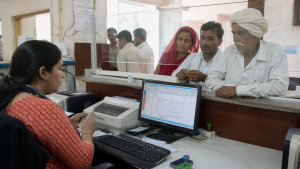
Financial inclusion is a major policy goal in India, aimed at bringing households, workers, and small businesses into the formal financial system. The focus is on expanding access to bank accounts, insurance, pensions, and collateral-free credit so that more people can save, borrow, and transact securely.
The RBI Financial Inclusion Index
The Reserve Bank of India (RBI) prepares an annual Financial Inclusion Index (FI-Index) to measure the extent of financial inclusion across the country. It covers banking, investments, insurance, postal services, and the pension sector.
- Range: The FI-Index has no base year and ranges from 0, indicating complete exclusion, to 100, indicating complete inclusion.
- Parameters: It is based on three components — Access (35%), Usage (52%), and Quality (13%).
- Trend: India’s overall FI-Index rose from 53.9 in 2018 to 67 in 2026.
Pradhan Mantri Jan Dhan Yojana (PMJDY)
Launched on August 28, 2014, PMJDY is the national mission for financial inclusion. It provides basic bank accounts to unbanked individuals and offers features such as no minimum balance requirement, a free RuPay debit card, and accident insurance cover.
- Basic features: Zero minimum balance, free RuPay debit card, and accident insurance cover of ₹2 lakh.
- Accounts opened: By August 19, 2026, PMJDY had 59.09 crore bank accounts with cumulative deposits of ₹3.17 lakh crore.
- Gender inclusion: Women held 55.7% of the total accounts, equal to 32.92 crore accounts.
- Rural outreach: Rural and semi-urban areas accounted for 77.8% of the accounts, or 45.95 crore accounts.
- Digital linkage: RuPay debit cards issued to PMJDY account holders crossed 41.29 crore as of August 2026.
The Jan Suraksha Social Security Schemes
The three Jan Suraksha schemes — Pradhan Mantri Jeevan Jyoti Bima Yojana (PMJJBY), Pradhan Mantri Suraksha Bima Yojana (PMSBY), and Atal Pension Yojana (APY) — completed 11 years of implementation on May 9, 2026.
- PMJJBY: A one-year renewable life insurance scheme with cover of ₹2 lakh for death due to any cause. It is available to individuals aged 18–50 years and has an annual premium of ₹436. By July 1, 2026, it had 27.84 crore cumulative enrollments and claims settled worth over ₹21,500 crore.
- PMSBY: A one-year personal accident insurance scheme offering ₹2 lakh cover for accidental death or total disability and ₹1 lakh for partial disability. It is meant for the 18–70 age group, with an annual premium of ₹20. As of July 1, 2026, it had 58.78 crore cumulative enrollments and claims settled worth nearly ₹3,660 crore.
- APY: A pension scheme for unorganized sector workers aged 18–40 years, providing a guaranteed minimum pension of ₹1,000 to ₹5,000 per month after attaining 60 years of age. It had 9.29 crore cumulative enrollments as of June 30, 2026.
Pradhan Mantri MUDRA Yojana (PMMY)
PMMY completed 11 years on April 8, 2026. It provides collateral-free institutional credit to micro and small enterprises, with the introduction of the Tarun Plus category raising the upper loan limit to ₹20 lakh.
- Loan categories: Shishu (up to ₹50,000), Kishor (₹50,001 to ₹5 lakh), Tarun (₹5 lakh to ₹10 lakh), and Tarun Plus (up to ₹20 lakh for entrepreneurs who have successfully repaid previous Tarun loans).
- Coverage: As of July 21, 2026, PMMY had sanctioned 59.14 crore loans totaling ₹41.71 lakh crore.
- Women borrowers: Women entrepreneurs accounted for approximately 60% of the loan accounts.
PM SVANidhi and Modified Stand-Up India
PM SVANidhi and Stand-Up India are targeted credit schemes for street vendors and disadvantaged entrepreneurs. Both have been revised or reworked to widen access to formal credit.
- PM SVANidhi extension: The scheme has been restructured and extended until March 31, 2030, with a revised financial outlay of ₹7,332 crore.
- Revised loan tranches: The first tranche has been increased to ₹15,000 from ₹10,000, and the second tranche to ₹25,000 from ₹20,000, while the third tranche remains ₹50,000.
- Digital incentive: Eligible vendors can receive a UPI-linked RuPay Credit Card after timely repayment of the second-tranche loan, along with digital cashbacks up to ₹1,600.
- Stand-Up India: The original scheme, which provided loans between ₹10 lakh and ₹1 crore to Scheduled Caste (SC), Scheduled Tribe (ST), and women entrepreneurs, expired on March 31, 2025.
- Successor scheme: A modified successor is being redrafted for Cabinet proposal and is proposed to support 5 lakh first-time SC/ST and women entrepreneurs with term loans up to ₹2 crore over five years.
Key Prelims Takeaways
- PMJDY offers basic savings accounts with zero minimum balance and accident insurance cover of ₹2 lakh.
- FI-Index measures financial inclusion through Access, Usage, and Quality, with weights of 35%, 52%, and 13%.
- PMJJBY provides one-year renewable life insurance cover of ₹2 lakh for death due to any cause.
- PMSBY covers accidental death or total disability for ₹2 lakh and partial disability for ₹1 lakh.
- APY offers a guaranteed minimum pension of ₹1,000 to ₹5,000 per month after age 60.
- PMMY now includes Shishu, Kishor, Tarun, and Tarun Plus loan categories.
- PM SVANidhi has been extended to March 31, 2030, with revised loan tranches of ₹15,000, ₹25,000, and ₹50,000.
| Related | |
|---|---|