India–Nepal Relations: History, Economy and Strategy
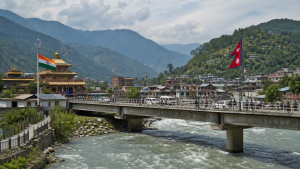
India and Nepal share a unique relationship shaped by open borders, deep cultural links, and close economic interdependence. The partnership is also important for regional security, hydropower trade, and cross-border connectivity.
For Prelims revision, the most relevant themes are the 1950 Treaty of Peace and Friendship, the Treaty of Sugauli, border disputes, growing power cooperation, and India’s role in Nepal’s trade, investment, and development assistance.
Historical and Treaty Foundations
- 1950 Treaty of Peace and Friendship: The core legal framework of India-Nepal ties. It allows citizens of both countries to cross the border without passports or visas and provides reciprocal rights for employment and property ownership.
- Open border: The India-Nepal border is unique in South Asia and supports extensive movement of people, goods, and services across the frontier.
- Treaty of Sugauli, 1816: Signed after the Anglo-Nepalese War between the Kingdom of Nepal and the British East India Company, it historically established the 1,751-km international boundary.
Territorial Disputes and Border Diplomacy
- Kalapani, Lipulekh, Limpiyadhura: These remain the main disputed areas, largely due to differing interpretations of the source of the Kali (Mahakali) River under the Treaty of Sugauli.
- Susta dispute: Another sensitive border issue, where Nepal claims territory that is currently administered by India, linked to historical shifts in the course of the Gandak River.
- Border talks: Nepal has proposed technical discussions involving historians and surveyors to verify and resolve border issues systematically.
Energy Cooperation and Grid Integration
- 25-year power trade agreement: Finalised in January 2024, it provides a long-term framework for Nepal to export electricity to India.
- Export target: The agreement targets export of 10,000 MW of electricity from Nepal to India over a 10-year span.
- Trilateral power transit: Nepal began exporting 40 MW of electricity to Bangladesh using India’s national grid, marking a key South Asian sub-regional power flow arrangement.
- Transmission expansion: India’s POWERGRID and the Nepal Electricity Authority (NEA) agreed to build two 400 kV lines: Inaruwa (Nepal)–New Purnea (India) and Lamki/Dododhara (Nepal)–Bareilly (India).
- Wet-season export ceiling: India raised Nepal’s wet-season power export limit from 1,200 MW to 1,650 MW, helping Nepal monetise surplus hydroelectricity during the monsoon period.
Economic Partnership, FDI, and Development Projects
- Trade and investment: India remains Nepal’s leading trading partner and the single largest source of foreign direct investment (FDI).
- FDI share: India accounts for more than 32% of Nepal’s total accumulated FDI stock.
- High-Impact Community Development Projects (HICDPs): India is funding school constructions in Dhanusha, Parsa, Achham, and Bara districts, along with a hospital in Manang district, under a ₹390 million grant.
- Agricultural cooperation: Under the 2025–26 Agricultural Cooperation Framework, the Indian Council of Agricultural Research (ICAR) supplies customised, climate-resilient seed varieties to support Nepal’s food security.
Defense and Security Cooperation
- Joint Working Group (JWG): Border management and security issues are reviewed regularly through this mechanism; its 14th meeting was held in August 2026 in Dehradun, Uttarakhand.
- Security focus: Discussions include joint patrols, prevention of illegal crossings, and coordination on border management.
- Surya Kiran exercise: The annual joint military exercise between India and Nepal strengthens interoperability and disaster-response preparedness.
- Gorkha Regiment link: The longstanding recruitment of Nepalese citizens into the Indian Army’s Gorkha Regiments remains an important defence tradition.
Key Prelims Takeaways
- 1950 Treaty of Peace and Friendship: Basis for visa-free travel, open border movement, employment rights, and reciprocal property ownership.
- Treaty of Sugauli, 1816: Historical basis of the 1,751-km India-Nepal boundary.
- Major disputes: Kalapani, Lipulekh, Limpiyadhura, and Susta.
- Energy pact: 25-year power trade agreement with a target of 10,000 MW exports from Nepal to India over 10 years.
- Cross-border power trade: Nepal’s 40 MW export to Bangladesh through India’s grid is a notable sub-regional development.
- Infrastructure projects: Two planned 400 kV lines are Inaruwa–New Purnea and Lamki/Dododhara–Bareilly.
- Economic and security links: India supplies over 32% of Nepal’s accumulated FDI stock and engages through the JWG, Surya Kiran exercise, and Gorkha recruitment tradition.
Current General Studies comprises current-affairs-based, General Studies-rich study material on policies, laws, institutions, economy, science, environment, governance, international relations, and other varied but important topics for UPSC and State PSC Prelims examinations.
Fortnightly PDF compilations: Available here
Originally written on
January 6, 2026
and last modified on
September 4, 2026.
| Related | |
|---|---|