Horticulture and Value Addition Schemes
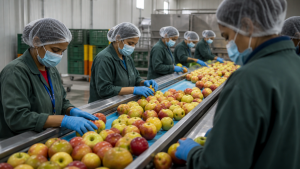
Horticulture and value addition schemes are designed to reduce post-harvest losses, strengthen farm-to-market linkages and expand processing capacity. They also support quality planting material, cold chain logistics and export-oriented infrastructure for fruits, vegetables and other perishables.
For Prelims, these schemes are important because they combine subsidy support, cluster-based development, certification systems and institutional financing across the horticulture and food-processing value chain.
Pradhan Mantri Kisan Sampada Yojana (PMKSY)
PMKSY is a Central Sector umbrella scheme implemented by the Ministry of Food Processing Industries (MoFPI). It aims to create modern food processing infrastructure and strengthen the farm-to-retail supply chain.
- Funding: The Cabinet approved a total outlay of Rs 6,520 crore for the 15th Finance Commission cycle, covering 2021-22 to 2025-26, including an additional allocation of Rs 1,920 crore.
- Main components: Integrated Cold Chain and Value Addition Infrastructure (ICCVAI), Infrastructure for Agro-processing Clusters, Creation/Expansion of Food Processing and Preservation Capacities, Food Safety and Quality Assurance Infrastructure, and Operation Greens.
- Subsidy pattern: Grants-in-aid are 35% of eligible project cost in general areas and 50% in difficult regions, including projects by SC/ST entrepreneurs, Farmer Producer Organisations and Self-Help Groups.
- Cap on support: Assistance is capped at Rs 5 crore.
- Infrastructure push: The revised allocation includes support for 50 multi-product food irradiation units under ICCVAI and 100 private-sector NABL-accredited food testing laboratories.
PM Formalisation of Micro Food Processing Enterprises (PMFME)
PMFME was launched in 2020 as a Centrally Sponsored Scheme with a budget of Rs 10,000 crore. It aims to formalise the unorganised micro food-processing segment and improve access to finance, technology and market linkages.
- Credit-linked subsidy: Individual micro-enterprises get assistance of 35% of eligible project cost, up to Rs 10 lakh per unit.
- Seed capital: Members of Self-Help Groups receive Rs 40,000 each, up to Rs 4 lakh per group, for working capital and basic tools.
- Common Facility Centres: These are eligible for 35% assistance up to Rs 3 crore.
- ODOP approach: The scheme uses the One District One Product framework to promote crop-specific processing based on local agricultural specialities.
- Coverage: The scheme reached its initial target of sanctioning two lakh micro units.
Clean Plant Programme (CPP)
The Clean Plant Programme focuses on providing pathogen-free, high-quality planting material for commercial horticulture. It is important for improving productivity, reducing disease spread and ensuring uniform quality in orchards.
- Institutional framework: The programme was conceptualised with the Asian Development Bank (ADB) and has a total allocation of Rs 1,765.67 crore, partly funded by a USD 98 million ADB loan.
- Implementing agencies: It is executed by the National Horticulture Board (NHB) along with the Indian Council of Agricultural Research (ICAR).
- Clean Plant Centres: The scheme establishes 9 state-of-the-art centres for diagnostics, therapy and mother plant maintenance.
- Focus crops: Grapes, citrus, apples and pomegranates are among the priority crops.
- Nursery assistance: Large nurseries can receive up to Rs 3 crore, while medium-sized nurseries can receive Rs 1.5 crore.
- Certification: Plant certification under the Seeds Act, 1966 tracks planting stock from propagation to commercial fields.
Cluster Development Programme (CDP) in Horticulture
The Cluster Development Programme is a Central Sector initiative implemented by the NHB to develop specialised horticulture clusters and improve competitiveness through integrated value chain interventions.
- Revised guidelines: The Ministry of Agriculture and Farmers Welfare notified updated operational guidelines on 31 December 2024.
- Multi-commodity high-value clusters: These focus on a designated fruit or vegetable crop with a minimum annual farm-gate value of Rs 100 crore.
- Geographic limit: Such clusters can cover a maximum of three contiguous districts.
- Peri-urban vegetable clusters: These promote vegetable cultivation within a 50 to 100 km radius of major urban demand centres.
- Purpose: The aim is to stabilise supplies, curb price volatility and improve market efficiency.
- Value chain support: CDP covers pre-production, high-density plantation, post-harvest logistics, cold chain integration and branding.
Key Prelims Takeaways
- PMKSY and PMFME: Both are central schemes under the Ministry of Food Processing Industries.
- CPP and CDP: These are implemented through the National Horticulture Board under the Ministry of Agriculture and Farmers Welfare.
- PMKSY support: The scheme gives 35% assistance in general areas and 50% in difficult regions, subject to a ceiling of Rs 5 crore.
- PMFME support: It provides a 35% credit-linked subsidy up to Rs 10 lakh for individual micro units.
- SHG assistance under PMFME: Members receive Rs 40,000 seed capital each, up to Rs 4 lakh per group.
- Clean Plant Programme: Certification under the Seeds Act, 1966 is a key legal feature.
- Operation Greens: Originally for TOP crops, it was expanded to cover 22 perishable crops.
Recent Context
In July 2025, the Union Cabinet approved an additional Rs 1,920 crore for PMKSY, taking its total budget to Rs 6,520 crore. The focus was on speeding up food irradiation units and food testing laboratories.
In mid-2026, PMFME crossed its target of sanctioning two lakh micro-processing units, and proposals were initiated for extending the scheme up to 2031.
| Related | |
|---|---|