Stellar and Exoplanetary Astrophysics Concepts
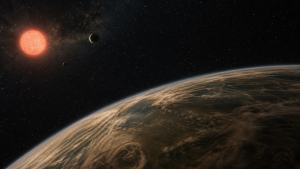
Exoplanetary astrophysics examines planets beyond our solar system with a focus on their atmospheres, composition, temperature, and chances of habitability. It combines transit observations, stellar physics, and atmospheric models to understand how planetary environments evolve under different kinds of stars.
Exoplanet Classification and Atmospheric Physics
- Super-Earths: These exoplanets are more massive than Earth but lighter than ice giants such as Uranus and Neptune. They usually fall in the range of 1 to 10 Earth masses and can have very different compositions.
- Red dwarf environments: Red dwarfs, or M-dwarfs, are the most common stars in the Milky Way. They often host planets in habitable zones, but strong magnetic activity and frequent flares can make atmospheric retention difficult.
- Molten planets: Some planets can sustain a global magma ocean because of tidal heating or extreme proximity to the host star. These bodies provide clues about intense thermal evolution and surface-atmosphere interaction.
- Atmospheric outgassing: Volcanic activity and mantle processes can release gases into a planet’s atmosphere. Such outgassing helps scientists infer the planet’s interior chemistry and thermal state.
- Chemical clues: The presence of gases such as hydrogen sulfide can indicate interactions between a molten mantle and the crust, helping model the planet’s geologic activity.
The Cosmic Shoreline and Atmospheric Loss
- Cosmic shoreline: This is an empirical boundary that separates planets retaining atmospheres from airless bodies. It is based on the balance between stellar irradiation and planetary escape velocity.
- Empirical Exoplanet Cosmic Shoreline (EECS): This model refines the atmospheric loss threshold using known bodies from the Solar System, including Mars, and highly irradiated exoplanets such as 55 Cancri e.
- Atmospheric stripping: High-energy stellar winds and extreme ultraviolet radiation can remove volatile outer layers, especially from planets orbiting active red dwarfs.
- Thermal state: A planet’s temperature profile strongly influences whether it retains gases, develops a thin atmosphere, or becomes airless.
Observational Challenges in Exoplanet Studies
- Transit spectroscopy: This method studies starlight that passes through a planet’s atmosphere during transit. Absorption lines in the spectrum reveal gases present in the atmosphere.
- Stellar contamination: Flare activity and starspots can distort transit data and create spectral anomalies, making it harder to identify the true atmospheric signature.
- Coronagraphy: A coronagraph blocks the direct glare of a host star, allowing direct imaging and spectroscopic study of faint nearby planets and debris disks.
- Habitable zone limits: The orbital region where liquid water may exist depends not only on distance from the star but also on atmospheric retention and stellar activity.
Comparative Analysis of Key Exoplanets
| Exoplanet | Planetary class | Key atmosphere and thermal traits | Distance and location |
| GJ 3378b | Super-Earth | Mass of 2.3 Earth masses; orbital period of 21.45 days; orbits in the habitable zone of a red dwarf; lies near the cosmic shoreline and may be prone to atmospheric stripping | 25 light-years away, in Camelopardalis |
| L 98-59d | Molten planet | Permanent global magma ocean; hydrogen-sulfide-rich atmosphere; chemically reducing mantle with active outgassing | 35 light-years away |
| TRAPPIST-1e | Rocky exoplanet | Located in the stellar habitable zone; atmospheric observations remain inconclusive because of stellar flares; may be nitrogen-rich or airless | 40 light-years away, in Aquarius |
Space Missions and Detection Technologies
- PLATO mission: The European Space Agency’s PLAnetary Transits and Oscillations of stars mission is scheduled for launch in March 2027 to identify Earth-sized planets orbiting Sun-like stars.
- Ariel mission: ESA’s Atmospheric Remote-sensing Infrared Exoplanet Large-survey mission, planned for 2031, will conduct chemical surveys of about 1,000 transiting exoplanet atmospheres.
- L2 Lagrange point: This stable location is about 1.5 million km from Earth in the anti-Sun direction and offers a clear, thermally stable viewing environment for space observatories.
- Space-based observatories: Missions placed in stable orbits can reduce interference from Earth’s atmosphere and improve the precision of planetary and stellar measurements.
Important Exoplanet Concepts
- TRAPPIST-1 system: An ultra-cool red dwarf star hosts seven Earth-sized rocky planets. Space observations have ruled out thick hydrogen- or carbon-dioxide-rich atmospheres on the three innermost planets, b, c, and d.
- 55 Cancri e: This highly irradiated, carbon-rich super-Earth is used as an extreme example for studying atmospheric loss and thermal conditions.
- Atmospheric retention: Whether a planet keeps its atmosphere depends on stellar radiation, escape velocity, and the planet’s geological activity.
- Planetary classification: Exoplanets are grouped using mass, composition, temperature, and atmospheric properties rather than only size or distance from the star.
Key Prelims Takeaways
- Super-Earths: Planets with masses above Earth’s but below those of ice giants; they often show wide variation in composition and density.
- Red dwarfs: The most common stars in the Milky Way, but their flares and magnetic activity can erode nearby planetary atmospheres.
- Cosmic shoreline: An empirical boundary separating atmosphere-bearing planets from airless ones.
- Transit spectroscopy: A key technique for detecting atmospheric gases through absorption features during planetary transits.
- Coronagraph: An instrument that blocks starlight and helps in direct imaging of faint exoplanets.
- PLATO and Ariel: ESA missions aimed at discovering Earth-like planets and analysing exoplanet atmospheres in detail.
- L2 point: A stable orbital region often chosen for deep-space observatories because of its thermal and viewing advantages.
Current General Studies comprises current-affairs-based, General Studies-rich study material on policies, laws, institutions, economy, science, environment, governance, international relations, and other varied but important topics for UPSC and State PSC Prelims examinations.
Fortnightly PDF compilations: Available here
Originally written on
January 2, 2026
and last modified on
September 4, 2026.
| Related | |
|---|---|