Major Indian Music and Cinema Awards
Indian music and cinema awards are important for recognising artistic excellence, technical skill, and cultural representation across languages and regions. For Prelims, the focus should be on the award’s origin, administering bodies, selection process, and key annual winners.
Evolution of the National Film Awards
Established in 1954, the National Film Awards were instituted to encourage films marked by artistic excellence, technical competence, and social relevance. Initially called the State Awards, they have remained the country’s most authoritative official film honours.
- Administration: The awards were handled by the Ministry of Information and Broadcasting from 1954 to 1973, and by the Directorate of Film Festivals from 1974 to 2022. Currently, the National Film Development Corporation (NFDC) manages the selection and execution process.
- Categories: The awards assess cinema in two main streams—Feature Films and Non-Feature Films—along with a separate category for Writing on Cinema.
- Eligibility: Participation is restricted to Indian citizens, and submitted films must be certified by the Central Board of Film Certification (CBFC) within the specified calendar year.
- Selection: A national jury appointed by the central government decides the winners.
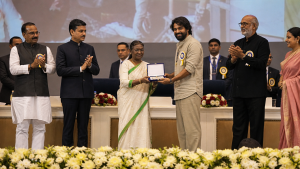
- Presentation: The awards are formally presented by the President of India in New Delhi.
Dadasaheb Phalke Award: Highest Cinematic Honour
The Dadasaheb Phalke Award is India’s highest honour in cinema and is presented annually during the National Film Awards ceremony. It recognises a lifetime contribution to the growth and development of Indian cinema and preserves the legacy of Dhundiraj Govind Phalke, who directed India’s first indigenous full-length feature film, Raja Harishchandra (1913).
- First recipient: Devika Rani received the award when it was introduced in 1969.
- Award components: The honour includes a Swarna Kamal (Golden Lotus) medallion, a shawl, and a cash prize of ₹1,000,000 (Rs. 10 lakh).
- Selection: A committee of eminent personalities from the Indian film industry selects the awardee under the Ministry of Information and Broadcasting.
Popular Recognition: The Filmfare Awards
Introduced in 1954 by Filmfare magazine of The Times Group, the Filmfare Awards were created to recognise artistic and technical excellence in Hindi cinema. They are among the best-known private awards in Indian film culture.
- Original name: The awards were first called the Clares or Clare Awards in honour of Clare Mendonça, a pioneering film critic for The Times of India.
- Venue: The inaugural ceremony was held at the Metro Theatre in Mumbai.
- Initial categories: The first edition had only five competitive awards: Best Film, Best Director, Best Actor, Best Actress, and Best Music Director.
- First winners: Bimal Roy’s Do Bigha Zameen won Best Film, while Dilip Kumar and Meena Kumari won the acting awards.
- Trophy: Winners receive the Black Lady, a bronze statuette representing a stylised female figure.
International Outreach: IIFA Awards
The International Indian Film Academy (IIFA) Awards were established in 2000 to project Hindi cinema on a global platform and build links with international film markets. Organised by Wizcraft International Entertainment, the awards are hosted in different international cities and support Indian cultural outreach abroad.
- First ceremony: The inaugural IIFA Awards were held at the Millennium Dome in London in 2000.
- Global format: The event shifts to a different host city each year, enhancing its international reach.
- IIFA Utsavam: Introduced in 2016, it is dedicated to the four South Indian language film industries: Tamil, Telugu, Malayalam, and Kannada.
- Industry linkages: The event also includes business forums, film trade interactions, and creative collaborations.
Key Exam Points on Recent Award Cycles
- 72nd National Film Awards: Article 370 was named Best Feature Film, and Yami Gautam won Best Actress.
- Best Actor: Mammootty (Bramayugam) and Kartik Aaryan (Chandu Champion) shared the Best Actor award.
- Other 72nd awards: Randeep Hooda won Best Debut Director for Swatantrya Veer Savarkar, and Kalki 2898 AD won Best Popular Film Providing Wholesome Entertainment.
- 71st National Film Awards: 12th Fail was named Best Feature Film, while Vikrant Massey (12th Fail) and Shah Rukh Khan (Jawan) shared Best Actor.
- Best Actress: Rani Mukerji won Best Actress for Mrs. Chatterjee vs. Norway.
- 71st Phalke honour: Veteran Malayalam actor Mohanlal received the Dadasaheb Phalke Award during the 71st ceremony.
- Recent private awards: At the 70th Filmfare Awards, Laapataa Ladies won Best Film; Kiran Rao won Best Director; Alia Bhatt won Best Actress for Jigra; and Best Actor was shared by Kartik Aaryan (Chandu Champion) and Abhishek Bachchan (I Want to Talk).
Key Prelims Takeaways
- National Film Awards: Official annual awards instituted in 1954 to honour artistic, technical, and socially relevant cinema.
- Administration: Currently managed by NFDC; winners are chosen by a national jury and presented by the President of India.
- Eligibility: Films must be Indian and CBFC-certified within the specified calendar year.
- Dadasaheb Phalke Award: India’s highest cinema honour; first awarded to Devika Rani in 1969.
- Filmfare Awards: Private awards started in 1954 by Filmfare magazine for Hindi cinema.
- IIFA Awards: Global platform launched in 2000; IIFA Utsavam was added in 2016 for South Indian languages.
- Trophies and symbols: Filmfare’s trophy is the Black Lady, while the Phalke Award includes a Swarna Kamal medallion.
| Related | |
|---|---|