India–Sri Lanka Relations: Framework and Agreements
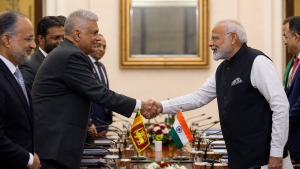
India and Sri Lanka share a relationship shaped by geography, history, trade, and security in the Indian Ocean region. The partnership is guided by formal agreements on defence, economic cooperation, energy, infrastructure, and development assistance.
For Prelims, the key points are the bilateral frameworks, major agreements, and ongoing areas of cooperation that define the relationship.
Strategic and Security Cooperation Framework
Bilateral ties operate under India’s Neighbourhood First policy and the maritime framework of Vision MAHASAGAR (Mutual and Holistic Advancement for Security and Growth Across Regions). These frameworks emphasize regional stability, security cooperation, and wider connectivity in the Indian Ocean.
In April 2025, India and Sri Lanka signed their first formal Memorandum of Understanding (MoU) on Defence Cooperation. The agreement created a five-year structured umbrella framework for security exchanges, military training, joint exercises, and maritime security coordination.
India’s security coordination with Sri Lanka also aligns with the Colombo Security Conclave, a minilateral group focused on regional security cooperation.
- Colombo Security Conclave members: India, Sri Lanka, Bangladesh, Mauritius, and the Maldives
Economic Trade and Debt Restructuring Agreements
The India–Sri Lanka Free Trade Agreement (ISFTA), operational since 2000, remains the principal trade framework between the two countries. Talks on the proposed Economic & Technological Cooperation Agreement (ETCA) continue to expand cooperation in services and investment.
During the April 2025 bilateral summit, the two sides concluded Bilateral Amendatory Agreements on Debt Restructuring. India, as co-chair of the Official Creditor Committee (OCC), agreed to reduce interest rates on outstanding loans as part of support for Sri Lanka’s economic stabilization.
This support was extended further through two INR-denominated Lines of Credit signed in August 2026 between the EXIM Bank of India and Sri Lanka’s Ministry of Finance.
- USD 250 million for railway projects
- USD 100 million for livestock and other priority requirements
Energy, Infrastructure, and Digital Cooperation
Energy security, digital integration, and green transition are important pillars of bilateral cooperation. In April 2025, India, Sri Lanka, and the United Arab Emirates (UAE) signed a tripartite MoU to develop Trincomalee as a regional energy hub.
Other major agreements and projects cover electricity transmission, digital governance, and renewable energy.
- HVDC interconnection: Planned for cross-border power trade through a High-Voltage Direct Current link
- Digital transformation: Sharing of population-scale digital solution frameworks for Sri Lanka
- Sampur Solar Power Project: Joint execution of the 120 MW project in the Eastern Province
- Solar rooftop units: Supply of 5,000 units to religious places across all 25 districts of Sri Lanka
Developmental Assistance and Disaster Relief
India’s developmental assistance to Sri Lanka covers railways, agriculture, and rehabilitation-related support. These projects reflect the practical and people-centric dimension of the partnership.
- Maho-Omanthai railway track: Upgradation work
- Maho-Anuradhapura line: Signalling system construction
- Dambulla agricultural warehouse: A 5,000 MT temperature-controlled facility to reduce post-harvest losses
India is also reviewing the implementation of a USD 450 million reconstruction assistance package extended to help Sri Lanka recover from the devastation caused by Cyclone Ditwah, which struck in November 2025.
Political Framework and the 13th Amendment
Political dialogue between India and Sri Lanka regularly addresses ethnic reconciliation and devolution of power. India continues to support the early holding of Provincial Council elections in Sri Lanka and calls for the full implementation of the Thirteenth Amendment (13A) to the 1978 Constitution of Sri Lanka.
The 13A emerged from the Indo-Sri Lanka Accord of 1987 and is considered important for devolving land, police, and financial powers to provincial administrations, especially in the context of the Tamil minority’s political aspirations.
Key Prelims Takeaways
- Vision MAHASAGAR: India’s maritime framework for security and growth across regions
- Neighbourhood First: The policy framework guiding India’s immediate regional engagement
- Defence MoU: Signed in April 2025; created a five-year umbrella framework for security cooperation
- Colombo Security Conclave: India, Sri Lanka, Bangladesh, Mauritius, and the Maldives
- ISFTA: The main trade agreement, operational since 2000
- ETCA: Proposed agreement for deeper cooperation in services and investment
- 13th Amendment: Linked to the 1987 Indo-Sri Lanka Accord and devolution of powers to provinces
- Trincomalee MoU: Tripartite energy hub agreement involving India, Sri Lanka, and the UAE
- INR-denominated LoCs: USD 350 million in August 2026, including USD 250 million for railways and USD 100 million for livestock
- Development assistance: Rail, agriculture, digital, and renewable energy projects remain central to cooperation