Agricultural Policies for Hills, Tribes and Northeast
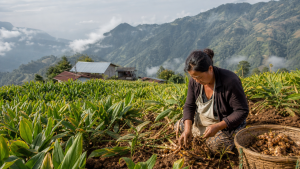
Agricultural development in India’s hilly, tribal and northeastern regions needs location-specific support because of difficult terrain, fragile ecosystems and distinct crop profiles. The focus is on building value chains, improving market access, strengthening tribal livelihoods and promoting sustainable cultivation, especially for high-value and organic crops.
Targeted Horticultural Missions in the Northeast
The Northeast has seen crop-focused missions designed to create branded value chains for local produce. These initiatives combine cultivation expansion, processing, infrastructure and marketing support to improve farmer incomes and region-specific agricultural growth.
- Mission Golden Spice: Launched on July 21, 2026, this five-year initiative (2025–2030) focuses on the Integrated Lakadong Turmeric Value Chain Enhancement Project in Meghalaya.
- Outlay and funding: The mission has a total financial outlay of ₹175.45 crore. It is jointly funded by the Meghalaya state government, the Union Ministry of Agriculture and the Ministry of Development of North Eastern Region (MDoNER), with MDoNER contributing 50% of the funding.
- Key targets: The mission aims to expand Lakadong turmeric cultivation from 2,500 hectares to 7,000 hectares by 2030.
- Farmer benefit: It seeks to raise farm-gate prices for turmeric from ₹30–40 per kilogram to ₹80 per kilogram, directly benefiting over 17,500 farmers.
- Women’s participation: Around 99% of the beneficiaries are women farmers.
- Mission Sikkim Organics: Launched on May 16, 2026, this three-year multi-stakeholder convergence initiative runs from 2026–2029.
- Coverage and budget: It has a budget of ₹335 crore to ₹360 crore and aims to strengthen the value chain of Sikkim’s organic crops, including large cardamom, ginger, turmeric and buckwheat.
- Support base: The mission is expected to benefit over 66,000 farming families, with MDoNER contributing ₹85 crore for infrastructure development.
Crop-Specific USP Missions in the Northeast
To replicate the organic and value-chain model in other northeastern states, MDoNER launched crop-specific Unique Selling Proposition (USP) missions in May and June 2026. These missions focus on signature crops with local market identity and export potential.
| Mission Name | Outlay (₹ crore) | Targeted State and Crop |
| Tripura Queen Pineapple Mission | 236.00 | Tripura (Queen Pineapple) |
| Mizoram Ginger Mission | 189.79 | Mizoram (Ginger) |
| Arunachal Kiwi Mission | 167.00 | Arunachal Pradesh (Kiwi fruit) |
| Coffees of Nagaland | State-specific | Nagaland (Coffee cultivation) |
Livelihood and Infrastructure Schemes for Tribal Areas
For tribal regions, the government has combined infrastructure support with livelihood-based interventions to address development gaps in remote and dispersed habitations. These schemes aim to improve basic services while also linking tribal communities to sustainable income opportunities.
- PM Janjatiya Unnat Gram Abhiyan (PM-JUGA): Also known as the Dharti Aaba Janjatiya Gram Utkarsh Abhiyan (DAJGUA), this five-year scheme runs from 2024 to 2029.
- Total budget: The scheme has an outlay of ₹79,156 crore, with ₹56,333 crore from the Central Government and ₹22,823 crore from State Governments.
- Coverage: It addresses infrastructure and livelihood gaps in 63,843 tribal-majority villages across 30 States and Union Territories.
- PM Janjatiya Vikas Mission (PM-JVM): This scheme focuses on tribal livelihoods through the development and marketing of minor forest produce (MFP).
- Van Dhan support: Under PM-JVM, 4,172 Van Dhan Vikas Kendras (VDVKs) had been sanctioned as of August 2026.
- Beneficiaries: These kendras provide livelihood and value-addition support to 12.48 lakh tribal individuals.
District-Level Agricultural Convergence Initiatives
Some recent schemes focus on convergence at the district level rather than on a single crop. The idea is to combine multiple existing programmes so that underperforming districts can improve productivity, infrastructure and income together.
- Prime Minister Dhan-Dhaanya Krishi Yojana (PM-DDKY): A six-year convergence-based scheme running from 2025–26 to 2030–31.
- Annual budget: The scheme operates with an annual budget of ₹24,000 crore.
- Target districts: It covers 100 underperforming districts to accelerate agricultural productivity and income growth.
- Convergence model: PM-DDKY integrates 36 existing Central schemes across 11 Union Ministries.
- Performance indicator: The average performance score of the 100 targeted districts improved from 22.54 in April 2026 to 38.85 in July 2026.
PM-DevINE and Allied Agricultural Projects
The Prime Minister’s Development Initiative for North Eastern Region (PM-DevINE) supports infrastructure-led development in the Northeast, while also funding selected agricultural and allied interventions. The scheme is relevant for building enabling systems around farming, processing and value addition.
- Funding pattern: PM-DevINE is a 100% centrally funded scheme with an approved outlay of ₹6,600 crore for FY 2022-23 to FY 2025-26.
- Sanction status: As of late August 2026, projects worth ₹6,044.36 crore had been sanctioned.
- Agricultural support: The scheme includes scientific organic agriculture promotion and a value-chain development project using banana pseudo stems to manufacture value-added products.
Key Prelims Takeaways
- Mission Golden Spice: Five-year project (2025–2030) with an outlay of ₹175.45 crore for Lakadong turmeric in Meghalaya.
- Mission Sikkim Organics: Three-year initiative (2026–2029) with a budget of ₹335–360 crore for organic crops in Sikkim.
- PM-JUGA / DAJGUA: Five-year tribal development scheme with an outlay of ₹79,156 crore for 63,843 tribal-majority villages.
- PM-JVM: Sanctioned 4,172 Van Dhan Vikas Kendras as of August 2026, supporting 12.48 lakh tribal persons.
- PM-DDKY: Six-year convergence scheme for 100 underperforming districts with an annual budget of ₹24,000 crore.
- Crop-specific USP missions: Tripura Queen Pineapple Mission (₹236 crore), Mizoram Ginger Mission (₹189.79 crore) and Arunachal Kiwi Mission (₹167 crore).
- PM-DevINE: Fully centrally funded with an approved outlay of ₹6,600 crore for FY 2022-23 to FY 2025-26.
Exam focus: MDoNER plays a central role in funding crop-specific missions in the Northeast, especially those linked to organic farming and local value chains.
| Related | |
|---|---|