India’s Textile and Apparel Sector
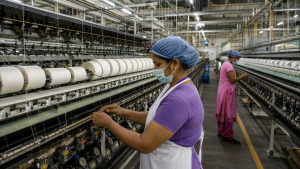
India’s textile and apparel sector is one of the country’s most important industrial and export segments. It covers the full value chain, from handloom and handicrafts to spinning, weaving, technical textiles and garments.
The sector is central to employment generation, rural-industrial linkages and foreign exchange earnings. For Prelims revision, schemes, missions, targets and institutional arrangements are especially important.
Sectoral Profile and Targets
- Administrative leadership: The Ministry of Textiles is headed by Union Cabinet Minister Giriraj Singh, with Pabitra Margherita as Minister of State. Smt. Neelam Shami Rao is the Secretary and Rohit Kansal is the Additional Secretary.
- Industry size target: The government aims to expand the domestic textile and apparel industry to USD 350 billion in the coming years.
- Export target: The sector, along with handicrafts, has a target of USD 100 billion in exports by 2030, or about ₹9 lakh crore.
- Production base: The industry combines traditional handloom production with modern, capital-intensive spinning and weaving mills.
- Global platform: Bharat Tex 2026 was held from July 14 to July 17, 2026 to support international trade linkages.
PM MITRA Scheme and Infrastructure
- Scheme name: PM Mega Integrated Textile Region and Apparel (PM MITRA) Parks scheme.
- Budget: The scheme has an approved outlay of ₹4,445 crore for FY 2021-22 to FY 2027-28.
- Coverage: Seven PM MITRA parks have been approved across seven states.
- Land status: Administrative progress has reached 100% land acquisition across all selected host states, along with signed MoUs.
- DPRs: Detailed Project Reports worth ₹13,537 crore have been finalized for all seven park locations as of August 2026.
- First operational park: The Kakatiya Mega Textile Park in Warangal, Telangana, was inaugurated on May 10, 2026 as the first operational PM MITRA Park.
Revised PLI Scheme for Textiles
- Scheme outlay: The Production Linked Incentive (PLI) Scheme for Textiles is backed by an allocation of ₹10,683 crore.
- Lower investment thresholds: Revisions effective from August 1, 2025 reduced the minimum investment requirement by 50% to ₹150 crore for Part-1 and ₹50 crore for Part-2.
- Flexibility in structure: Firms can set up new units within existing companies instead of creating separate legal entities.
- Expanded coverage: The revised framework added 17 new HSN codes.
- Eased turnover condition: The annual incremental turnover growth requirement for incentives was reduced from 25% to 10%.
- Applications: The registration window was extended until March 31, 2026, taking the number of approved companies to 170 as of July 2026.
National Technical Textiles and Cotton Missions
- National Technical Textiles Mission (NTTM): The mission has an allocation of ₹1,480 crore for 2020-21 to 2025-26.
- Technical textiles trade surplus: In FY 2025-26, the segment recorded a trade surplus of ₹3,420.20 crore.
- Exports and imports: Technical textiles exports stood at ₹29,217.60 crore, while imports were ₹25,797.40 crore.
- Mission for Cotton Productivity (MCP): The Union Cabinet approved the mission in May 2026 with an outlay of ₹5,659.22 crore for 2026-27 to 2030-31.
- Productivity target: The MCP aims to raise average cotton lint productivity from 440 kg per hectare to 755 kg per hectare.
- Output target: The mission seeks to increase national cotton output to 498 lakh bales by 2031.
Key Prelims Takeaways
- Ministry of Textiles: Giriraj Singh is the Union Minister; Pabitra Margherita is Minister of State.
- Industry goal: The domestic textile and apparel market is targeted to reach USD 350 billion.
- Export goal: The combined textile and handicrafts export target is USD 100 billion by 2030.
- PM MITRA: The scheme has an outlay of ₹4,445 crore and seven approved parks.
- First PM MITRA park: Kakatiya Mega Textile Park, Warangal, Telangana, became operational on May 10, 2026.
- PLI textiles: Investment norms were reduced to ₹150 crore and ₹50 crore, with turnover growth eased to 10%.
- Cotton mission: The MCP aims for 755 kg/ha lint productivity and 498 lakh bales output by 2031.
Current General Studies comprises current-affairs-based, General Studies-rich study material on policies, laws, institutions, economy, science, environment, governance, international relations, and other varied but important topics for UPSC and State PSC Prelims examinations.
Fortnightly PDF compilations: Available here
Originally written on
January 3, 2026
and last modified on
September 4, 2026.
| Related | |
|---|---|