Union Budget: Process and Constitutional Provisions
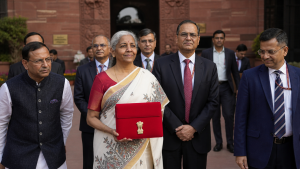
The Union Budget is the government’s annual financial statement, showing estimated receipts and expenditures for the coming fiscal year. It is a key instrument of fiscal policy and is governed by constitutional provisions, parliamentary procedure and statutory rules.
Constitutional Framework and Fund Classifications
Under Article 112 of the Constitution, the Union Budget is officially called the Annual Financial Statement (AFS). It presents the estimated receipts and expenditures of the Government of India for a fiscal year, which runs from 1 April to 31 March.
- Consolidated Fund of India (Article 266(1)): All revenues received by the government, loans raised, and loan repayments are credited here. No money can be withdrawn without parliamentary authorization.
- Public Account of India (Article 266(2)): This contains money received by or on behalf of the government that does not belong to the Consolidated Fund, such as provident funds and small savings. It is operated through executive action and does not require a vote of Parliament.
- Contingency Fund of India (Article 267(1)): This is an interest-bearing fund kept at the disposal of the President to meet unforeseen expenditure pending parliamentary approval. The corpus is held by the Finance Secretary on behalf of the President.
Budget Passage in Parliament
The Union Budget passes through a set parliamentary process. In practice, the Lok Sabha plays the central role in voting on expenditure and taxation proposals.
- Presentation of Budget: The Finance Minister presents the Budget and delivers the Budget Speech in the Lok Sabha.
- General Discussion: Both Houses discuss the Budget as a whole, but there is no voting at this stage.
- Scrutiny by Departmental Committees: Standing Committees examine the Demands for Grants of different ministries.
- Voting on Demands for Grants: The Lok Sabha votes on the demands; this stage is exclusive to the Lower House.
- Appropriation Bill: Under Article 114(3), this bill authorises withdrawals from the Consolidated Fund of India.
- Finance Bill: Tax and revenue proposals are enacted through the Finance Bill, which is classified as a Money Bill.
Key Legislative Provisions
The Budget is not just a statement of estimates; it becomes operational only after legislative approval through specific constitutional instruments.
- Demands for Grants (Article 113): These are the expenditure estimates from the Consolidated Fund that require voting by the Lok Sabha. Generally, one Demand for Grant is presented for each ministry or department.
- Appropriation Act (Article 114): This provides legal authority to withdraw money from the Consolidated Fund of India.
- Tax Authorization (Article 265): No tax can be levied or collected except by authority of law.
- Money Bill (Article 110): The Finance Bill, which includes tax proposals, is introduced after the Budget presentation.
Exam point: No money can be withdrawn from the Consolidated Fund of India except under an Appropriation Act passed by Parliament.
Structural Changes in Budget Presentation
The timing and format of Budget presentation have changed over time. Since 2017, the Union Budget has been presented on 1 February instead of the last working day of February. This allows parliamentary approval and implementation before the start of the next fiscal year on 1 April.
The separate Railway Budget, a practice that began in 1924 after the Acworth Committee recommendations, was merged with the General Budget in 2017. This brought railway finances into the main budgetary framework.
Article 293 governs state borrowing. State governments may borrow within India against their Consolidated Funds, but central government consent is needed if any previous central loans or guarantees remain outstanding.
Fiscal Responsibility and Deficit Management
The Fiscal Responsibility and Budget Management (FRBM) Act, 2003, which came into force on 5 July 2004, provides the framework for reducing fiscal deficit and maintaining macroeconomic stability. It aims to promote long-term fiscal discipline through deficit management targets and policy transparency.
Under this framework, the government places key fiscal statements before Parliament along with the Budget, including the Medium-term Fiscal Policy Statement.
The Union Budget 2026-27 set the fiscal deficit target at 4.3% of GDP as the Budget Estimate, lower than the 4.4% of GDP projected in the revised estimates for 2025-26.
Key Prelims Takeaways
- AFS: Under Article 112, the Union Budget is formally the Annual Financial Statement.
- Fiscal year: The Union Budget covers the period from 1 April to 31 March.
- Consolidated Fund of India: Withdrawals from this fund require parliamentary authorization.
- Public Account: Funds here are operated by executive action and are not voted by Parliament.
- Article 114(3): No withdrawal from the Consolidated Fund is allowed without an Appropriation Act.
- Finance Bill: Tax and revenue proposals are enacted through the Finance Bill, treated as a Money Bill.
- FRBM Act: Enforced from 5 July 2004 to support fiscal discipline and deficit reduction.
| Related | |
|---|---|