GST Governance, Council and Administration
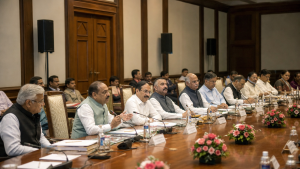
GST in India is built on a cooperative federal structure that brings the Union and the States together for decisions on tax rates, exemptions, administration, and related reforms. The GST Council is the core institutional mechanism for this coordination, ensuring uniformity while preserving federal balance.
Constitutional Framework and Composition
- Constitutional body: The GST Council was created under Article 279A of the Indian Constitution through the 101st Constitutional Amendment Act, 2016.
- Constitution by President: The President constituted the Council within 60 days of the commencement of the amendment.
- Headquarters: The administrative secretariat is in New Delhi.
- Secretary: The Union Revenue Secretary serves as the ex-officio Secretary to the GST Council.
- Chairperson: The Council is chaired by the Union Finance Minister.
- Members: It includes the Union Minister of State for Finance and the Finance or Taxation Ministers of all States and Union Territories with legislatures.
- Vice-Chairperson: The members choose a Vice-Chairperson from among the state representatives.
Decision-Making and Voting Structure
- Quorum: At least 50% of the total members must be present for a valid meeting.
- Validity of proceedings: No act or proceeding of the Council can be invalidated merely because of a vacancy or defect in its constitution.
- Voting majority: Decisions require a three-fourths majority of the weighted votes of members present and voting.
- Weighted voting: The Central Government has one-third of the total weighted votes, while the States collectively have two-thirds.
- Federal balance: This structure prevents unilateral decisions by either the Centre or the States and encourages consensus.
GST Administration and Institutional Roles
- CBIC: The Central Board of Indirect Taxes and Customs (CBIC) administers CGST and IGST.
- State departments: State tax departments administer SGST.
- GSTN: The GST Network (GSTN) provides the common IT backbone for registration, return filing, and invoice matching.
- GSTAT: The GST Appellate Tribunal is the specialised forum for appeals against orders of appellate and revisional authorities.
GST 2.0 Structural Reforms and Tax Slabs
- Effective date: The GST 2.0 reforms became effective from September 22, 2025.
- Slab rationalisation: The earlier four-slab structure of 5%, 12%, 18%, and 28% was simplified into two standard slabs of 5% and 18%.
- Luxury and demerit goods: A consolidated 40% rate applies to luxury and sin goods.
- Earlier 28% + cess structure: The earlier combination of 28% GST plus Compensation Cess was merged into the headline 40% rate for most luxury and sin goods.
- Insurance: Premiums for term, endowment, ULIPs, and health insurance are exempt under the current rules.
- Essential items: Generic food items and select primary educational supplies are also at nil rate.
| Parameter | Old GST Framework | GST 2.0 Framework |
| Standard slabs | 5%, 12%, 18%, 28% | 5% and 18% |
| Luxury / sin rate | 28% + Compensation Cess | Consolidated 40% |
GST Compensation Cess and Transition
- Purpose: The GST (Compensation to States) Act, 2017 guaranteed States a 14% annual growth rate in GST revenues for five years.
- Shortfall mechanism: Revenue shortfalls were met through the GST Compensation Cess.
- Expiry: The cess is scheduled to expire on March 31, 2026.
- Extension: It was extended beyond the initial five-year period to repay ₹2.69 lakh crore in pandemic-era loans and associated interest.
- Review mechanism: A dedicated Group of Ministers (GoM) reviews the transition of the compensation cess and the use of any surplus in the GST Compensation Fund after the expiry date.
Key Prelims Takeaways
- Article 279A: Provides the constitutional basis for the GST Council.
- Composition: Chaired by the Union Finance Minister; includes state finance/taxation ministers and the Union Minister of State for Finance.
- Voting pattern: Centre has one-third weight; States together have two-thirds.
- Decision rule: Council decisions need a 75% majority of weighted votes, with a 50% quorum.
- GST 2.0 slabs: The framework now uses 5% and 18% slabs, with a 40% rate for luxury and demerit goods.
- Compensation cess: Scheduled to end on March 31, 2026, after servicing pandemic-era borrowing.
- Key institutions: CBIC handles CGST and IGST; GSTN manages the portal; GSTAT handles appeals.
Current General Studies comprises current-affairs-based, General Studies-rich study material on policies, laws, institutions, economy, science, environment, governance, international relations, and other varied but important topics for UPSC and State PSC Prelims examinations.
Fortnightly PDF compilations: Available here
Originally written on
February 8, 2026
and last modified on
September 4, 2026.
| Related | |
|---|---|