India–Nepal Disaster Management Institutions and Coordination
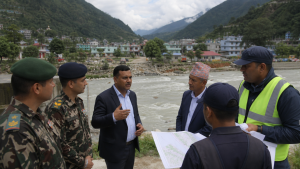
India and Nepal share a dense network of transboundary rivers across the fragile Himalayan region, making disaster management a key area of bilateral cooperation. Their coordination covers water-resource planning, flood control, early warning systems, and response to Himalayan hazards such as inundation and glacial lake outburst floods (GLOFs).
Three-Tier Bilateral Water Architecture
The core framework for water resource management and flood control between India and Nepal operates through a three-tier institutional structure.
- Joint Ministerial Level Commission on Water Resources (JMCWR): The apex body for high-level policy decisions.
- Joint Committee on Water Resources (JCWR): The secretary-level mechanism for administrative coordination.
- Joint Standing Technical Committee (JSTC): The technical body responsible for engineering and operational matters.
This structure helps divide responsibilities between political decision-making, administrative follow-up, and technical execution. In March 2025, the two countries also signed a Memorandum of Understanding (MoU) to extend cooperation into the Water, Sanitation, and Hygiene (WASH) sector, with emphasis on capacity building, technology transfer, and joint groundwater monitoring.
Technical Committees and Project Management
For operational issues related to transboundary rivers and project sites, India and Nepal rely on specialised sub-level committees.
- Joint Committee on Inundation and Flood Management (JCIFM): Handles inundation-related coordination and flood management issues.
- Joint Committee on Kosi and Gandak Projects (JCKGP): Oversees the Kosi and Gandak project areas and related field problems.
- Joint Team on Flood Forecasting (JTFF): Coordinates seasonal flood prediction and technical data sharing.
These committees deal with local disputes, maintenance issues, and project-level concerns in flood-prone areas. During the 11th meeting of the JCKGP, both sides agreed to remove illegal encroachments in project zones, use Global Positioning System (GPS) technology for leasing-land demarcation, and address drainage issues in the Western Koshi Main Canal and the Valmikinagar Gandak Barrage.
Non-Structural Mitigation and Early Warning Systems
Non-structural mitigation is central to disaster preparedness in the Himalayan river basins. It depends on real-time information flow, hydrometeorological monitoring, and advance warning to downstream states.
- Real-time data exchange: Nepal’s Department of Hydrology and Meteorology uploads hydrometeorological data hourly during the monsoon season.
- CWC flood forecasting: The data feeds into the Central Water Commission (CWC) flood forecasting units in Lucknow and Patna.
- Downstream benefit: The system supports advance flood warnings for northern Bihar and eastern Uttar Pradesh.
On Nepal’s side, the National Disaster Risk Reduction and Management Authority (NDRRMA) functions as the central coordinating agency for disaster risk management. It is led by Executive Chief Dharma Raj Upreti, who assumed charge in July 2026.
GLOF Mitigation and Seismic Preparedness
The Himalayan arc is highly vulnerable to Glacial Lake Outburst Floods (GLOFs), which has led to targeted mitigation programmes and updated safety standards.
- National GLOF Risk Mitigation Programme (NGRMP): Administered by the National Disaster Management Authority (NDMA) of India with an outlay of ₹150 crore.
- Coverage: The programme focuses on four Himalayan states and two Union Territories — Himachal Pradesh, Uttarakhand, Sikkim, Arunachal Pradesh, Jammu & Kashmir, and Ladakh.
- Main focus: Monitoring high-risk glacial lakes and installing automated early-warning systems.
- Earthquake code: The Bureau of Indian Standards (BIS) temporarily notified revised earthquake code IS 1893 (Part 1): 2025 in November 2025.
- Zone VI proposal: The draft proposed a highly sensitive “Zone VI” for the Himalayan arc.
- Withdrawal: BIS withdrew the code in March 2026 due to implementation concerns and high construction cost projections.
Exam fact: India’s flood-warning support for Nepal is closely linked to real-time monsoon data from Nepal’s hydrometeorological agency and CWC forecasting centres in Lucknow and Patna.
Regional Cooperation in Disaster Management
India has also pushed disaster-management cooperation through regional platforms. At the Sixth BIMSTEC Summit in 2025, India proposed a BIMSTEC Centre of Excellence for Disaster Management. This reflects the wider regional approach to Himalayan and Bay of Bengal disaster preparedness, complementing bilateral mechanisms with Nepal.
Key Prelims Takeaways
- Three-tier structure: JMCWR, JCWR, and JSTC form the main India-Nepal water cooperation framework.
- Specialised committees: JCIFM, JCKGP, and JTFF address inundation, project management, and flood forecasting.
- JCKGP decisions: Encroachment removal, GPS-based demarcation, and drainage fixes at key project sites.
- WASH MoU: Signed in March 2025 for capacity building, technology transfer, and groundwater monitoring.
- Early warning system: Nepal’s hourly monsoon data goes to CWC flood forecasting units in Lucknow and Patna.
- NDRRMA: Nepal’s central disaster agency, led by Executive Chief Dharma Raj Upreti from July 2026.
- GLOF preparedness: NDMA’s ₹150 crore NGRMP covers four states and two Union Territories.
| Related | |
|---|---|