Indian Sports Governing Bodies: IOA, SAI and NSFs
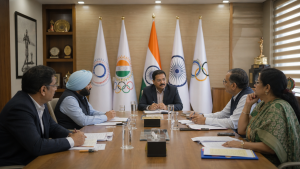
India’s sports governance works through a tripartite structure led by the Ministry of Youth Affairs and Sports, the Indian Olympic Association (IOA), the Sports Authority of India (SAI), and National Sports Federations (NSFs). Together, they handle administration, athlete support, international representation, and discipline-specific promotion.
For Prelims, the key areas are the legal status of each body, their mandates, and the newer statutory framework governing recognition, representation, and dispute resolution in Indian sport.
The Indian Olympic Association (IOA)
- Legal status: Established in 1927 under the Societies Registration Act, 1860, the IOA is recognised by the International Olympic Committee as India’s National Olympic Committee.
- Core role: It has the authority to select, prepare, and manage Indian contingents for the Olympic Games, Commonwealth Games, and Asian Games.
- Leadership: PT Usha is the President; Raghuram Iyer serves as the Chief Executive Officer.
- Significance: The IOA is the main interface between Indian athletes and international multi-sport events, making its recognition and governance structure important for exam questions.
Sports Authority of India (SAI)
- Legal status: SAI was formed in 1984 as an autonomous body under the Ministry of Youth Affairs and Sports.
- Core role: It functions as the apex national sports promotion body, supporting grassroots and elite sport development.
- Leadership: Hari Ranjan Rao holds dual charge as Sports Secretary and Director General of SAI, while Ram Singh serves as Secretary.
- Programmes: SAI administers initiatives such as the Target Olympic Podium Scheme and the Khelo India Programme.
- Support system: It also manages sports science and high-performance support centres across the country.
National Sports Federations (NSFs)
- Nature: NSFs are private, autonomous bodies recognised by the central government to promote and administer specific sports at the national level.
- Function: They are responsible for the organisation of their respective sports, including competitions, athlete selection processes, and development pathways.
- Recognition issue: Their recognition status is important because it affects funding, governance, and eligibility to function as the official national body for a sport.
- Judicial principle: The Delhi High Court held in All India Carrom Federation v. Union of India that an NSF cannot be treated as automatically de-recognised or suspended merely because annual recognition is not renewed.
- Due process: The Court said that formal suspension requires a positive act, supported by due process and a fair hearing.
- Relevant precedent: The ruling relied on the earlier precedent in Union of India v. Taekwondo Federation of India.
National Sports Governance Act, 2025
- Statutory framework: The Act, passed in August 2025 and partially implemented on December 31, 2025, replaces the National Sports Code of 2011.
- Purpose: It creates a legal framework for the recognition, regulation, and accountability of national sports bodies.
- National Sports Board: The Act provides for a National Sports Board to grant and renew recognition to sports federations.
- National Sports Tribunal: It also establishes a National Sports Tribunal with civil court powers to decide disputes relating to athlete selections and elections.
- RTI coverage: Sports governing bodies receiving government funding are brought under the Right to Information Act, 2005.
- Exam angle: The Act is important for understanding the shift from a largely code-based regime to a more formal statutory system.
National Sports Governance Rules, 2026
- Sportspersons of Outstanding Merit (SOMs): The rules require at least four SOMs in the General Bodies of all national sports bodies.
- Gender reservation: Half of these SOM positions are reserved for female SOMs.
- Executive committees: Recognised NSFs must include at least four women in their executive committees.
- Eligibility framework: The rules provide a ten-tier eligibility system for SOM designation.
- Basic conditions: Candidates must be at least 25 years old and retired from competitive sports for at least one year.
Ministry and Administrative Structure
- Apex ministry: The Ministry of Youth Affairs and Sports is the administrative authority supervising the sports governance ecosystem.
- Leadership: Mansukh Mandaviya is the Union Minister, and Raksha Khadse is the Minister of State.
- Institutional role: The Ministry coordinates with the IOA, SAI, and NSFs on policy, funding, recognition, and governance matters.
- Structure: In exam terms, the system combines a government ministry, an autonomous promotion body, a recognised Olympic committee, and sport-specific federations.
Key Prelims Takeaways
- IOA: It is a registered society under the Societies Registration Act, 1860 and recognised by the IOC as India’s National Olympic Committee.
- SAI: It is an autonomous body created in 1984 to promote sports and support athlete development.
- NSFs: They are autonomous bodies recognised by the central government for the administration of individual sports.
- New law: The National Sports Governance Act, 2025 replaces the National Sports Code of 2011.
- New institutions: The Act establishes the National Sports Board and the National Sports Tribunal.
- RTI linkage: Government-funded sports bodies are brought under the RTI Act, 2005.
- Representation rules: The 2026 Rules require four SOMs in general bodies and at least four women in NSF executive committees.
Current General Studies comprises current-affairs-based, General Studies-rich study material on policies, laws, institutions, economy, science, environment, governance, international relations, and other varied but important topics for UPSC and State PSC Prelims examinations.
Fortnightly PDF compilations: Available here
Originally written on
February 19, 2026
and last modified on
September 4, 2026.
| Related | |
|---|---|