Indian E-Governance and Digital Public Infrastructure
India’s e-governance model is built on Digital Public Infrastructure (DPI): open, interoperable platforms that connect identity, payments, documents, health records, and public services. Known globally as the India Stack, this ecosystem supports financial inclusion, paperless service delivery, and wider access across urban and rural India.
Core Pillars of Digital Public Infrastructure
The foundation of India’s digital transformation rests on scalable public platforms that serve millions of citizens through common standards and shared digital rails.
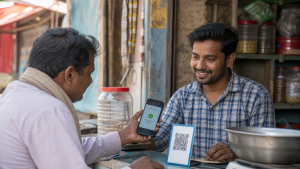
- Unified Payments Interface (UPI): UPI accounted for 85% of India’s total digital payment transactions by volume in FY 2025–26 and is accepted in 11 countries.
- DigiLocker: A paperless document exchange platform with more than 72.43 crore registered users and access to 5,437 document types as of July 31, 2026.
- UMANG: The Unified Mobile Application for New-age Governance provides a single platform for central and state services, hosting around 2,575 services for over 11.66 crore registered users as of July 31, 2026.
- Common Service Centres (CSCs): These provide physical-digital linkage in rural areas, with 4,07,122 functional CSCs at the Gram Panchayat level, including 70,069 operated by women Village Level Entrepreneurs (VLEs) as of June 30, 2026.
Healthcare, Commerce, and Language Platforms
India’s DPI extends beyond payments and identity into healthcare, e-commerce, and language technology, helping create sector-specific digital public systems.
- Ayushman Bharat Digital Mission (ABDM): Over 94.87 crore Ayushman Bharat Health Accounts (ABHAs) had been registered as of July 20, 2026.
- ABDM registries: The Health Facility Registry included 5.36 lakh registered facilities and the Healthcare Professionals Registry had 10.09 lakh professionals as of July 20, 2026.
- Health records linkage: More than 100 crore health records were digitally linked with ABHAs, creating a unified digital health architecture.
- Open Network for Digital Commerce (ONDC): An open-protocol e-commerce network that had onboarded over 900 network participants as of April 2026 and enabled more than 35 crore cumulative transactions by late 2025.
- BHASHINI: The Digital India BHASHINI Division migrated its language AI platform to Yotta’s sovereign Government Community Cloud and Shakti Cloud in February 2026, keeping datasets, models, and interactions within Indian jurisdiction.
Regulatory and Legal Frameworks
Digital governance also depends on laws and rules governing privacy, online safety, and the responsibilities of intermediaries and data handlers.
- DPDP Rules, 2025: The Digital Personal Data Protection (DPDP) Rules were notified by MeitY on November 13, 2025, starting a phased 18-month transition timeline.
- Data Protection Board of India: Established under Phase I on November 13, 2025, as the key enforcement body under the DPDP framework.
- Appellate authority: The Telecom Disputes Settlement and Appellate Tribunal (TDSAT) has been designated as the appellate authority under the DPDP Act.
- Compliance timeline: Registration for Consent Managers is scheduled to begin on November 13, 2026, while full compliance duties for data fiduciaries are slated to take effect on May 13, 2027.
- IT Rules, 2021: The Information Technology (Intermediary Guidelines and Digital Media Ethics Code) Rules, 2021, were last amended on October 22, 2025, to address synthetically generated information, deepfakes, and emerging cyberspace risks.
- Digital India Act: This remains a proposed cyber law intended to replace the Information Technology Act, 2000, and has not yet been enacted by Parliament.
Administrative and Institutional Features
MeitY is the nodal ministry for India’s electronic governance architecture and digital public platforms. It coordinates policy, institutional oversight, and implementation across key digital systems.
- MeitY leadership: The ministry is led by Cabinet Minister Shri Ashwini Vaishnaw, Minister of State Shri Jitin Prasada, and Secretary Shri S. Krishnan, IAS.
- Open ecosystem: India’s DPI works on interoperable and open standards, allowing services to be integrated across platforms and institutions.
- Public service delivery: The model combines digital identity, payments, documents, and sectoral platforms to reduce paperwork and improve access.
- Localization: Platforms such as BHASHINI support language access and help extend digital services to non-English-speaking users.
Key Prelims Takeaways
- India Stack: India’s digital governance model is built on open, interoperable Digital Public Infrastructure.
- UPI share: UPI accounted for 85% of India’s digital payment transactions by volume in FY 2025–26.
- DigiLocker scale: DigiLocker had 72.43 crore registered users and 5,437 document types as of July 31, 2026.
- UMANG services: UMANG hosted around 2,575 services for over 11.66 crore users as of July 31, 2026.
- ABDM identifiers: Over 94.87 crore ABHAs were created under the digital health mission as of July 20, 2026.
- DPDP authority: The Data Protection Board of India is the enforcement body, while TDSAT is the appellate authority.
- Proposed vs enacted law: The Digital India Act is still proposed, whereas the IT Rules, 2021, have been amended to address deepfakes and synthetically generated content.
| Related | |
|---|---|