India–ASEAN Political, Economic and Defence Cooperation
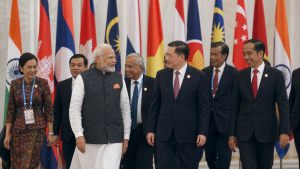
India’s engagement with ASEAN is a central pillar of its Act East Policy and a key element of its wider Indo-Pacific vision. The partnership covers political dialogue, trade and investment, and defence cooperation, with an emphasis on regional stability, connectivity, and a rules-based order.
Political and Institutional Framework
- Evolution of ties: India began as a Sectoral Dialogue Partner in 1992, became a Full Dialogue Partner in 1995, a Summit-level Partner in 2002, and a Strategic Partner in 2012. The relationship was elevated to a Comprehensive Strategic Partnership in November 2022.
- ASEAN grouping: ASEAN is a regional organisation of Southeast Asian countries, and its cooperation with India has expanded across political, economic, and socio-cultural areas.
- Plan of Action (2026–2030): Adopted in July 2025 to implement the Comprehensive Strategic Partnership, the plan began its first year of implementation in 2026. It aligns regional cooperation with the ASEAN 2045: Our Shared Future framework.
- Focus areas: The plan gives emphasis to peace, security, and digital public infrastructure, reflecting the growing importance of technology-enabled regional integration.
- Joint Cooperation Committee: The ASEAN-India Joint Cooperation Committee (AIJCC) oversees the implementation of the Plan of Action and coordinates functional cooperation across political, economic, and socio-cultural pillars.
Economic Relations and Trade Agreements
- Bilateral trade: India and ASEAN recorded bilateral trade of USD 128 billion in FY 2025-26. This accounts for about 11% of India’s total global trade.
- Trade importance: ASEAN remains one of India’s major trading partners, with trade links supported by free trade and investment frameworks.
- Trade deficit concern: India’s trade deficit with ASEAN rose from USD 9.66 billion in 2016-17 to USD 43.57 billion in 2022-23, prompting calls for an early review of the goods agreement.
- AITIGA: The ASEAN-India Trade in Goods Agreement was signed in 2009 and entered into force in January 2010. It remains the core legal framework for goods trade.
- Industry concerns: Indian domestic industries have raised concerns over asymmetric market access and non-tariff barriers under the existing arrangement.
- Services and investment agreements: The ASEAN-India Free Trade Area also includes the Agreement on Trade in Services and the Agreement on Investment, both of which came into force in 2015.
- Policy objective: These agreements aim to facilitate investment flows and ease the movement of professionals across the region.
AITIGA Modernization and Review
- Review process: India hosted the 13th Joint Committee meeting to review and modernize AITIGA from July 6 to 10, 2026, in New Delhi.
- Objective: The review seeks to make the agreement more user-friendly, simpler, and trade-facilitative for businesses.
- Co-chairs: The meeting was co-chaired by Nitin Kumar Yadav, Additional Secretary, Department of Commerce, India, and Ms. Mastura Ahmad Mustafa, Deputy Secretary General of Trade, Ministry of Investment, Trade and Industry, Malaysia.
- Negotiation areas: Discussions were held in three sub-committees: Customs Procedures and Trade Facilitation; National Treatment and Market Access; and Rules of Origin.
- Rules of origin: These discussions are important for preventing trade routing from third parties and for ensuring stricter checks in the agreement.
Defence and Maritime Cooperation
- Year of Maritime Cooperation: During the 22nd ASEAN-India Summit in Kuala Lumpur on October 26, 2025, India designated 2026 as the ASEAN-India Year of Maritime Cooperation.
- Maritime priorities: The initiative focuses on joint patrols, anti-piracy operations, and disaster management.
- Defence framework: Defence cooperation is anchored by mechanisms such as the ASEAN Defence Ministers’ Meeting Plus (ADMM-Plus).
- ASEAN-India Maritime Exercise: The second edition of the ASEAN-India Maritime Exercise (AIME 2026) was co-hosted by India and the Philippines. Its preparations were finalised in August 2026, with Subic, Zambales, selected as the venue.
- Full participation: AIME 2026 is the first iteration of the maritime exercise to include all 11 ASEAN member states.
- Defence proposals: At the Second India-ASEAN Defence Ministers’ Informal Meeting on October 31, 2025, in Kuala Lumpur, India proposed two initiatives: the ASEAN-India Initiative on Women in UN Peacekeeping Operations and the ASEAN-India Defence Think-Tank Interaction.
Key Prelims Takeaways
- India-ASEAN ties: Began as a Sectoral Dialogue Partnership in 1992 and were upgraded to a Comprehensive Strategic Partnership in November 2022.
- Plan of Action: The ASEAN-India Plan of Action (2026–2030) guides cooperation under the Comprehensive Strategic Partnership.
- Framework link: The plan aligns with ASEAN 2045: Our Shared Future.
- Trade volume: Bilateral trade reached USD 128 billion in FY 2025-26.
- Trade deficit: India’s ASEAN trade deficit increased from USD 9.66 billion in 2016-17 to USD 43.57 billion in 2022-23.
- AITIGA: Signed in 2009 and effective from January 2010; review discussions were held in New Delhi in July 2026.
- Maritime exercise: AIME 2026 will be held at Subic, Zambales, with participation from all 11 ASEAN member states.
Current General Studies comprises current-affairs-based, General Studies-rich study material on policies, laws, institutions, economy, science, environment, governance, international relations, and other varied but important topics for UPSC and State PSC Prelims examinations.
Fortnightly PDF compilations: Available here
Originally written on
February 19, 2026
and last modified on
September 4, 2026.
| Related | |
|---|---|