Marine Conservation and Fisheries Policies in India
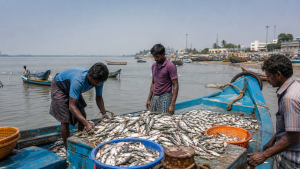
India’s fisheries sector is closely tied to coastal livelihoods, nutrition, exports and the blue economy. With a long coastline, a large Exclusive Economic Zone and growing marine production, policy focus now combines conservation, digital traceability, and support for fishing communities.
India’s Fisheries Sector Profile
| Parameter | Value / Metric | Reference Period |
| Global production rank | Second largest producer, around 8% of global output | FY 2024–25 |
| Total fish production | 197.75 lakh tonnes | FY 2024–25 |
| Growth since FY 2013–14 | 106% increase from 95.79 lakh tonnes | FY 2013–14 to FY 2024–25 |
| Share in agricultural GVA | 7.43% | FY 2024–25 |
| Seafood export value | ₹62,408 crore; frozen shrimp is the dominant item | FY 2024–25 |
| Top marine fishing state | Tamil Nadu overtook Gujarat | 2025 CMFRI report |
Legislative Framework and EEZ Fishing Rules
- Legal basis: The Ministry of Fisheries, Animal Husbandry and Dairying notified the Sustainable Harnessing of Fisheries in the Exclusive Economic Zone of India Rules, 2025 on November 4, 2025.
- Parent law: The rules were issued under the Territorial Waters, Continental Shelf, Exclusive Economic Zone and Other Maritime Zones Act, 1976.
- Access Pass requirement: Mechanized fishing vessels, motorized fishing vessels of 24 metres and above Overall Length (OAL), and pole-and-line fishing vessels must obtain an Access Pass.
- Digital portal: Applications for the Access Pass are to be made through the ReAlCraft portal.
- Conservation objective: The rules are designed to promote sustainable use of marine resources while regulating fishing activity in the EEZ.
- Fishing ban: A uniform 61-day ban was implemented for 2026 to support marine conservation.
- Ban period: East Coast: April 15 to June 14; West Coast: June 1 to July 31.
- Exemption: Traditional non-motorized fishing units remained exempt from the restrictions.
Digital Traceability and Infrastructure Frameworks
- Traceability framework: The Department of Fisheries unveiled the National Framework on Traceability in Fisheries and Aquaculture 2025 on November 21, 2025.
- Coverage: The framework aims to create a national digital traceability system across the fisheries and aquaculture value chain, from harvest to retail.
- Infrastructure support: Detailed SOPs were also released for basic infrastructure at marine fish landing centres, smart and integrated fishing harbours, and mariculture operations.
- Export relevance: These steps are intended to align Indian marine exports with international food safety and quality standards.
- Market access: The framework helps meet sanitary and phytosanitary requirements in major global markets.
National Schemes and Budgetary Support
- Budget support: The Union Budget 2026–27 proposed a record annual allocation of ₹2,761.80 crore for the fisheries sector.
- PMMSY allocation: Out of this, ₹2,530 crore was earmarked for the flagship Pradhan Mantri Matsya Sampada Yojana (PMMSY).
- Fiscal facilitation: The budget proposed duty-free treatment for fish caught by Indian vessels within the EEZ and on the high seas.
- Export treatment: Overseas landings by Indian vessels were proposed to be treated as exports.
- PM-MKSSY: The Pradhan Mantri Matsya Kisan Samridhi Sah Yojana (PM-MKSSY) is a Central Sector sub-scheme under PMMSY.
- Period: It is active from FY 2023–24 to FY 2026–27.
- Investment: The approved investment under PM-MKSSY is ₹6,000 crore.
- NFDP: The National Fisheries Digital Platform was launched on September 11, 2024, under PM-MKSSY.
- Purpose of NFDP: It works as a single-window system for digital registry and helps formalise the unorganised fisheries sector.
Marine Production and Biodiversity Initiatives
- Marine catch: According to the 2025 CMFRI report, India’s total marine catch reached 3.57 million tonnes.
- State position: Tamil Nadu emerged as the top marine fish-producing state, overtaking Gujarat.
- Ornamental fisheries: The strategic action plan Mission Rangeen Machhli 2031 was released to promote ornamental fisheries.
- Launch location: The plan was officially released at Agatti, Lakshadweep, on August 31, 2026.
- Blue economy link: Seaweed farming is being scaled up under the Blue Economy initiative.
- Livelihood aspect: Seaweed cultivation is being promoted as an alternative livelihood option for traditional fishing communities.
Key Prelims Takeaways
- Parent ministry: The fisheries sector is handled by the Ministry of Fisheries, Animal Husbandry and Dairying.
- EEZ rules: The 2025 EEZ rules require an Access Pass through the ReAlCraft portal for specified vessels.
- Fishing ban: A uniform 61-day ban was used in 2026, with different dates for the East and West Coasts.
- Traceability: The National Framework on Traceability in Fisheries and Aquaculture 2025 covers the full value chain.
- Budget allocation: Fisheries received ₹2,761.80 crore in the Union Budget 2026–27, with ₹2,530 crore for PMMSY.
- PM-MKSSY: The scheme runs from FY 2023–24 to FY 2026–27 with an approved investment of ₹6,000 crore.
- Top producer: India is the second-largest fish producer globally, with total production of 197.75 lakh tonnes in FY 2024–25.
Current General Studies comprises current-affairs-based, General Studies-rich study material on policies, laws, institutions, economy, science, environment, governance, international relations, and other varied but important topics for UPSC and State PSC Prelims examinations.
Fortnightly PDF compilations: Available here
Originally written on
January 11, 2026
and last modified on
September 4, 2026.
| Related | |
|---|---|