Disaster Management and Humanitarian Assistance Framework
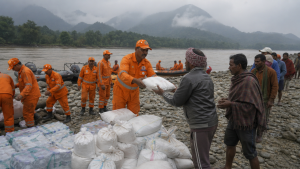
India’s disaster management system has moved from a relief-first model to one focused on prevention, preparedness, mitigation, and rapid response. The framework is anchored in the Disaster Management Act, 2005, which sets up institutions at the national, state, and district levels.
Evolution of India’s Disaster Management Architecture
The Disaster Management Act, 2005 created a three-tier structure to coordinate disaster response. At the national level, the National Disaster Management Authority (NDMA), chaired by the Prime Minister, functions as the apex body. At the state level, State Disaster Management Authorities (SDMAs) are headed by Chief Ministers, while District Disaster Management Authorities (DDMAs) handle local-level planning and response.
Financial planning has also been strengthened through dedicated disaster risk management funds. The 15th Finance Commission recommended allocations under the National Disaster Risk Management Fund (NDRMF) and State Disaster Risk Management Fund (SDRMF). These are structured on an 80:20 split, with 80% for response and 20% for mitigation.
Core Reforms under the 2025 Amendment Act
The Disaster Management (Amendment) Act, 2025 introduced structural changes to address operational gaps in the earlier framework.
- Plan-making powers: The responsibility for preparing national and state disaster management plans has been shifted from the National and State Executive Committees to the NDMA and SDMAs.
- Broader definition: The definition of “disaster management” now explicitly includes “disaster risk reduction”, placing greater emphasis on proactive mitigation.
- Man-made disasters: The law clarifies that man-made causes do not include matters related to law and order, reducing overlap with routine police administration.
Decentralization and Urban Disaster Governance
The 2025 amendment strengthens disaster governance at the urban level, especially for climate-sensitive cities.
- Urban Disaster Management Authorities (UDMAs): Under Section 41A, state governments may establish UDMAs for state capitals and cities with municipal corporations.
- Urban risk focus: These bodies are intended to handle localized threats such as urban flooding and heatwaves.
- Excluded regions: The provision does not apply to the National Capital Territory of Delhi and Chandigarh.
- First UDMA: Karnataka was the first state to implement a UDMA for the Bruhat Bengaluru Mahanagara Palike (BBMP).
Institutional and Command Structures
The amendment also gives statutory recognition to existing command structures and improves coordination across agencies.
- NCMC: The National Crisis Management Committee, chaired by the Cabinet Secretary, now has formal statutory recognition.
- HLC: The High-Level Committee, chaired by the Union Home Minister, is also formally recognised.
- SDRFs: State governments are authorized to establish and define the functions of their own State Disaster Response Forces, in line with the National Disaster Response Force (NDRF).
- National Disaster Database: The Act provides for a centralized, real-time database covering disaster risk assessments, mitigation plans, resource availability, fund allocations, and expenditure records.
Technology and Weather Forecasting: Mission Mausam
Technology has become central to disaster early warning, forecasting, and humanitarian assistance. Mission Mausam, launched on January 14, 2025, marks the 150th anniversary of the India Meteorological Department (IMD) and is a ₹2,000-crore central sector scheme under the Ministry of Earth Sciences.
- Objective: To upgrade weather modelling, meteorological observation networks, and disaster-alert systems.
- Use of AI/ML: The IMD is integrating artificial intelligence and machine learning tools for forecasting.
- Advance warnings: The scheme aims to provide seven-day advance predictions for cyclones and floods.
Key Prelims Takeaways
- NDMA: Chaired by the Prime Minister of India.
- SDMAs: Headed by Chief Ministers.
- DDMAs: Handle district-level disaster planning and response.
- Fund structure: NDRMF and SDRMF follow an 80:20 split between response and mitigation.
- Section 41A: Empowers states to create Urban Disaster Management Authorities for state capitals and municipal corporation cities.
- Exclusions: Delhi and Chandigarh are excluded from the UDMA provision.
- Mission Mausam: A ₹2,000-crore central sector scheme under the Ministry of Earth Sciences.
- AI-based forecasting: Mission Mausam uses AI/ML for improved cyclone and flood prediction.
| Related | |
|---|---|