Major Ancient Indian Universities and Learning Centres
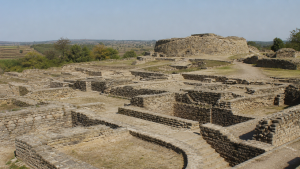
Ancient India developed a wide and decentralized network of higher learning centres that drew students from across Asia. These institutions taught both religious and secular subjects, and many became major centres of debate, translation, medicine, grammar, philosophy, and statecraft.
Takshashila: The Ancient Seat of Learning
Takshashila, in present-day Punjab, Pakistan, was one of the earliest and most celebrated centres of higher learning in ancient India. It flourished roughly from the 6th century BCE to the 5th century CE and stood at an intellectual crossroads linking India, Central Asia, and the Hellenistic world.
- Subjects taught: Vedas, grammar, philosophy, medicine, warfare, astronomy, and statecraft.
- Associated figures: Chanakya, Chandragupta Maurya, Panini, and Charaka are linked with this centre in historical tradition.
- Historical importance: It was known for attracting scholars and students from distant regions for advanced learning.
- World heritage recognition: The site was designated a UNESCO World Heritage Site in 1980.
Nalanda: The Premier Residential University
Nalanda, in present-day Bihar, was founded in the 5th century CE by Emperor Kumaragupta I of the Gupta dynasty. It is regarded as one of the world’s earliest large-scale residential universities and remained a leading centre of Buddhist and interdisciplinary learning for centuries.
- Residential system: It housed thousands of students and teachers and provided free education, boarding, and lodging.
- Funding: Support came from royal endowments and revenue from surrounding villages.
- Library complex: The famous Dharma Ganj library consisted of Ratnasagara, Ratnadadhi, and Ratnaranjaka.
- Visitors: Chinese Buddhist monks Xuanzang and Yijing studied and recorded details of the institution in the 7th century CE.
- Destruction: Nalanda was destroyed in the late 12th century CE during military invasions led by Bakhtiyar Khilji, a commander of the Ghurid forces.
Nalanda is remembered not only for Buddhist studies but also for its large residential system, rich library, and international scholarly reputation.
Monastic Universities of the Pala Dynasty
The Pala rulers of Bengal and Bihar were major patrons of Buddhist education. Their support led to the rise of several mahaviharas, which became important centres of monastic scholarship and attracted students from abroad.
- Vikramashila: Founded in the 8th century CE by King Dharmapala of the Pala dynasty in modern-day Bhagalpur, Bihar.
- Specialization: It was known for Vajrayana Buddhism, logic, and grammar.
- Odantapuri: Founded by King Gopala I of the Pala dynasty in the 8th century CE in Bihar.
- Odantapuri’s role: It was a major Buddhist monastic university that hosted thousands of monks until its destruction in the late 12th century CE.
- Somapura Mahavihara: Founded by King Dharmapala in the late 8th century CE in modern-day Bangladesh.
- Academic character: It functioned as a major centre of Buddhist and multi-religious education.
Valabhi and Sharada Peeth: Western and Northern Hubs
Beyond the eastern heartland, other regions also developed influential centres of higher learning. Valabhi in the west and Sharada Peeth in Kashmir became important for secular administration, Sanskrit scholarship, and religious philosophy.
- Valabhi University: Situated in modern-day Saurashtra, Gujarat, and established in the 6th century CE under the Maitraka dynasty.
- Valabhi’s focus: Hinayana Buddhism, law, economics, and public administration.
- Administrative role: It was known for producing officers for regional kingdoms and western Indian courts.
- Sharada Peeth: Located in Kashmir, it functioned as a temple-university and a centre of Sanskrit scholarship.
- Sharada Peeth’s significance: It was important for manuscript preservation and the development of the Sharada script.
- Religious associations: It was revered as a centre of Kashmiri Shaivism and Shaktism.
Comparative Summary of Key Centres
| University | Modern Location | Founder/Patron | Main Feature |
| Takshashila | Punjab, Pakistan | Multiple regional rulers | Secular learning, medicine, grammar |
| Nalanda | Bihar, India | Kumaragupta I | Mahayana Buddhism, multi-disciplinary studies |
| Vikramashila | Bihar, India | Dharmapala | Vajrayana Buddhism, Tantra, logic |
| Valabhi | Gujarat, India | Maitraka dynasty | Hinayana Buddhism, administration |
| Odantapuri | Bihar, India | Gopala I | Buddhist monastic studies |
| Somapura | Naogaon, Bangladesh | Dharmapala | Buddhist and multi-religious learning |
| Sharada Peeth | Azad Kashmir, Pakistan | Local Kashmiri rulers | Sanskrit, Sharada script, Shaivism |
Key Prelims Takeaways
- Takshashila: One of the earliest centres of higher learning in ancient India, known for secular and scientific subjects.
- Nalanda: A large residential university supported by royal patronage and village revenue.
- Dharma Ganj: The famous Nalanda library complex had three buildings: Ratnasagara, Ratnadadhi, and Ratnaranjaka.
- Pala patronage: Vikramashila, Odantapuri, and Somapura were linked to the Pala dynasty’s support for Buddhist learning.
- Valabhi: Known for law, economics, and public administration, apart from Buddhist studies.
- Sharada Peeth: Important for Sanskrit scholarship, manuscript preservation, and the Sharada script.
- UNESCO sites: Takshashila and the ruins of Nalanda Mahavihara are UNESCO World Heritage Sites.
| Related | |
|---|---|