India’s Renewable Energy Targets and Schemes
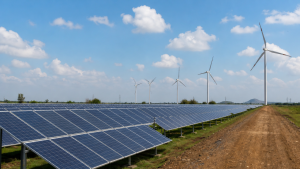
India is expanding its non-fossil fuel power base through a mix of central schemes, manufacturing incentives and policy support. The focus is on adding clean electricity capacity, improving energy access and meeting climate commitments.
Institutional Framework and Budgetary Allocations
- MNRE leadership: The Ministry of New and Renewable Energy (MNRE) is led by Union Cabinet Minister Pralhad Joshi, with Minister of State Shripad Yesso Naik and Secretary Santosh Kumar Sarangi.
- Budget support: In the Union Budget 2026–27, MNRE received ₹44,614.67 crore, marking a 40.52% increase over the previous year’s budget estimates.
- Power policy update: The Ministry of Power released the Draft National Electricity Policy (NEP) 2026 for stakeholder consultation.
- Long-term goal: The draft policy is aligned with Viksit Bharat @2047 and the target of 2,000 kWh per capita electricity consumption by 2030.
Installed Capacity and National Targets
India’s total installed power capacity stood at about 552 GW, while installed non-fossil fuel capacity crossed 300 GW to reach 300.50 GW as of July 31, 2026. Non-fossil sources now account for more than 54% of the country’s total electricity generation capacity.
| Source | Installed Capacity (GW) |
| Solar Power | 164.59 |
| Wind Power | 58.14 |
| Hydroelectric Power | 57.24 |
| Bio-power | 11.75 |
| Nuclear Power | 8.78 |
| Total Non-Fossil Capacity | 300.50 |
- Paris Agreement target achieved: India met its Nationally Determined Contribution (NDC) target of securing 50% cumulative electric power capacity from non-fossil sources in June 2025, five years ahead of the 2030 deadline.
- 2030 target: The domestic aim is to scale installed non-fossil fuel electricity capacity to 500 GW by 2030.
- Global rank: India ranks third globally in cumulative renewable energy installed capacity, behind China and the United States.
- Annual addition: A record 55.29 GW of non-fossil fuel capacity was added during financial year 2025–26, led by 44.6 GW of solar and 6 GW of wind power.
Solar Manufacturing and Rooftop Initiatives
- PM Surya Ghar: Launched in February 2024, the scheme provides a central subsidy of up to ₹78,000 for residential rooftop solar systems.
- Household coverage: More than 51.58 lakh households had benefited under the scheme as of August 12, 2026.
- Future plan: The government is planning a successor scheme for residential solar and is considering extending the PM Surya Ghar deadline by three to four months from its original target of March 2027.
- Solar manufacturing: Driven by the Production-Linked Incentive (PLI) scheme, India’s solar PV module manufacturing capacity reached about 233 GW by June 2026.
- Utilisation gap: Operational utilisation remains at 35% to 40% because of upstream cell and ingot-wafer supply imbalances.
- Polysilicon push: MNRE is drafting a new PLI scheme for domestic polysilicon manufacturing to support capacity exceeding 10 GW.
Agricultural Solarisation and Hydro Schemes
- PM-KUSUM extension: The completion deadline for eligible projects with signed Power Purchase Agreements (PPAs) or Notices to Proceed (NTP) on or before December 31, 2025, has been extended to March 31, 2027.
- PM-KUSUM 2.0: Committed financial liabilities of the existing scheme will be subsumed under a new PM KUSUM 2.0 framework, which is under development.
- Small Hydro Power scheme: The Union Government approved the Small Hydro Power (SHP) Development Scheme for 2026–31 with an outlay of ₹2,584.60 crore.
- Capacity support: The scheme is expected to support around 1,500 MW of capacity.
Green Hydrogen and Alternative Fuels
- National Green Hydrogen Mission: Approved in January 2023 with an outlay of ₹19,744 crore through 2029–30.
- Production target: The mission aims to establish annual green hydrogen production capacity of at least 5 Million Metric Tonnes (MMT) by 2030.
- Current capacity: About 8,000 tonnes per annum of green hydrogen production capacity was commissioned in India by February 2026.
- Hydrogen mobility: In July 2026, the government initiated 12 pilot projects supporting 70 hydrogen-powered vehicles across 21 routes.
- SAF mandate: India has proposed a 1% sustainable aviation fuel (SAF) blending mandate on international flights departing from the country starting in 2027, rising to 2% in 2028.
- Coal gasification support: A ₹37,500 crore financial scheme was approved in May 2026 to incentivise surface coal and lignite gasification.
- Gasification target: The scheme aims to reach 100 Million Tonnes (MT) of gasification by 2030.
Key Prelims Takeaways
- Non-fossil capacity: India crossed 300 GW of installed non-fossil fuel capacity by July 31, 2026.
- Share in total capacity: Non-fossil sources now make up more than 54% of total installed power capacity.
- NDC milestone: India achieved the 50% non-fossil power capacity target in June 2025, ahead of schedule.
- 2030 ambition: The country aims to reach 500 GW of non-fossil fuel electricity capacity by 2030.
- Rooftop solar support: PM Surya Ghar offers a central subsidy of up to ₹78,000 for residential rooftop solar.
- Green hydrogen: The National Green Hydrogen Mission targets at least 5 MMT annual production capacity by 2030.
- PM-KUSUM and SHP: PM-KUSUM project deadlines have been extended to March 31, 2027, and the SHP Development Scheme for 2026–31 has an outlay of ₹2,584.60 crore.
Current General Studies comprises current-affairs-based, General Studies-rich study material on policies, laws, institutions, economy, science, environment, governance, international relations, and other varied but important topics for UPSC and State PSC Prelims examinations.
Fortnightly PDF compilations: Available here
Originally written on
January 6, 2026
and last modified on
September 4, 2026.
| Related | |
|---|---|