G20: Structure, Membership, Functions and Major Outcomes
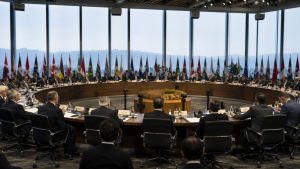
The G20 is an informal intergovernmental forum that brings together the world’s major developed and developing economies. It is used to coordinate global economic policy, strengthen financial stability, and support sustainable growth.
Unlike a treaty-based organisation, the G20 has no permanent secretariat. Its work is driven by a rotating presidency, two parallel tracks, and year-round negotiations among members.
Evolution and Membership Structure
- Establishment: The G20 was created in 1999 after the Asian financial crisis as a forum for finance ministers and central bank governors. It was elevated to the level of heads of state and government in 2008 during the global financial crisis.
- Permanent membership: The forum has 21 permanent members: 19 sovereign countries, the European Union and the African Union. The African Union became a permanent member at the 2023 New Delhi Summit.
- Geographic spread: The membership reflects broad regional representation. North America is represented by the United States, Canada and Mexico; South America by Brazil and Argentina; Europe by Germany, France, Italy, the United Kingdom and the European Union; Asia-Pacific by China, Japan, India, South Korea, Australia and Indonesia; the Middle East by Saudi Arabia and Turkey; and Africa by South Africa and the African Union.
- Russia: Russia remains one of the 19 sovereign members and is counted among the Eurasian representatives in the forum.
- No permanent secretariat: The G20 functions without a standing secretariat or permanent staff. Administrative and agenda-setting responsibilities are handled by the annual presidency.
- Rotating presidency: The host country presides over meetings, coordinates the agenda, and manages the annual work programme.
- Troika system: Continuity is maintained through a Troika made up of the immediate past, current and incoming presidencies. For the 2026 cycle, the Troika consists of South Africa, the United States and the United Kingdom.
- Disruption in continuity: In 2026, the usual Troika continuity faced disruption when the U.S. presidency excluded the South African government from participation in G20 meetings.
Operational Framework and Working Tracks
- Sherpa Track: This track deals with non-financial issues such as trade, energy, employment, health, agriculture, anti-corruption and innovation.
- Sherpas: Sherpas are the personal representatives of heads of state or government. They negotiate priorities, prepare drafts and guide discussions throughout the year.
- Finance Track: This track focuses on macroeconomic stability, monetary policy, fiscal coordination, international financial architecture and global tax cooperation.
- Finance ministers and central bank governors: They lead the Finance Track and discuss financial regulation and economic coordination.
- Finance deputies: Senior officials from finance ministries and central banks prepare technical work for the Finance Track meetings.
- International organisations: The G20 process involves bodies such as the UN, IMF, World Bank, WTO, Financial Stability Board and the ILO.
- Core role: The forum functions as a platform for policy coordination rather than as a decision-making body with binding legal powers.
Policy Shifts: South Africa 2025 and United States 2026
- South African presidency (2025): Under the theme Solidarity, Equality, Sustainability, South Africa focused on biodiversity, land degradation, climate adaptation and inclusive global growth.
- Johannesburg Declaration: The 2025 presidency concluded on November 22, 2025, with the adoption of the G20 Johannesburg Leaders’ Declaration.
- Key commitments: The declaration referred to faster preparation of infrastructure projects, global debt relief and support for African developmental projects.
- U.S. presidency (2026): The U.S. presidency, running from December 1, 2025, to November 30, 2026, narrowed the agenda and reorganised work into four specialised groups.
- U.S. working groups: The four categories are Trade, Growth and Deregulation, Innovation, and Energy Abundance.
- Policy direction: This marked a shift away from the broader environmental and development emphasis seen under the 2025 presidency.
Key Prelims Takeaways
- Membership: The G20 has 21 permanent members: 19 countries, the European Union and the African Union.
- Origin: It was formed in 1999 after the Asian financial crisis and upgraded to leaders’ level in 2008.
- Secretariat: There is no permanent secretariat; the rotating presidency handles coordination and logistics.
- Troika: Agenda continuity is maintained by the past, present and incoming presidencies.
- Two tracks: The G20 works through the Sherpa Track and the Finance Track.
- 2026 U.S. focus: The main working groups are Trade, Growth and Deregulation, Innovation, and Energy Abundance.
- AU entry: The African Union was admitted as a permanent member in 2023.
Exam fact: The G20 is an informal forum, not a treaty-based organisation, and its decisions are not legally binding.
Current General Studies comprises current-affairs-based, General Studies-rich study material on policies, laws, institutions, economy, science, environment, governance, international relations, and other varied but important topics for UPSC and State PSC Prelims examinations.
Fortnightly PDF compilations: Available here
Originally written on
April 1, 2026
and last modified on
September 5, 2026.
| Related | |
|---|---|