DRDO: Major Establishments, Laboratories and Their Key Projects
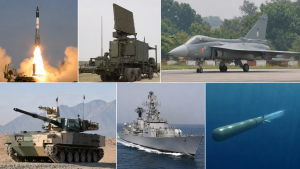
Defence Research and Development Organisation (DRDO) is India’s premier agency for defence research, design and development. It works under the Ministry of Defence to build indigenous military technologies, strategic systems and critical sensors for the armed forces.
For Prelims revision, the most useful DRDO points are its major laboratory network, their technology clusters, and a few flagship projects that often appear in exam questions.
Organizational Framework and Funding
- Parent ministry: DRDO functions under the Department of Defence Research and Development in the Ministry of Defence, Government of India.
- Lab network: It manages 52 specialized laboratories grouped into technology clusters such as Aeronautical Systems, Armaments & Combat Engineering, and Missiles & Strategic Systems.
- Leadership: Defence Secretary Rajesh Kumar Singh holds additional charge as Chairman of DRDO and Secretary of the Department of Defence Research and Development, following the retirement of Dr. Samir V. Kamat.
- Budget 2025–26: The approved DRDO budget is ₹26,816.82 crore.
- Use of funds: The allocation supports basic research, technology demonstration projects, and grants under the Technology Development Fund (TDF).
Major Missile and Strategic System Laboratories
- Research Centre Imarat (RCI), Hyderabad: Works on advanced avionics, high-precision seekers, navigation assemblies, and control systems for air-defence and tactical missile platforms.
- Advanced Systems Laboratory (ASL), Hyderabad: Specialises in solid propellant rocket motors, advanced composite materials, and strategic long-range missile systems such as the Agni series.
- Defence Research and Development Laboratory (DRDL), Hyderabad: Leads work on liquid and solid propulsion technologies, airframe integration, structural dynamics, and complete missile weapon system design.
Aeronautical and Land Combat System Laboratories
- Aeronautical Development Establishment (ADE), Bengaluru: Focuses on unmanned aerial vehicles (UAVs), digital flight control systems, flight simulators, and pilotless target aircraft.
- Gas Turbine Research Establishment (GTRE), Bengaluru: Develops aero-gas turbine engines and marine gas turbines; it is also associated with the technical challenges of the Kaveri engine programme for combat aircraft.
- Combat Vehicles Research & Development Establishment (CVRDE), Avadi: Works on tracked combat vehicles, main battle tanks like the MBT Arjun, and specialised armoured recovery vehicles.
Naval Systems Laboratories
- Naval Physical & Oceanographic Laboratory (NPOL), Kochi: Specialises in underwater acoustics, oceanographic data collection, sonar systems, and underwater oceanographic sensors.
- Naval Science & Technological Laboratory (NSTL), Visakhapatnam: Focuses on underwater weapons, including heavy-weight and light-weight torpedoes, underwater decoy systems, and naval mines.
Key Projects and Technologies
- Project Kusha: An indigenous extended range air defence system being developed as a long-range surface-to-air missile (LR-SAM) platform.
- Interceptor tiers: The system is designed with three interceptors — M1 (150 km), M2 (250 km) and M3 (350 km) — to counter cruise missiles, stealth fighters and other complex aerial threats.
- Mission Divyastra: DRDO’s programme to validate Multiple Independently Targetable Re-entry Vehicle (MIRV) technology on the indigenous Agni-5 ballistic missile.
- MIRV significance: It enables a single missile to carry multiple warheads capable of targeting separate locations.
- SHIELD programme: The S-band High-Power Microwave Integrated Evaluation System for Lethality and Damage is linked to the Technology Development Fund (TDF) scheme and uses Gallium Nitride-based Solid State Power Amplifier technology.
- Purpose of SHIELD: It is meant to assess the vulnerability of military electronics to directed-energy weapons.
- TAPAS-BH-201 (Rustom-II): A medium-altitude long-endurance (MALE) UAV developed by ADE.
- Technology transfer: After mission-mode closure in January 2024 due to not fully meeting Joint Services Qualitative Requirements (JSQRs) for altitude and endurance, DRDO shifted in May 2026 to transferring key subsystem technologies to private industry.
Exam focus: Hyderabad is the key hub for missile laboratories, Bengaluru for aeronautical systems, and Kerala/Visakhapatnam for naval systems.
Key Prelims Takeaways
- DRDO network: It has 52 laboratories across India, organised into functional technology clusters.
- Missile labs in Hyderabad: RCI, ASL and DRDL are the main establishments for strategic missile development.
- Aeronautical hubs: ADE and GTRE are important Bengaluru-based laboratories linked to UAVs and engine development.
- Naval systems: NPOL and NSTL are the main DRDO labs for underwater acoustics, sonar and torpedo-related work.
- Project Kusha ranges: The three interceptors are planned for 150 km, 250 km and 350 km ranges.
- Mission Divyastra: It validates MIRV capability on Agni-5.
- TAPAS and SHIELD: TAPAS-BH-201 is linked to UAV technology transfer, while SHIELD is aimed at testing vulnerability to high-power microwave threats.
Current General Studies comprises current-affairs-based, General Studies-rich study material on policies, laws, institutions, economy, science, environment, governance, international relations, and other varied but important topics for UPSC and State PSC Prelims examinations.
Fortnightly PDF compilations: Available here
Originally written on
March 30, 2026
and last modified on
September 5, 2026.
| Related | |
|---|---|