India–ASEAN Relations: Key Dialogues, Agreements and Strategic Partnerships
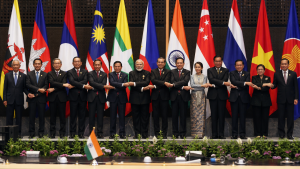
India’s ties with ASEAN are a central pillar of the Act East Policy and its wider Indo-Pacific engagement. The relationship covers political dialogue, trade, maritime security, connectivity, and people-to-people cooperation, making ASEAN one of India’s most important regional partners.
Institutional Evolution
- 1992: India became an ASEAN Sectoral Dialogue Partner.
- 1995: The partnership was upgraded to a Full Dialogue Partner.
- 2002: The relationship was elevated to a Summit-level Partnership.
- 2012: India and ASEAN announced a Strategic Partnership during the Commemorative Summit in New Delhi.
- 2022: On completion of 30 years of formal relations, ties were upgraded to a Comprehensive Strategic Partnership.
- The relationship is currently guided by the Plan of Action to Implement the ASEAN-India Comprehensive Strategic Partnership for 2026–2030.
Major ASEAN-Led Dialogues
- East Asia Summit (EAS): India participates in this key strategic forum for regional and security dialogue.
- ASEAN Regional Forum (ARF): India is part of this important platform for political and security cooperation.
- ADMM-Plus: India engages with ASEAN through the ASEAN Defence Ministers’ Meeting Plus mechanism for defence and security coordination.
- These forums provide India with institutional channels to discuss maritime security, regional stability, and strategic issues in the Indo-Pacific.
Trade and Economic Agreements
- The ASEAN–India Trade in Goods Agreement (AITIGA) was signed in Bangkok on 13 August 2009 and came into force on 1 January 2010.
- The agreement is being modernized through a comprehensive review covering customs procedures, trade facilitation, national treatment, market access, and rules of origin.
- Sub-committees continue negotiations to address trade imbalances and non-tariff barriers.
- India and ASEAN missed the target deadline of December 2025 to conclude the review, and the talks remain active.
- Bilateral trade between India and ASEAN reached USD 128 billion in the 2025–26 fiscal year, accounting for around 11% of India’s overall global trade.
Security and Connectivity Cooperation
- 2026 has been designated as the ASEAN-India Year of Maritime Cooperation.
- Thematic activities include the ASEAN-India Conference on Blue Economy, the ASEAN-India Maritime Exercise, the East Asia Summit Conference on Maritime Security Cooperation, and the East Asia Summit Maritime Heritage Festival.
- Maritime cooperation reflects the growing focus on naval coordination, marine resources, and the security of sea lanes.
- Connectivity remains a major priority through projects such as the India-Myanmar-Thailand Trilateral Highway and the Kaladan Multi-Modal Transit Transport Project.
- Security cooperation is also supported through joint training and institutional exchanges under ASEAN-led mechanisms.
Diplomatic Architecture
- India maintains a dedicated diplomatic mission to ASEAN in Jakarta, which handles multi-sectoral engagement with the bloc.
- The Resident Ambassador of India to ASEAN is Srinivas Gotru, who assumed office on 6 August 2025.
- The annual ASEAN-India Summit is the highest-level dialogue mechanism in the relationship.
- The 22nd ASEAN-India Summit was held on 26 October 2025, with Prime Minister Narendra Modi participating virtually.
- The Philippines serves as the ASEAN Chair for 2026.
Key Prelims Takeaways
- ASEAN formation: The group was established on 8 August 1967 through the Bangkok Declaration.
- Member states: ASEAN has 10 members — Brunei, Cambodia, Indonesia, Laos, Malaysia, Myanmar, Philippines, Singapore, Thailand, and Vietnam.
- India’s status: India became a Sectoral Dialogue Partner in 1992 and a Full Dialogue Partner in 1995.
- Strategic upgrade: The partnership became a Strategic Partnership in 2012 and a Comprehensive Strategic Partnership in 2022.
- Trade agreement: AITIGA was signed on 13 August 2009 and implemented on 1 January 2010.
- Trade volume: India–ASEAN trade stood at USD 128 billion in 2025–26, or about 11% of India’s global trade.
- Maritime focus: 2026 has been designated as the ASEAN-India Year of Maritime Cooperation.
Current General Studies comprises current-affairs-based, General Studies-rich study material on policies, laws, institutions, economy, science, environment, governance, international relations, and other varied but important topics for UPSC and State PSC Prelims examinations.
Fortnightly PDF compilations: Available here
Originally written on
March 30, 2026
and last modified on
September 5, 2026.
| Related | |
|---|---|