Major Rural Electrification Schemes in India
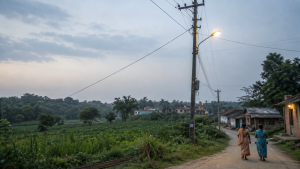
Rural electrification is a key driver of India’s socio-economic development and rural infrastructure growth. Over time, policy focus has shifted from village-level electrification to universal household connectivity through central schemes, feeder separation, and targeted support for left-out and vulnerable households.
Constitutional Provisions and Village Electrification Criteria
Electricity is a shared Centre-State subject, so rural electrification is implemented through coordinated policy and funding. The rules for declaring a village electrified were also formalised to create a uniform benchmark for coverage.
- Constitutional status: Electricity is in the Concurrent List of the Seventh Schedule, making rural electrification a joint responsibility of the Centre and the States.
- Rural Electrification Policy, 2006: This policy laid down the criteria for declaring a village electrified in India.
- Basic infrastructure: A village must have distribution transformers and distribution lines in the inhabited locality, including Dalit hamlets.
- Public institutions: Schools, panchayat offices, health centres, dispensaries, and community centres must have electricity connections.
- Household threshold: At least 10% of the total households in the village must have electricity connections.
Deen Dayal Upadhyaya Gram Jyoti Yojana
Launched in December 2014, DDUGJY was designed to address structural weaknesses in rural distribution networks and move beyond mere village electrification.
- Main objectives: The scheme aimed to electrify inhabited unelectrified census villages, strengthen rural sub-transmission and distribution systems, and separate agricultural and non-agricultural feeders to improve supply quality.
- Subsumed scheme: DDUGJY subsumed the Rajiv Gandhi Grameen Vidyutikaran Yojana (RGGVY), launched in 2005.
- Village electrification milestone: All 18,374 inhabited unelectrified census villages in India were electrified by 28 April 2018.
- Closure: The scheme closed on 31 March 2022.
- Financials: Actual expenditure stood at ₹64,495 crore, including ₹45,025 crore as central budgetary support, against an approved outlay of ₹75,893 crore.
- CAG audit: A Comptroller and Auditor General performance audit presented in December 2025 reported that 82% of projects faced delays in award and 92% in completion, while the target to reduce distribution losses was missed in 13 of 26 states and Union Territories.
Pradhan Mantri Sahaj Bijli Har Ghar Yojana
SAUBHAGYA marked the shift from village electrification to direct household connectivity. It aimed to ensure that willing households, including those in remote areas, were not left out of the grid.
- Launch and nodal agency: SAUBHAGYA was launched in October 2017, with REC Limited as the nodal agency.
- Objective: The scheme aimed at universal household electrification through last-mile connectivity in rural and urban areas.
- Coverage: Free electricity connections were provided to poor households.
- Other households: Non-poor households could obtain connections by paying ₹500 in ten instalments.
- Outcome: The scheme closed on 31 March 2022 after electrifying 2.86 crore households.
- Financials: Total expenditure was ₹9,246 crore, including ₹5,782 crore in central budgetary support.
Revamped Distribution Sector Scheme and Targeted Electrification
After SAUBHAGYA, the focus moved to left-out households and hard-to-electrify areas, especially among vulnerable communities. The current approach combines on-grid expansion with off-grid solar support where grid reach is difficult.
- RDSS period: The Revamped Distribution Sector Scheme is running from FY 2021-22 to FY 2025-26.
- Outlay: The scheme has an outlay of ₹3,03,758 crore.
- Purpose: RDSS supports states in electrifying left-out households that existed before 31 March 2019 but were missed during SAUBHAGYA.
- Sanctioned works: On-grid electrification works worth ₹6,521 crore have been sanctioned for 13.65 lakh households.
- Beneficiary groups: These include Particularly Vulnerable Tribal Group (PVTG) families under PM-JANMAN, Scheduled Tribes under Dharti Aaba Janjatiya Gram Utkarsh Abhiyan (DA-JGUA), and Scheduled Castes under PM-AJAY.
- PM-JANMAN solar scheme: Running from FY 2023-24 to FY 2025-26, this ₹515 crore scheme provides solar off-grid systems to 1 lakh unelectrified PVTG households where grid expansion is not feasible.
- Off-grid progress: As of 30 June 2026, 11,838 households had been electrified under the PM-JANMAN solar scheme, with ₹57.10 crore in Central Financial Assistance released.
Scheme Linkages and Policy Evolution
India’s rural electrification policy has evolved in stages: from village infrastructure creation to feeder separation, then universal household connections, and now targeted coverage for left-out households and remote tribal settlements.
- From villages to households: The policy focus shifted from electrifying inhabited villages to ensuring every willing household gets a connection.
- Infrastructure strengthening: DDUGJY addressed supply-side weaknesses by improving rural networks and feeder management.
- Universal access: SAUBHAGYA focused on last-mile connectivity and household-level inclusion.
- Targeted gap-filling: RDSS now addresses households missed earlier, especially in vulnerable and underserved communities.
- Off-grid option: PM-JANMAN supplements grid electrification where extension of the network is not practical.
Key Prelims Takeaways
- Concurrent List: Electricity falls under the Concurrent List, so both Centre and States are responsible for rural electrification.
- Village electrification norm: Under the 2006 policy, a village is electrified only when infrastructure, public institution supply, and at least 10% household connections are in place.
- DDUGJY: Launched in December 2014, it focused on rural distribution strengthening and feeder separation.
- RGGVY linkage: DDUGJY subsumed the earlier Rajiv Gandhi Grameen Vidyutikaran Yojana.
- SAUBHAGYA: Launched in October 2017, it was designed for universal household electrification and used REC Limited as nodal agency.
- RDSS: This scheme now handles left-out household electrification after SAUBHAGYA.
- PM-JANMAN: It provides solar off-grid systems for un-electrified PVTG households where grid connectivity is not feasible.
| Related | |
|---|---|