Parliamentary and Presidential Systems Compared
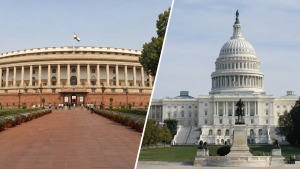
Democratic constitutions generally adopt either a parliamentary or a presidential system to structure the relationship between the executive and the legislature. The key distinction is whether the executive is drawn from the legislature and accountable to it, or whether it functions independently with a separate constitutional mandate.
These two models shape cabinet responsibility, tenure of the government, dissolution powers, and the overall balance between stability and responsiveness in governance.
Core Features of the Parliamentary System
In a parliamentary system, the executive is closely linked with the legislature and remains responsible to it. This model is followed in India, the United Kingdom, Germany, and Canada.
- Dual executive: There are two heads. The Head of State, such as a monarch or president, has nominal authority, while the Head of Government, usually the Prime Minister, exercises real executive power.
- Collective responsibility: Ministers are collectively responsible to the lower house. In India, Article 75(3) provides that the Council of Ministers is collectively responsible to the Lok Sabha.
- Legislative accountability: The Prime Minister and the cabinet are drawn from the legislature and can be removed if they lose majority support, including through a vote of no confidence.
- Fusion of powers: The executive and legislature are not rigidly separated; they function in a coordinated manner.
- Dissolution of the lower house: The executive can recommend dissolution of the lower house before the end of its term, leading to fresh elections.
- Cabinet government: Real authority lies with the cabinet as a collective body, which acts through legislative confidence.
Core Features of the Presidential System
The presidential system rests on a strict separation of powers, where the executive, legislature, and judiciary function independently. The United States, Brazil, and Argentina are key examples.
- Single executive: The President serves as both Head of State and Head of Government.
- Fixed constitutional term: The President is elected directly or through an electoral college for a fixed term and cannot be removed by the legislature except through impeachment.
- Separate executive membership: Cabinet members are appointed by the President and generally cannot be members of the legislature.
- Independent mandate: The executive does not depend on legislative confidence for survival in office.
- Checks and balances: The President may veto bills, while the legislature controls the budget, can override vetoes, and approves major appointments and treaties.
- No dissolution power: The President cannot dissolve the legislature.
Key Operational Differences
| Feature | Parliamentary System | Presidential System |
| Executive structure | Dual executive: nominal and real heads | Single executive: both Head of State and Government |
| Accountability | Executive accountable to the legislature | Executive independent of the legislature |
| Cabinet membership | Ministers are usually members of the legislature | Ministers are not members of the legislature |
| Tenure | Not fixed; depends on majority support | Fixed constitutional term |
| Dissolution of legislature | Lower house can be dissolved | Executive cannot dissolve the legislature |
| Power dynamic | Fusion of legislative and executive powers | Strict separation of legislative and executive powers |
Stability, Representation, and Hybrid Models
Many countries modify these basic models to suit local political conditions and to reduce deadlock or concentration of power.
- Stability: Presidential systems generally offer executive stability because the President has a fixed term.
- Risk of gridlock: A strong separation of powers may lead to deadlock if the executive and legislature are controlled by different political forces.
- Responsiveness: Parliamentary systems are more responsive to shifting legislative majorities and political coalitions.
- Government flexibility: A parliamentary government can be replaced without waiting for the full term to end.
- Coalition instability: Parliamentary systems may face instability when no single party has a clear majority.
- Semi-presidential model: This system combines a popularly elected President with a Prime Minister and cabinet responsible to the legislature, as in France.
- Modified constitutional design: Some states mix elements of both systems to balance executive strength with legislative accountability.
India, the UK, and the US: Important Distinctions
- India: Follows the parliamentary system with an elected President as Head of State, unlike the British hereditary monarch.
- Union provisions: Articles 74 and 75 govern the parliamentary system at the Union level.
- State provisions: Articles 163 and 164 provide for the parliamentary system in the States.
- No-confidence motion: It can be introduced only in the lower house, such as the Lok Sabha.
- United Kingdom: Shows parliamentary supremacy, with the government dependent on legislative confidence.
- United States: The President cannot dissolve Congress and remains separate from the legislature.
- Shadow cabinet: A distinct parliamentary institution in the UK, where opposition members track government portfolios.
Key Prelims Takeaways
- Parliamentary system: Executive emerges from the legislature and remains accountable to it.
- Presidential system: Executive has a separate constitutional mandate and is not dependent on legislative confidence.
- Collective responsibility: A defining feature of the parliamentary system; in India, it applies under Article 75(3).
- Fixed tenure: A central feature of the presidential system.
- Dissolution power: Present in the parliamentary system, absent in the presidential system.
- India’s model: Parliamentary, but with an elected President, making it different from the British model.
- Semi-presidential model: Combines a directly elected President with a Prime Minister responsible to the legislature.
| Related | |
|---|---|