India–United Kingdom Relations: History, Trade and Agreements
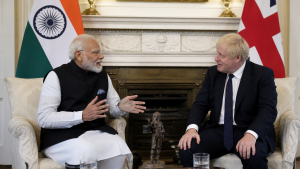
India and the United Kingdom share one of India’s most important bilateral relationships, shaped by historic links, strong people-to-people ties and expanding economic cooperation. Over time, the partnership has moved from broad diplomatic engagement to structured collaboration on trade, security, climate and mobility.
Evolution of the Institutional Framework
- Strategic Partnership: The formal diplomatic relationship was upgraded to a Strategic Partnership in 2004.
- Comprehensive Strategic Partnership: This was further elevated in May 2021.
- Roadmap 2030: Adopted in 2021, it provides the broad framework for bilateral engagement.
- Five priority areas: People-to-people contacts, trade and prosperity, defense and security, climate action, and health.
- Enhanced Trade Partnership: Declared in May 2021, it paved the way for formal trade negotiations.
- Trade talks: Negotiations for the bilateral trade deal began in January 2022.
- Vision 2035 link: The final agreement was concluded in principle on May 6, 2025, aligning with longer-term bilateral targets.
Bilateral Trade and Investment Landscape
- Total trade: Bilateral trade in goods and services between India and the UK was valued at £48 billion in calendar year 2025.
- FY 2025-26 trade: Up to November 2025, cumulative trade stood at USD 15.31 billion.
- Trade surplus: India recorded a favorable surplus of USD 2.56 billion in this period.
- FDI inflows: The UK is the sixth-largest foreign direct investor in India.
- Cumulative FDI: Inflows reached USD 36.44 billion from April 2000 through September 2025.
India–UK Comprehensive Economic and Trade Agreement
- Signing and entry into force: The India–UK Comprehensive Economic and Trade Agreement (CETA) was signed on July 24, 2025, and entered into force on July 15, 2026.
- Zero-duty access: The UK grants immediate zero-duty market access for about 99% of India’s exports.
- Merchandise coverage: This covers nearly 100% of total merchandise trade value.
- Tariff disadvantage removed: The agreement addresses the earlier tariff disadvantage of 4% to 16% faced by Indian exporters compared with regional competitors.
- UK market access for Indian goods: Labour-intensive sectors such as textiles, footwear and marine products are expected to benefit significantly.
- Trade expansion estimate: Annual bilateral trade may increase by £25.5 billion.
- GDP impact: The agreement is projected to add £5.1 billion to India’s GDP and £4.8 billion to the UK’s GDP per year.
| Area | CETA provision |
| Indian exports to the UK | Immediate zero-duty access on about 99% |
| UK exports to India | Duty-free or reduced-tariff access on 90% |
| Scotch whisky | Tariff reduced from 150% to 40% over 10 years |
| Passenger vehicles | Tariff reduced from 100% to 10% under a quota of 37,000 units |
Double Contribution Convention and Labor Mobility
- Also known as: The bilateral Agreement on Social Security is referred to as the Double Contribution Convention (DCC).
- Purpose: It prevents dual social security contributions by Indian and British professionals on short-term postings.
- Exemption period: The exemption for relocated temporary workers has been extended from three years to five years, or 60 months.
- Eligibility condition: The worker must have been covered by the home-country system for at least 30 days prior to relocation.
- Transitional rule: Employees already on assignment on the implementation date are not eligible for the new Certificate of Coverage and must follow existing host-country legislation.
- Expected benefit: The change benefits over 75,000 Indian professionals and about 900 employers by reducing costs and improving take-home pay.
Administrative Structures and Policy Oversight
- United Kingdom: Trade policy oversight moved under a reorganization that merged the Department for Science, Innovation and Technology (DSIT) with the Department for Business and Trade (DBT).
- New department: The resulting entity is the Department for Business, Innovation, Science and Trade.
- UK leadership: It is headed by Secretary of State Jonathan Reynolds.
- India: Trade negotiations and implementation are handled by the Union Minister of Commerce and Industry, Piyush Goyal, and the Department of Commerce.
Key Prelims Takeaways
- Strategic upgrade: India–UK ties were upgraded to a Strategic Partnership in 2004 and a Comprehensive Strategic Partnership in May 2021.
- Roadmap 2030: The bilateral framework focuses on five areas: people-to-people ties, trade, defense and security, climate action and health.
- Trade value: Bilateral trade in goods and services was £48 billion in 2025.
- FDI rank: The UK is India’s sixth-largest foreign direct investor.
- FDI inflows: Cumulative inflows from the UK stood at USD 36.44 billion from April 2000 to September 2025.
- CETA benefit: The UK gives zero-duty access to about 99% of Indian exports.
- DCC benefit: The social security exemption for posted workers extends to 60 months.
Current General Studies comprises current-affairs-based, General Studies-rich study material on policies, laws, institutions, economy, science, environment, governance, international relations, and other varied but important topics for UPSC and State PSC Prelims examinations.
Fortnightly PDF compilations: Available here
Originally written on
February 9, 2026
and last modified on
September 4, 2026.
| Related | |
|---|---|