Indian Ocean Maritime Security Challenges and Initiatives
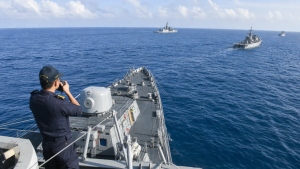
The Indian Ocean Region is a major corridor for global trade, energy flows, and maritime commerce, so its security is crucial for regional stability. India has built a layered maritime security framework through coordination mechanisms, information-sharing hubs, regional groupings, and updated strategic doctrines to address both traditional and non-traditional threats.
Institutional Architecture and Coordination
India relies on dedicated national bodies to streamline coastal defence, strategic coordination, and merchant vessel protection. These institutions help link the Navy, civilian agencies, and diplomatic channels in day-to-day maritime security management.
- National Maritime Security Coordinator (NMSC): Operates within the National Security Council Secretariat (NSCS) and reports directly to the National Security Advisor (NSA), Ajit Doval.
- Current NMSC: Vice Admiral (Retd) Biswajit Dasgupta, who succeeded India’s first NMSC, Vice Admiral (Retd) G Ashok Kumar, in April 2025.
- Maritime Security Branch: Functions under the Directorate General of Shipping (DGS) to coordinate protection measures for Indian seafarers and commercial vessels.
- Order and coordination: The branch was established under DGS Order No. 2 of 2023 and works with the Indian Navy, the Ministry of External Affairs, and international maritime security organizations.
Colombo Security Conclave
The Colombo Security Conclave (CSC) has grown into an important regional platform for addressing shared Indian Ocean vulnerabilities. Its evolution reflects the increasing need for structured cooperation on maritime and non-maritime security concerns.
- Institutional upgrade: In April 2026, the CSC began upgrading into a formally institutionalized regional security organization.
- Permanent structure: It is managed through a permanent secretariat in Colombo, Sri Lanka, and led by a Secretary-General.
- Founding members: India, Sri Lanka, the Maldives, and Mauritius signed the Charter and Memorandum of Understanding (MoU) in August 2024.
- Membership: As of 2026, the CSC has six member states — India, Sri Lanka, the Maldives, Mauritius, Bangladesh, and Seychelles.
- New member: Seychelles was admitted as a full member during the 7th NSA-level meeting hosted by India in New Delhi in November 2025.
- Operational pillars: Maritime Safety and Security; Countering Terrorism and Radicalisation; Combating Trafficking and Transnational Organised Crime; Cyber Security and Protection of Critical Infrastructure; and Humanitarian Assistance and Disaster Relief (HADR).
Information Fusion Centre – Indian Ocean Region
Maritime domain awareness and information sharing are central to India’s security strategy. The Information Fusion Centre – Indian Ocean Region (IFC-IOR) serves as a key node for tracking shipping movements, identifying risks, and supporting cooperative surveillance.
- Location: Hosted by the Indian Navy in Gurugram.
- White shipping network: Linked with 28 partner countries for white shipping and security information sharing.
- Organizational links: Connected with 54 international organizations.
- International Liaison Officers: The centre hosts officers from 15 partner nations — Australia, Bangladesh, France, Italy, Japan, Kenya, Maldives, Mauritius, Myanmar, Seychelles, Singapore, Sri Lanka, Thailand, the United Kingdom, and the United States of America.
Strategic Doctrines and Blueprints
India’s maritime planning is supported by updated doctrines that define its operational role across the Indian Ocean and the wider Indo-Pacific. These documents reflect a shift toward jointness, multi-domain operations, and flexible responses to grey-zone challenges.
- Indian Navy Maritime Security Strategy 2026 (INMSS-2026): Released in May 2026, replacing the 2015 strategy titled Ensuring Secure Seas.
- Alignment: INMSS-2026 is aligned with the Indian Maritime Doctrine 2025 (IMD-25).
- Key concepts: Both documents formally recognise No War No Peace (NWNP) conditions, multi-domain operations, and jointness.
- Strategic continuum: They frame India, the Indian Ocean, and the Indo-Pacific as a unified strategic space.
- RAKSHA document: Released by the Ministry of Defence in September 2026, it provides a 10-year roadmap for defence diplomacy and global partnerships.
- Strategic positioning: The document reinforces India’s role as a Net Security Provider and First Responder.
Cooperative Operations and Initiatives
India’s vision of cooperative security is implemented through naval deployments, multilateral exercises, and regional forums. These initiatives combine operational engagement with diplomacy and capacity building.
- IOS SAGAR: The second edition of the Indian Ocean Ship (IOS) SAGAR initiative began on March 16, 2026.
- Operational platform: INS Sunayna was deployed for joint exercises, port calls, and professional exchanges with friendly foreign countries in the region.
- Visakhapatnam convergence: In February 2026, India hosted the International Fleet Review (IFR) 2026, Exercise MILAN 2026, and the Indian Ocean Naval Symposium (IONS) Conclave of Chiefs together.
- MAHASAGAR vision: The convergence was used to operationalize the Mutual and Holistic Advancement for Security and Growth Across Regions (MAHASAGAR) vision.
- Indian Ocean Conference 2026: The 9th Indian Ocean Conference was held in Mauritius from April 10 to 12, 2026.
- Theme: The conference focused on Collective Stewardship for Indian Ocean Governance.
Key Prelims Takeaways
- NMSC: Vice Admiral (Retd) Biswajit Dasgupta heads the National Maritime Security Coordinator framework under the NSCS and reports to NSA Ajit Doval.
- Shipping security: The Maritime Security Branch of the DGS coordinates protection for Indian seafarers and commercial vessels.
- CSC membership: India, Sri Lanka, the Maldives, Mauritius, Bangladesh, and Seychelles are the six members of the Colombo Security Conclave.
- CSC structure: The conclave is being institutionalized with a permanent secretariat in Colombo, Sri Lanka.
- IFC-IOR: Based in Gurugram, it links India with 28 partner countries and 54 international organizations.
- INMSS-2026: The new naval security strategy updates the 2015 doctrine and recognises NWNP and multi-domain operations.
- RAKSHA: The Ministry of Defence’s 10-year defence diplomacy document strengthens India’s partnership-based maritime posture.
| Related | |
|---|---|