Government Schemes and Policies for the Leather Sector
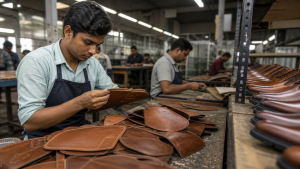
The Indian leather and footwear sector is a labour-intensive industry with strong links to exports, employment and MSME growth. To improve competitiveness, the government has focused on technology upgradation, environmental compliance, cluster development and easier access to inputs.
Indian Footwear and Leather Development Programme (IFLDP)
The Indian Footwear and Leather Development Programme (IFLDP) is a central sector scheme implemented by the Department for Promotion of Industry and Internal Trade (DPIIT). It has an approved financial outlay of ₹1,700 crore till March 31, 2026.
- Core sub-schemes: The programme has six components: Sustainable Technology and Environmental Promotion (STEP), Integrated Development of Leather Sector (IDLS), Mega Leather Footwear and Accessories Cluster Development (MLFACD), Establishment of Institutional Facilities (EIF), Brand Promotion and Development of Design Studios.
- STEP support: This component provides financial assistance of up to 70% of project cost, and up to 80% for the North Eastern Areas, for upgrading Common Effluent Treatment Plants (CETPs) and installing Zero Liquid Discharge (ZLD) systems.
- IDLS assistance: The sub-scheme supports technology modernisation and capacity expansion. MSMEs receive assistance at 30% of plant and machinery cost, while non-MSME units receive 20%.
- Regional enhancement: MSMEs in the North Eastern regions can get modernisation assistance of up to 40% under the IDLS guidelines.
Focus Product Scheme for Footwear and Leather Sectors
The Focus Product Scheme was introduced in the Union Budget 2025–26 to strengthen design capacity, address machinery gaps and expand component manufacturing for both leather and non-leather footwear.
- Turnover target: The scheme aims to generate an overall industry turnover of ₹4 lakh crore.
- Export goal: It targets export revenue of more than ₹1.1 lakh crore.
- Employment goal: The policy aims to create employment for 22 lakh people.
- Diversified manufacturing: It covers both leather and synthetic footwear components to broaden the industrial base.
Budgetary Reforms and Tariff Adjustments
Recent Union Budgets introduced measures to reduce input costs, simplify trade timelines and support leather clusters.
- Extended duty-free imports: The Union Budget 2026–27 extended duty-free import facilities to include shoe uppers, which were earlier limited to finished leather or synthetic footwear exports.
- Relaxed export deadline: The time limit for completing final product exports using duty-free imported inputs was increased from 6 months to 12 months for leather or textile garments, leather or synthetic footwear, and other leather products.
- Cluster revitalisation: The Budget proposed a national initiative to revitalize 200 legacy industrial clusters, including leather hubs, through infrastructure and technology upgrades.
| Item | Previous Rate | New Rate (Budget 2025-26) |
| Wet Blue Leather Import Duty | 10% | Nil |
| Crust Leather Export Duty | 20% | Nil |
| Designated Footwear Import Duty | 35% | 20% |
Regional Policies and Subnational Initiatives
State governments have also introduced targeted policies to attract investment and develop manufacturing hubs.
- Uttar Pradesh Leather & Footwear Policy 2025: The policy offers capital subsidies of up to 35% for standalone manufacturing units.
- Mega Anchor incentives: It provides incentives of up to ₹1,500 crore for Mega Anchor Units and footwear clusters.
- Land subsidies: Units setting up in economically backward areas of Purvanchal, Madhyanchal and Bundelkhand can receive land cost subsidies of up to 80%.
Industry Profile and Market Position
India has a strong position in global leather and footwear manufacturing because of its raw material base and skilled workforce.
- Global standing: India is the second-largest producer and consumer of footwear in the world.
- Leather share: It contributes about 13% of global leather hides and skins production.
- Production target: The domestic industry has set an aggregate production target of USD 50 billion by 2030.
- Domestic and export split: Of this, USD 36 billion is earmarked for domestic consumption and USD 14 billion for exports.
- Export performance: Indian leather and footwear exports reached USD 4.75 billion in FY 2025–26.
- Leading state: Tamil Nadu led the domestic export share with USD 1.59 billion, nearly 37% of India’s total.
Key Prelims Takeaways
- IFLDP: Central sector scheme under DPIIT, valid till March 31, 2026, with an outlay of ₹1,700 crore.
- STEP funding: Up to 70% support for CETPs and ZLD, and up to 80% in the North Eastern Areas.
- IDLS support: 30% assistance for MSMEs and 20% for non-MSME units; up to 40% for MSMEs in the North East.
- Focus Product Scheme: Aims for ₹4 lakh crore turnover, USD 1.1 lakh crore+ exports and 22 lakh jobs.
- Duty changes: Wet Blue leather import duty is Nil, crust leather export duty is Nil, and designated footwear import duty is 20%.
- Trade facilitation: Export deadline using duty-free inputs has been extended from 6 months to 12 months.
- State leadership: Tamil Nadu remains the leading exporter among states.
| Related | |
|---|---|