Constitutional Provisions for Scheduled Tribes in India
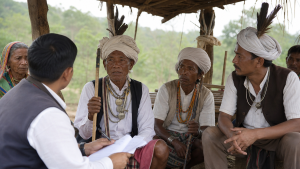
The Constitution provides special safeguards for Scheduled Tribes to protect their identity, representation, and access to development. These provisions operate through constitutional definitions, special administrative schedules, political reservation, and statutory support for tribal self-governance and forest rights.
Constitutional Definition and Allocation of Powers
Article 366(25) defines Scheduled Tribes as tribes or tribal communities deemed under Article 342. Under Article 342, the President specifies Scheduled Tribes for each State or Union Territory through a public notification.
- Parliament’s role: Only Parliament can include or exclude entries from the Scheduled Tribes list.
- Executive limitation: Neither the President nor State governments can alter these Presidential lists by executive notification.
- Article 275(1): Provides grants-in-aid from the Consolidated Fund of India to promote the welfare of Scheduled Tribes and raise the level of administration in Scheduled Areas.
Fifth and Sixth Schedules
Article 244(1) and the Fifth Schedule apply to the administration of Scheduled Areas and Scheduled Tribes in 10 states. This framework provides protective governance through Tribes Advisory Councils (TACs).
- Tribes Advisory Council: A TAC can have not more than 20 members.
- ST representation: Three-fourths of the members must be representatives of the Scheduled Tribes in the State Legislative Assembly.
- Purpose: The TAC advises on matters relating to the welfare and administration of Scheduled Tribes in Scheduled Areas.
Article 244(2) and the Sixth Schedule govern tribal administration in Assam, Meghalaya, Tripura, and Mizoram. The system functions through Autonomous District Councils (ADCs) and Regional Councils.
- Powers: These bodies have legislative, executive, and judicial powers within their jurisdiction.
- Objective: They protect tribal land, resources, customs, and local self-government.
Political Representation and Constitutional Oversight
- Articles 330 and 332: Provide for reservation of seats for Scheduled Tribes in the Lok Sabha and State Legislative Assemblies, respectively, in proportion to population.
- Article 338A: Establishes the National Commission for Scheduled Tribes (NCST) through the Constitution (89th Amendment) Act, 2003.
- NCST role: The commission monitors safeguards for Scheduled Tribes and advises on constitutional and legal protections.
- NCST composition: It consists of a Chairperson, a Vice-Chairperson, and three full-time members.
- Current composition: Antar Singh Arya is the Chairperson, and the members are Dr. Asha Lakra, Nirupam Chakma, and Jatothu Hussain.
Statutory Support: PESA and Forest Rights Act
- PESA Act, 1996: Extends the provisions of Part IX to Fifth Schedule areas to strengthen self-governance through Gram Sabhas.
- State rules: Nine of the 10 Fifth Schedule states have notified their state-specific PESA rules.
- Jharkhand: Notified its PESA rules in January 2026.
- Odisha: Remains the only Fifth Schedule state yet to finalize PESA rules.
- Forest Rights Act, 2006: Recognizes forest rights of forest-dwelling Scheduled Tribes.
- Claims filed: As of May 31, 2025, a cumulative 2,11,609 community forest rights claims had been filed.
- Claims disposed: 1,74,744 claims, or 82.58%, had been disposed of.
- Titles distributed: 1,21,705 titles had been distributed under the Act.
Important Legislative Amendments and Judicial Rulings
- Andhra Pradesh ST list (2024): The Constitution (Scheduled Tribes) Order (Amendment) Act, 2024, added the Bondo Porja, Khond Porja, and Konda Savaras.
- Odisha ST list (2024): The Constitution (SC and ST) Orders (Amendment) Act, 2024, included the Muka Dora, Konda Reddy, Tamadia, and Tamudia communities.
- Jammu and Kashmir ST list (2024): The Constitution (Jammu and Kashmir) Scheduled Tribes Order (Amendment) Act, 2024, granted ST status to the Pahari Ethnic Group, Paddari Tribe, Koli, and Gadda Brahmin.
- Sub-classification: In August 2024, a seven-judge Constitution Bench upheld sub-classification within Scheduled Castes and Scheduled Tribes, overruling E.V. Chinnaiah (2004).
- Religious conversion: In Chinthada Anand v. State of Andhra Pradesh (March 2026), the Supreme Court held that a Scheduled Tribe person does not automatically lose ST status on conversion unless there is complete abandonment of tribal practices and severance from tribal life.
- SC/ST Act interpretation: In Ramkrishna Chauhan v. State of U.P. (August 2026), the Court held that a caste-based insult in an enclosed room without public visibility does not meet the “place within public view” requirement under Section 3(1)(r) and 3(1)(s) of the SC/ST (Prevention of Atrocities) Act.
- Pension protection: In September 2026, the Court held that Article 142 can be used in exceptional circumstances to protect pension and retiral benefits even if a Scheduled Tribe certificate is later invalidated.
Key Prelims Takeaways
- Article 342: The Presidential list of Scheduled Tribes can be modified only by Parliament.
- Article 366(25): Defines Scheduled Tribes by reference to Article 342.
- Article 275(1): Provides grants-in-aid for tribal welfare and administration in Scheduled Areas.
- Fifth Schedule: Applies to 10 states and provides for Tribes Advisory Councils.
- Sixth Schedule: Applies to Assam, Meghalaya, Tripura, and Mizoram through ADCs and Regional Councils.
- NCST: A constitutional body created by the 89th Amendment Act, 2003.
- PESA and FRA: Strengthen self-governance and forest rights for tribal communities.
| Related | |
|---|---|