Important Global Scientific Research Organisations
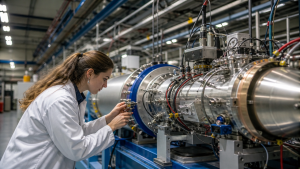
Global scientific research organisations shape the pace of discovery by pooling expertise, funding, and infrastructure across countries. They are especially important in particle physics, space exploration, fusion energy, climate science, and public health.
For Prelims revision, the key is to remember each body’s mandate, headquarters, and current leadership, along with a few flagship missions or projects linked to it.
CERN and High-Energy Physics
CERN, the European Organization for Nuclear Research, is the leading international centre for particle physics. It operates major accelerator facilities and supports experiments that study the fundamental structure of matter.
- Director-General: British physicist Mark Thomson, who began a five-year term on January 1, 2026, succeeding Fabiola Gianotti.
- Headquarters: Geneva, Switzerland.
- Major facility: The Large Hadron Collider (LHC), the world’s most powerful particle accelerator.
- Long Shutdown 3 (LS3): The LHC shut down on June 29, 2026, for upgrade work and is expected to remain offline until 2030.
- Leadership for 2026–2030: Oliver Brüning, Director for Accelerators and Technology; Gautier Hamel de Monchenault, Director for Research and Computing; and Enrica Porcari, Chief Information Officer.
- Future Circular Collider (FCC): A proposed 91-kilometre electron-positron ring, with a decision on approval anticipated by 2028 and possible operation in 2045–2048.
NASA and ESA in Space Exploration
National and regional space agencies lead large-scale missions in human spaceflight, planetary science, and deep-space exploration. NASA and the European Space Agency (ESA) remain central to such international cooperation.
- NASA Administrator: Jared Isaacman, who assumed office on December 18, 2025.
- Artemis II: Completed from April 1 to April 11, 2026, as the first crewed lunar flyby in over 50 years.
- Artemis II crew: Reid Wiseman, Victor Glover, Christina Koch, and Jeremy Hansen.
- Artemis schedule change: After the February 2026 adjustment, NASA plans to test lunar lander docking in Earth orbit during Artemis III, pushing the first crewed landing to Artemis IV.
- Artemis IV target: 2028.
- Mission directorates: In May 2026, NASA merged the Exploration Systems Development Mission Directorate and the Space Operations Mission Directorate into a unified Human Spaceflight Mission Directorate.
- SR-1 Freedom Mars probe: NASA’s nuclear-propulsion pathfinder mission targeted for launch in 2028.
- ESA Director-General: Dr. Josef Aschbacher, whose mandate has been extended through March 2029.
- BepiColombo: The ESA/JAXA mission entered its Mercury Arrival Phase on September 3, 2026, after separation of the Mercury Transfer Module; orbital insertion is planned for November 21, 2026.
- SMILE mission: A joint ESA–Chinese Academy of Sciences spacecraft launched on May 19, 2026, aboard a Vega-C rocket.
ITER and ISRO Programmes
Large scientific infrastructure projects in fusion energy and spaceflight depend on long-term public investment, technical coordination, and international partnerships.
- ITER Organization: Directed by Pietro Barabaschi and based in Cadarache, France.
- ITER project: The tokamak reactor is being assembled for experimental fusion research.
- Revised timeline: First plasma and the start of experimental operations are now targeted for 2034.
- ITER-India: Mahendrajit Singh became Officiating Project Director on March 1, 2026.
- ISRO Chairman: Dr. V. Narayanan, who also serves as Secretary of the Department of Space, taking office on January 13, 2025 for a two-year term.
- Gaganyaan: ISRO’s first uncrewed validation mission is scheduled for launch by the end of 2026.
Climate and Health Institutions
Intergovernmental organisations are central to climate assessment and global health governance. Their reports, conventions, and leadership changes are closely tracked in competitive examinations.
- IPCC Chair: Professor Sir Jim Skea of the United Kingdom, leading the seventh assessment cycle (AR7).
- IPCC Secretary: Annett Möhner, appointed to begin on November 1, 2026.
- WHO Director-General: Dr. Tedros Adhanom Ghebreyesus, whose second and final term ends on August 15, 2027.
- WHO succession prospects: Four candidates proposed in August 2026 were Dr. Hanan Mohammed Al-Kuwari, Dr. Hanan Balkhy, Dr. Hans Henri P. Kluge, and Budi Gunadi Sadikin.
- IARC Director: Dr. Elisabete Weiderpass, serving her second five-year term from January 1, 2024.
- IARC: The International Agency for Research on Cancer works under the broader global health research framework linked to WHO.
Quick Organisation Facts for Revision
| Organisation | Headquarters | Current Leadership | Primary Focus / Key Project |
| CERN | Geneva, Switzerland | Mark Thomson | Particle physics; Future Circular Collider (FCC) |
| NASA | Washington D.C., USA | Jared Isaacman | Space exploration; Artemis Programme, SR-1 Freedom |
| ESA | Paris, France | Dr. Josef Aschbacher | Space technology; BepiColombo, SMILE mission |
| ITER | Cadarache, France | Pietro Barabaschi | Nuclear fusion; tokamak reactor assembly |
| IPCC | Geneva, Switzerland | Prof. Sir Jim Skea | Climate science; Seventh Assessment Cycle (AR7) |
| WHO | Geneva, Switzerland | Dr. Tedros Adhanom Ghebreyesus | Global public health; IARC-related cancer research |
Key Prelims Takeaways
- LS3: CERN’s Long Shutdown 3 is the LHC upgrade phase running from June 2026 to 2030.
- FCC: CERN’s proposed Future Circular Collider is planned as a 91-kilometre electron-positron ring.
- Artemis II: NASA completed the first crewed lunar flyby in over 50 years in April 2026.
- Artemis IV: The first crewed lunar landing has been pushed to 2028.
- SMILE: ESA’s mission with the Chinese Academy of Sciences studies solar wind-magnetosphere interactions.
- ITER: The first plasma target has been shifted to 2034.
- Gaganyaan: ISRO’s first uncrewed validation mission is scheduled by the end of 2026.
| Related | |
|---|---|