Indian Launch Vehicles and Their Typical Payloads
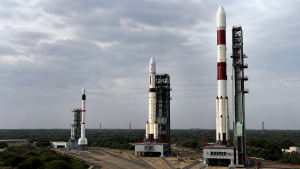
India’s launch vehicle fleet is built to handle a wide range of missions, from small satellites in low or polar orbits to heavier communication and deep-space payloads. ISRO’s rockets differ mainly by stage configuration, propellant type and payload capacity, making each vehicle suited to a specific orbit and mission class.
For Prelims revision, the most useful facts are the payload limits, propulsion systems, and the role of each launcher in India’s space programme.
Polar Satellite Launch Vehicle (PSLV)
The Polar Satellite Launch Vehicle is India’s most dependable and versatile launcher. It has carried Indian and foreign satellites for more than three decades and remains the workhorse for Earth observation and small-to-medium satellite missions.
- Configuration: Four stages, alternating between solid and liquid propulsion.
- Propulsion pattern: Stages 1 and 3 use solid rocket motors, while Stages 2 and 4 use liquid engines.
- Stage 2 engine: Vikas engine.
- Stage 4 engine: Twin PS-4 engines.
- Control features: Liquid stages are controllable, throttleable and restartable, allowing precise orbital injection.
- Payload to SSPO: Up to 1,750 kg to a Sun-Synchronous Polar Orbit at about 600 km altitude.
- Payload to GTO: Up to 1,425 kg to Geosynchronous Transfer Orbit.
- Major variants: PSLV-CA (Core Alone), PSLV-DL (2 strap-on boosters), PSLV-QL (4 strap-on boosters) and PSLV-XL (6 larger strap-on boosters).
- Exam note: PSLV is especially associated with reliable satellite deployment and multi-satellite launches.
PSLV is the primary Indian launcher for polar and Sun-Synchronous missions.
Geosynchronous Satellite Launch Vehicle (GSLV Mk II)
GSLV Mk II is designed mainly for communication, meteorological and navigation satellites that need high-altitude orbits. It is a three-stage vehicle that combines solid, liquid and cryogenic propulsion technologies.
- Stage 1 (GS1): Solid rocket motor with four liquid-propellant strap-on boosters.
- Stage 2 (GS2): Liquid-propellant stage.
- Stage 3: Cryogenic Upper Stage (CUS) powered by the indigenous CE-7.5 engine.
- Payload to GTO: Up to 2,250 kg.
- Payload to LEO: Up to 6,000 kg.
- Use case: Built for larger satellites than PSLV, especially those destined for geosynchronous transfer orbits.
- Programme status: ISRO has planned its retirement after the remaining approved missions are completed, with future tasks in this class shifting to LVM3.
Launch Vehicle Mark-3 (LVM3)
LVM3, formerly called GSLV Mk III, is India’s heaviest active operational launcher. It is used for heavy communication satellites and also supports deep-space and future human spaceflight missions.
- Stages: Two solid strap-on boosters (S200), a liquid core stage (L110) and a cryogenic upper stage (C25).
- S200 booster: One of the largest solid boosters in the world, carrying 204 tonnes of HTPB propellant.
- C25 stage: Uses the fully indigenous CE-20 cryogenic engine.
- Propellants: CE-20 operates on liquid hydrogen (LH2) and liquid oxygen (LOX).
- Cycle: Gas-generator cycle.
- Payload to GTO: Up to 4,000 kg.
- Payload to LEO: About 8,000 kg to 10,000 kg.
- Human-rated variant: HRLV is designated for Gaganyaan missions.
LVM3 is India’s heavy-lift launcher for GTO missions and future human spaceflight.
Small Satellites and Next-Generation Systems
India is also expanding into rapid-launch small satellite systems and next-generation heavy-lift vehicles to meet commercial and strategic demand. These launchers are meant to improve flexibility, reduce launch turnaround time and increase lift capability.
- SSLV: Small Satellite Launch Vehicle is a three-stage, all-solid rocket with a liquid-based Velocity Trimming Module (VTM) at the terminal stage.
- SSLV payload: Up to 500 kg to LEO and about 300 kg to SSO.
- Operational purpose: Designed for quick deployment of small satellites.
- NGLV: Next Generation Launch Vehicle, also called Project Soorya, is under development as a partially reusable heavy-lift launcher.
- NGLV configuration: Planned as a three-stage vehicle.
- NGLV propellants: Uses liquid methane-liquid oxygen (methalox) engines and a cryogenic upper stage based on CE-20 technology.
- NGLV capacity: Targets up to 30 tonnes to LEO and 12 tonnes to GTO in the heavy variant.
Comparison of Launch Vehicles
| Vehicle | Stages | Typical Payload to LEO | Typical Payload to GTO | Key Propulsion |
| SSLV | 3 + VTM | 500 kg | N/A | Solid and liquid VTM |
| PSLV | 4 | 3,800 kg (XL) | 1,425 kg | Solid and liquid (Vikas) |
| GSLV Mk II | 3 | 6,000 kg | 2,250 kg | Solid, liquid and cryogenic (CE-7.5) |
| LVM3 | 3 | 8,000–10,000 kg | 4,000 kg | Solid, liquid and cryogenic (CE-20) |
| NGLV | 3 | 30,000 kg | 12,000 kg | Methalox and cryogenic |
Key Prelims Takeaways
- PSLV: India’s most reliable launcher for polar and Sun-Synchronous missions.
- PSLV propulsion: Four stages, with solid stages 1 and 3, and liquid stages 2 and 4.
- GSLV Mk II: Uses solid, liquid and cryogenic propulsion, with CE-7.5 in the upper stage.
- LVM3: India’s heaviest active launcher and the main vehicle for heavy GTO payloads.
- CE-20 engine: Powers the cryogenic upper stage of LVM3.
- SSLV: Important for small satellites and quick launches.
- NGLV: Future heavy-lift launcher under development with methalox propulsion.
| Related | |
|---|---|