Universal Health Coverage: Indicators, Goals, and Measurement
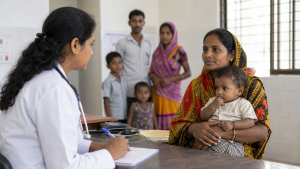
Universal Health Coverage: Meaning and Measurement
Universal Health Coverage (UHC) means that all people can access the health services they need without suffering financial hardship. It is monitored globally under SDG Target 3.8, which focuses on access to essential services and protection from out-of-pocket health costs.
The global UHC framework uses two core indicators. One tracks how widely essential health services are covered; the other measures whether households face financial strain due to paying for care directly from their own pockets.
Core UHC Indicators
- SDG Indicator 3.8.1: The Service Coverage Index (SCI), a composite score from 0 to 100 that measures average coverage of essential health services.
- SDG Indicator 3.8.2: Financial protection, measured by the proportion of the population facing hardship because of direct out-of-pocket (OOP) health spending.
- Custodian agencies: The World Health Organization (WHO) and the World Bank jointly manage the monitoring of these indicators.
- Purpose of the framework: To assess both service availability and the affordability of care for households.
Revised Financial Protection Metric
In March 2025, the United Nations Statistical Commission approved revisions to the financial protection indicator proposed by the WHO and the World Bank. The updated framework measures hardship as the share of the population whose positive OOP health expenditures exceed 40% of household discretionary budget.
- Discretionary budget: Calculated as total household consumption expenditure or income minus the Societal Poverty Line (SPL).
- Societal Poverty Line (SPL): Defined in 2017 purchasing power parities (PPPs) as the higher of US 2.15 or US 1.15 plus 50% of median household consumption expenditure or income net of OOP health spending.
- Broader coverage: The revised metric captures both catastrophic and impoverishing health spending.
- Automatic breach: Any OOP spending by individuals below the SPL, where discretionary budgets are negative, is treated as a threshold breach.
Service Coverage Index and Its Domains
The Service Coverage Index (SCI) measures the reach of essential health interventions across populations. It is calculated using a weighted geometric mean and is based on 14 tracer indicators grouped into four domains.
- Reproductive, maternal, newborn and child health (RMNCH): Covers essential services across maternal and child health.
- Infectious diseases: Tracks coverage related to communicable disease control.
- Non-communicable diseases (NCDs): Measures service coverage for chronic disease care and prevention.
- Service capacity and access: Assesses the health system’s ability to deliver services.
- Tracer updates: The 2025 revision updated three tracer indicators to improve alignment, replace proxy measures with actual coverage data, and expand data availability.
- Weighting scheme: A new weighting method was introduced to prevent infectious diseases from disproportionately driving global SCI trends.
Out-of-Pocket Spending and Global Trends
The revised financial protection framework classifies spending into tiers. Large OOP expenditures consume between 40% and 100% of the household discretionary budget, while impoverishing OOP expenditures exceed 100%.
Medicines remain the main driver of financial hardship in many countries. In three-quarters of surveyed countries, medicines account for at least 55% of OOP health expenses, rising to a median of 60% among the poorest populations.
- Global SCI trend: The SCI rose from 54 in 2000 to 71 in 2023.
- Slower progress: The annualized improvement rate fell from 1.5% during 2000–2015 to 0.5% during 2015–2023.
- Coverage gap: About 4.6 billion people lacked full coverage of essential health services in 2023.
- Financial hardship: The share of the global population facing financial hardship declined from 34% in 2000 to 26% in 2022.
- Population affected: This still represented about 2.1 billion people, of whom 1.6 billion were pushed or further impoverished by health costs.
- 2030 projection: The SCI is projected to reach 74 by 2030, below the target of 80, while 24% of the population may still face financial hardship.
UHC Monitoring Framework at a Glance
| Feature | SDG Indicator 3.8.1 | SDG Indicator 3.8.2 |
| Primary metric | Composite index scored from 0 to 100 | Percentage of population facing financial strain |
| Focus | Access to essential health interventions | Household OOP spending burden |
| Framework basis | 14 tracer indicators across 4 domains | 40% of household discretionary budget threshold |
| Core input | Coverage and health-system capacity data | Household consumption, income, and SPL |
Key Prelims Takeaways
- SDG Target 3.8: Aims to achieve universal health coverage, including access to quality essential health services and financial risk protection.
- SCI: The Service Coverage Index is the key measure for service coverage under UHC.
- Financial protection indicator: Tracks the share of people facing hardship from direct health payments.
- WHO and World Bank: Jointly oversee UHC indicator tracking.
- SPL formula: Uses 2017 PPPs and takes the higher of US 2.15 or US 1.15 plus 50% of median household consumption/income net of OOP spending.
- 3.8.2 threshold: Positive OOP spending above 40% of discretionary budget is treated as financial hardship.
- 2030 gap: The SCI target is 80, but projections suggest it may reach only 74 by 2030.
| Related | |
|---|---|