Major Central Employment and Skill Development Schemes
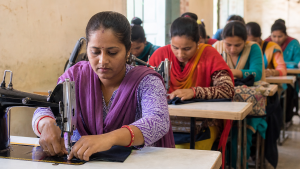
Central employment and skill development schemes aim to expand livelihood opportunities, encourage formal hiring, and align training with market demand. They also support rural wage employment, internships for first-time entrants, and the preservation of traditional crafts through targeted incentives.
Viksit Bharat – Guarantee for Rozgar and Ajeevika Mission (Gramin)
The Viksit Bharat – Guarantee for Rozgar and Ajeevika Mission (Gramin) (VB-G RAM G) Act, 2025, marks a major shift in rural employment policy. It creates a distinct legal and financial framework for wage employment in rural areas.
- Legislative change: Commenced on July 1, 2026, and repealed the Mahatma Gandhi National Rural Employment Guarantee Act (MGNREGA), 2005.
- Work guarantee: Provides 125 days of unskilled manual wage employment per rural household annually, which is 25 days more than MGNREGA.
- Budget and wages: Outlay of ₹95,692.31 crore for FY 2026-27, with an interim base wage rate of at least ₹300 per day across 34 States and UTs.
- Funding pattern: Introduces a 60:40 cost-sharing model between the Centre and states for wages.
- Work suspension: Provides for a 60-day peak season suspension of public works during regional harvests to ensure labour availability for agriculture.
Pradhan Mantri Viksit Bharat Rozgar Yojana
The Pradhan Mantri Viksit Bharat Rozgar Yojana (PM-VBRY) is designed to expand formal employment by rewarding both new employees and employers. It is one of the key central schemes for job creation in the organised sector.
- Objective and budget: Approved on July 1, 2025, with an outlay of ₹99,446 crore to create over 3.5 crore jobs between August 2025 and July 2027.
- Implementation: Administered by the Ministry of Labour & Employment through the Employees’ Provident Fund Organisation (EPFO).
- Employee incentive: First-time employees earning up to ₹1,00,000 monthly receive up to ₹15,000 through Direct Benefit Transfer in two instalments over 12 months.
- Employer incentive: Employers receive up to ₹3,000 per month per new employee for two years; this is extended to three and four years in manufacturing.
- Verification: Requires Universal Account Number verification through Face Authentication Technology on the UMANG app.
Skill India Programme and NAVYA Scheme
The Skill India Programme supports vocational training and apprenticeship pathways so that skill development remains aligned with changing industry requirements. It brings together several training and skilling components under one broad framework.
- Continuity of the programme: Restructured up to March 2026 with an outlay of ₹8,800 crore for FY 2022-23 to FY 2025-26.
- Consolidated components: Merges PM Kaushal Vikas Yojana 4.0 (PMKVY 4.0), PM National Apprenticeship Promotion Scheme (PM-NAPS), and Jan Shikshan Sansthan (JSS).
- PMKVY 4.0 timeline: Extended to March 31, 2027, with training ending on February 28, 2027.
- Target group: Covers the 15-59 age group under the National Skills Qualifications Framework (NSQF) guidelines.
- NAVYA initiative: Implemented with the Ministry of Women & Child Development to train 3,850 adolescent girls aged 16-18 years in non-traditional trades across 27 aspirational districts.
PM Internship Scheme
The PM Internship Scheme aims to provide structured industry exposure to young people and improve their employability through real workplace experience. It focuses on large companies and offers financial support during the internship period.
- Internship target: Aims to create 1 crore internship opportunities in the top 500 companies over five years.
- Eligibility: Open to youth aged 18-25 years with family income below ₹12 lakh.
- Stipend: Provides ₹9,000 per month for 6 to 9 months.
- Administrative focus: Linked to formal industry participation and skill-building through workplace exposure.
PM Vishwakarma
PM Vishwakarma is a central scheme for traditional artisans and craftsmen. It supports skill upgradation, tool support, and access to credit for those engaged in age-old occupations.
- Coverage: Supports traditional artisans across 18 trades.
- Allocation: Has an allocation of ₹13,000 crore for FY 2023-24 to FY 2027-28.
- Credit support: Provides collateral-free loans up to ₹3 lakh at 5% interest.
- Toolkit incentive: Offers a ₹15,000 toolkit incentive.
- Training support: Includes a ₹500 daily training stipend.
Key Prelims Takeaways
- VB-G RAM G Act, 2025: Replaced MGNREGA and provides 125 days of rural wage employment per household.
- VB-G RAM G funding: ₹95,692.31 crore outlay for FY 2026-27; wage rate at least ₹300 per day.
- PM-VBRY: Formal job creation scheme with ₹99,446 crore outlay and a target of over 3.5 crore jobs.
- PM-VBRY benefits: Up to ₹15,000 for first-time employees and up to ₹3,000 per month for employers.
- Skill India Programme: Umbrella skilling framework with PMKVY 4.0, PM-NAPS and JSS under it.
- PM Internship Scheme: Aims at 1 crore internships; stipend is ₹9,000 per month for 6-9 months.
- PM Vishwakarma: Targets traditional artisans with credit, toolkit support and training assistance.
| Related | |
|---|---|