Ministry of Culture: Major Schemes, Organisations and Programmes
The Ministry of Culture is the nodal agency for preserving, promoting and conserving India’s tangible and intangible cultural heritage. It works through attached offices, autonomous bodies and national missions that combine heritage protection, documentation and digital access.
The Archaeological Survey of India and Heritage Conservation
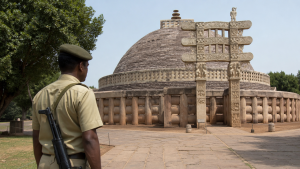
The Archaeological Survey of India (ASI) is responsible for archaeological research and for the protection of over 3,600 monuments of national importance. It also regulates archaeological excavations under the Ancient Monuments and Archaeological Sites and Remains Act, 1958.
- Attached office: The ASI functions as an attached office of the Ministry of Culture.
- Leadership: Dr. Yadubir Singh Rawat serves as the Director General of the ASI.
- Adopt a Heritage 2.0: Launched in September 2023, the scheme designates corporate entities as Monument Mitras to develop and maintain amenities at protected sites.
- CSR funding: These public and private entities use Corporate Social Responsibility (CSR) funds to improve visitor infrastructure.
- MoUs: A total of 30 Memorandums of Understanding (MoUs) have been signed with corporate partners under this framework as of March 2026.
National Missions on Cultural Mapping and Manuscripts
Preserving India’s intangible heritage requires systematic documentation of local traditions, village culture and rare manuscripts. The ministry runs dedicated missions for this purpose, with emphasis on data collection, digitisation and archival access.
- National Mission on Cultural Mapping (NMCM): Implements the Mera Gaon Meri Dharohar (MGMD) initiative to record the cultural identity of Indian villages.
- Nodal agency: The Indira Gandhi National Centre for the Arts (IGNCA) serves as the nodal implementing agency for this mapping programme.
- Coverage: As of March 2026, around 6.23 lakh of the targeted 6.38 lakh villages have been culturally mapped.
- Verification: The ministry works with the Ministry of Panchayati Raj to validate mapping data through local Gram Sabhas.
- Scope of NMCM: It is strictly a documentation and mapping programme and does not provide financial aid, registration or welfare benefits to artists.
- National Mission for Manuscripts (NMM): Renamed under the Gyan Bharatam initiative; the original mission was set up in 2003.
- Gyan Bharatam National Manuscript Survey: Launched on March 16, 2026, to identify and document manuscript wealth across 100 districts.
- Digitisation target: The mission aims to catalogue and digitise over 1 crore manuscripts in a National Digital Repository.
- Digital tools: The work is supported through the Kriti Sampada portal and volunteer Pandulipi Mitras.
National Mission on Libraries and Digital Access
Library modernisation under the Ministry of Culture focuses on improving access to rare texts, strengthening public libraries and encouraging reading habits. Digital platforms now form an important part of this effort.
- National Mission on Libraries (NML): Provides financial support to establish model libraries, including one State Central Library and one District Library per State or Union Territory.
- Raja Rammohun Roy Library Foundation (RRRLF): Functions as the central administrative, planning and budgeting agency for the NML.
- National Virtual Library of India (NVLI): The Indian Culture Portal was developed under the NVLI, which is a key component of the NML.
- Indian Culture Portal 2.0: Launched on March 5, 2026, with a React-based frontend.
- Bharti chatbot: A multilingual AI chatbot integrated with the Bhashini platform.
Art Projects and Commemorative Initiatives
Besides conservation and documentation, the ministry also supports public art and commemorative programmes that bring cultural heritage into public spaces and collective memory.
- Project PARI: Public Art of India, initiated in July 2024 to coincide with the 46th session of the UNESCO World Heritage Committee in New Delhi.
- Implementing bodies: Executed by the Lalit Kala Akademi and the National Gallery of Modern Art (NGMA).
- Purpose: Installs regional and contemporary art in public spaces.
- Vande Mataram commemoration: A year-long nationwide programme marking the 150th anniversary of the composition of the National Song runs from November 7, 2025, to November 7, 2026.
Key Prelims Takeaways
- Ministry role: It is the nodal agency for preserving, promoting and conserving India’s cultural heritage.
- ASI mandate: The ASI protects over 3,600 monuments of national importance and regulates excavations under the AMASR Act, 1958.
- Adopt a Heritage 2.0: Corporate entities act as Monument Mitras and use CSR funds to improve visitor facilities.
- NMCM focus: The cultural mapping mission documents village culture and does not provide welfare or financial assistance to artists.
- Manuscript push: Gyan Bharatam is linked to the National Mission for Manuscripts and aims at large-scale digitisation through Kriti Sampada.
- Library infrastructure: The NML is supported by RRRLF and linked to the Indian Culture Portal under the NVLI framework.
- Digital access: Bharti, the multilingual AI chatbot on the Indian Culture Portal, is integrated with Bhashini.
Exam fact: As of March 2026, about 6.23 lakh of 6.38 lakh villages had been culturally mapped under NMCM.
| Related | |
|---|---|