Key Emergency Response Agencies and Protocols in India
India’s disaster management system is built on a layered institutional framework that covers mitigation, preparedness, response and recovery. It operates through national, state and local bodies backed by statutory powers, dedicated forces and emergency communication systems.
The Disaster Management (Amendment) Act, 2025
- Assent and commencement: The Disaster Management (Amendment) Act, 2025 received presidential assent on March 29, 2025 and came into force on April 9, 2025.
- Plan preparation: The Act assigns direct responsibility for preparing national and state disaster management plans to the NDMA and SDMAs, replacing the earlier role of the National Executive Committee and State Executive Committee.
- National Crisis Management Committee: The NCMC has been given statutory status as the nodal body for major disasters with national ramifications.
- High-Level Committee: The HLC has also been given statutory backing to oversee disaster finance assistance.
- Urban disaster bodies: State governments may set up separate Urban Disaster Management Authorities for state capitals and municipal cities.
- State response forces: The Act formally recognises the power of states to constitute their own State Disaster Response Forces (SDRFs).
- Disaster databases: The Act mandates comprehensive national and state disaster databases covering risk details, fund allocations, expenditures, preparedness and mitigation plans.
NDMA and NIDM Organizational Structure
- NDMA leadership: The Prime Minister serves as the ex-officio Chairperson of the National Disaster Management Authority (NDMA).
- Role of NDMA: NDMA steers the country’s disaster response policy and framework.
- NDMA members: In 2026, the key nominated members include Rajendra Singh, Lt. Gen. (Retd) Syed Ata Hasnain and Dr. Krishna Vatsa.
- Vice Chairperson vacancy: The NDMA Vice Chairperson post has remained vacant since June 2014.
- NIDM role: The National Institute of Disaster Management (NIDM) handles capacity building, training, research and policy advocacy.
- NIDM presidency: The Union Home Minister serves as the President of NIDM.
- NIDM Governing Body: In the absence of an active NDMA Vice Chairperson, the Union Home Secretary serves as Chairperson of NIDM’s Governing Body.
- NIDM Executive Director: Madhup Vyas (IAS:2000:AGMUT) assumed charge as Executive Director on September 18, 2025.
National Disaster Response Force and ERSS-112
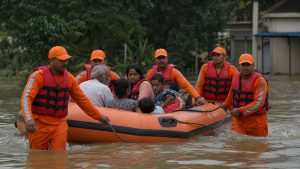
- NDRF status: The National Disaster Response Force (NDRF) is the specialised federal force for disaster response.
- Legal basis: It was originally constituted under Section 44 of the Disaster Management Act, 2005.
- Leadership: In 2026, Piyush Anand (1991-batch IPS, UP cadre) serves as Director General of the NDRF.
- Tenure extension: His tenure has been extended by the Appointments Committee of the Cabinet for one year beyond March 30, 2026.
- Strength and structure: The NDRF has 16 battalions with a sanctioned strength of 18,581 personnel.
- ERSS-112: The Emergency Response Support System is a pan-India single emergency helpline numbered 112.
- Integrated services: It consolidates police, fire, ambulance, and women and child safety services.
- Digital features: The system supports real-time GPS location sharing and a voluntary citizen response system through the “112 India” mobile application.
Disaster Management Financial Architecture
- 15th Finance Commission: The Commission recommended dedicated financial allocations for the 2021-2026 award period for disaster response and mitigation.
- SDRF: The State Disaster Response Fund is the main state-level response fund for relief and immediate assistance.
- NDRF: The National Disaster Response Fund supports major disaster response at the national level and is fully funded by the Central Government.
- SDMF: The State Disaster Mitigation Fund is meant for state-level prevention projects.
- NDMF: The National Disaster Mitigation Fund is meant for national-level prevention projects.
- FY 2025-26 release: The Central Government released Rs 20,735.20 crore to 28 states under the SDRF and Rs 3,628.18 crore to 21 states under the NDRF.
| Fund Category | Total Allocation (2021-2026) | Share Breakdown |
| State Disaster Response Fund (SDRF) | Rs 1,28,122.40 crore | Central share: Rs 98,080.80 crore; State share: Rs 30,041.60 crore |
| National Disaster Response Fund (NDRF) | Rs 54,770 crore | Fully funded by the Central Government |
| State Disaster Mitigation Fund (SDMF) | Rs 32,030.60 crore | Allocated for state-level prevention projects |
| National Disaster Mitigation Fund (NDMF) | Rs 13,693 crore | Allocated for national-level prevention projects |
Key Prelims Takeaways
- Plan-making shift: The 2025 Amendment Act transfers direct disaster plan preparation to NDMA and SDMAs.
- Statutory bodies: NCMC and HLC now have explicit statutory recognition.
- Urban governance: States can create Urban Disaster Management Authorities for capitals and municipal cities.
- Response force: NDRF remains the specialised federal force for disaster response, while states may also constitute SDRFs.
- Single emergency number: ERSS-112 functions as the unified emergency helpline for multiple services.
- Funding divide: Response funds (NDRF, SDRF) are distinct from mitigation funds (NDMF, SDMF).
- Institutional roles: NDMA formulates policy, NIDM handles training and capacity building, and NDRF handles operational response.
Current General Studies comprises current-affairs-based, General Studies-rich study material on policies, laws, institutions, economy, science, environment, governance, international relations, and other varied but important topics for UPSC and State PSC Prelims examinations.
Fortnightly PDF compilations: Available here
Originally written on
February 26, 2026
and last modified on
September 5, 2026.
| Related | |
|---|---|