Major Indian Armed Forces Tri-Service Exercises
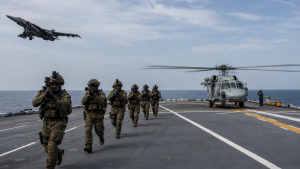
The Indian Armed Forces conduct tri-service exercises to improve interoperability, jointmanship, and operational readiness across the Army, Navy, and Air Force. These drills help refine command coordination, test joint doctrine, and prepare forces for multi-domain warfare in a complex security environment.
Institutional Framework for Joint Operations
- Chief of Defence Staff (CDS): The office of the CDS was created in December 2019 on the basis of the Kargil Review Committee’s recommendations. It supports joint planning, procurement, and integration of the three services.
- Headquarters Integrated Defence Staff (HQ IDS): Established in October 2001, HQ IDS drives integration among the Army, Navy, and Air Force. It functions under the Ministry of Defence and works on joint training, doctrine, and long-term capability planning.
- Centre for Joint Warfare Studies (CENJOWS): Founded on August 27, 2007, under HQ IDS, CENJOWS is an autonomous tri-services think tank registered under the Societies Registration Act, 1860. It publishes the peer-reviewed journal Synergy and offers research and policy inputs on joint warfare and national security.
- Andaman and Nicobar Command (ANC): Established in October 2001 at Port Blair, the ANC is India’s first and only operational tri-service theatre command. It oversees strategic maritime choke points in the Bay of Bengal, the Andaman Sea, and the Malacca Strait approach.
Theatre-Level and Large-Scale Joint Exercises
- Exercise Trishul (TSE-2025): Conducted from November 3 to 13, 2025, across Rajasthan, Gujarat, Sir Creek, and the northern Arabian Sea. Coordinated by the Western Naval Command, it involved more than 20,000 personnel and integrated the Army’s Southern Command, the South Western Air Command, the Indian Coast Guard, and the Border Security Force.
- Operational focus: The exercise tested joint defensive and offensive tactics in a multi-threat border and maritime environment.
- Sub-exercises Trinetra and Mahagujarat: These component drills validated joint intelligence, surveillance, reconnaissance (ISR), electronic warfare (EW), and cyber warfare procedures under simulated high-intensity threat conditions.
- AMPHEX 2025: India’s biennial tri-service amphibious exercise was conducted in Karwar, Karnataka, in January-February 2025. It also served as the concluding phase of Exercise Trishul in November 2025 to validate large-scale sea-to-land assault operations.
- Amphibious platforms: The exercise focused on the deployment of landing platform docks and amphibious transport docks for coordinated assault and shore-entry operations.
- TROPEX-2025: The Indian Navy’s capstone Theatre Level Operational Exercise was held from January to March 2025 across the Indian Ocean Region. It integrated 65–70 naval ships, 9–10 submarines, over 80 aircraft, and troops from the Army and Air Force.
- Purpose of TROPEX: The exercise tested joint combat readiness, coastal defence networks, and maritime security protocols in the Indo-Pacific.
Regional and High-Altitude Drills
- Exercise Poorvi Prachand Prahar: Conducted from November 11 to 15, 2025, in Mechuka, Arunachal Pradesh, about 30 km from the Line of Actual Control (LAC). It was the third major eastern integration phase after Exercise Bhala Prahar (2023) and Exercise Poorvi Prahar (November 2024).
- High-altitude formations: The exercise marked the first deployment of Bhairav Battalion, Ashni Drone Platoons, and Divyastra Artillery Batteries in such terrain.
- Bhairav Battalions: The Army has operationalised 5 of its planned 25 Bhairav Light Combat Battalions, designed for lean, high-impact operations.
- Save and Raise model: These units are being raised by reorganising existing manpower without additional fiscal cost.
- Exercise Dweep Shakti: Conducted in March 2026 under the Andaman and Nicobar Command, this tri-service coastal and island defence drill focused on multi-domain interoperability.
- Operational validation: The exercise tested rapid troop mobilisation, special forces insertions, and amphibious landings on remote islands to secure India’s exclusive economic zone (EEZ).
Indigenous Capabilities and Firepower
- Exercise Bharat Shakti: Conducted on March 12, 2024, at Pokhran, Rajasthan, this exercise showcased integrated tri-service firepower using exclusively indigenous military hardware.
- Strategic significance: It highlighted self-reliance in defence manufacturing under the Atmanirbhar Bharat initiative.
- Equipment profile: The hardware displayed included the Light Combat Aircraft (LCA) Tejas, Advanced Light Helicopter (ALH) Dhruv, Main Battle Tank (MBT) Arjun, Pinaka multi-barrel rocket system, and indigenous air-defence radar networks.
Key Prelims Takeaways
- Sole tri-service theatre command: The Andaman and Nicobar Command in Port Blair is India’s only operational tri-service command.
- CDS office: Created in December 2019, the CDS framework supports joint planning, procurement, and integration.
- HQ IDS: Established in October 2001, it is the key institutional mechanism for tri-service integration.
- CENJOWS: An autonomous tri-services think tank under HQ IDS, it publishes Synergy.
- Trishul coordination: Exercise Trishul (2025) was coordinated by the Western Naval Command and included the Border Security Force along with the three services and the Coast Guard.
- Eastern joint series: The sequence of eastern border integration exercises is Bhala Prahar (2023), Poorvi Prahar (2024), and Poorvi Prachand Prahar (2025).
- Amphibious benchmark: AMPHEX is a biennial tri-service amphibious exercise; the 2025 edition was held at Karwar, Karnataka.
Current General Studies comprises current-affairs-based, General Studies-rich study material on policies, laws, institutions, economy, science, environment, governance, international relations, and other varied but important topics for UPSC and State PSC Prelims examinations.
Fortnightly PDF compilations: Available here
Originally written on
February 25, 2026
and last modified on
September 5, 2026.
| Related | |
|---|---|