Major Welfare Schemes of Indian States
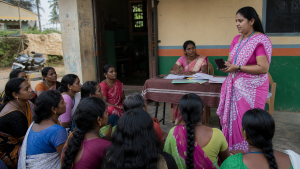
State governments in India run a wide range of welfare schemes to support women, farmers, students and other vulnerable groups. Many of these programmes use direct benefit transfer (DBT) and digital verification to ensure targeted delivery and reduce leakages.
Karnataka’s Five Flagship Guarantees
Karnataka’s welfare framework is built around five guarantee schemes that together form a large part of the state’s social support architecture. The 2026–27 Budget allocated ₹51,286 crore to these schemes, or about 12% of the state’s estimated expenditure of ₹4,12,688 crore (excluding loan repayments).
- Gruha Lakshmi: Monthly cash transfer of ₹2,000 to women heads of households.
- Gruha Jyothi: Free electricity for domestic consumers up to 200 units.
- Anna Bhagya: Free foodgrains or rice, with 10 kg per person.
- Shakti: Free travel for women in state-run buses.
- Yuva Nidhi: Unemployment allowance for graduates and diploma holders.
Women-Centric DBT in Maharashtra and Madhya Pradesh
Women-focused DBT schemes in Maharashtra and Madhya Pradesh have become major welfare instruments, with clearly defined income and age criteria. These schemes are also notable for periodic verification to remove ineligible beneficiaries.
- Maharashtra’s Majhi Ladki Bahin: Launched on June 28, 2024, it provides ₹1,500 per month to eligible women aged 21 to 65 years with annual family income below ₹2.5 lakh.
- Verification drive: A strict verification and e-KYC exercise in 2025–26, with an April 30, 2026 deadline, removed 65 lakh to 80 lakh ineligible or unverified beneficiaries.
- Payout status: Despite proposals to increase the amount, the official payout remains ₹1,500 per month.
- Madhya Pradesh’s Ladli Behna: The Mukhyamantri Ladli Behna Yojana provides ₹1,500 per month to eligible married, widowed, divorced and abandoned women aged 21 to 60.
- Budget support: The 2026–27 Madhya Pradesh Budget allocated ₹23,882 crore for the scheme to benefit about 1.25 crore women with annual family income below ₹2.5 lakh.
West Bengal’s Shift to Annapurna Yojana
West Bengal has restructured its women’s welfare support into a flat cash-transfer model. The new arrangement was designed to standardise benefits across eligible women.
- Transition: The Annapurna Yojana, earlier known as Matri Shakti Bharosa, took effect on June 1, 2026, replacing the earlier Lakshmir Bhandar scheme.
- Cash transfer: Eligible female residents aged 25 to 60 receive a flat ₹3,000 per month through DBT.
- Additional support: The scheme also includes free travel on state-run buses.
- Budgetary scaling: The 2026–27 West Bengal Budget allocated ₹36,000 crore to the scheme, up from ₹17,076.03 crore in 2025–26 under Lakshmir Bhandar.
- Earlier structure: Lakshmir Bhandar paid ₹1,200 per month to SC/ST households and ₹1,000 per month to general category households.
Agricultural Support through Telangana’s Rythu Bharosa
Telangana’s Rythu Bharosa is a key agricultural investment support scheme that uses technology to target payments more accurately. The scheme replaced the earlier Rythu Bandhu programme in January 2025.
- Payment rate: Agricultural investment support is ₹12,000 per acre per year, paid as ₹6,000 for each crop season, Kharif and Rabi.
- Earlier rate: The payment was increased from the previous ₹10,000 per acre per year under Rythu Bandhu.
- Budget support: The 2026–27 state budget allocated ₹13,603 crore for the scheme.
- Technology use: Satellite mapping is used to restrict payouts to active and cultivable farming plots.
Odisha and Andhra Pradesh Welfare Schemes
Odisha and Andhra Pradesh have introduced welfare measures aimed at women and schoolchildren, combining annual cash support with sector-specific assistance.
- Odisha’s Subhadra Yojana: Launched on September 17, 2024, it provides ₹50,000 over five years, or ₹10,000 annually in two equal instalments of ₹5,000.
- Eligibility: The scheme covers women aged 21 to 60.
- Budget outlay: The 2026–27 Odisha Budget allocated ₹10,145 crore for Subhadra Yojana.
- Andhra Pradesh’s Talliki Vandanam: Replacing Jagananna Amma Vodi, it provides ₹15,000 annually per student from Class 1 to 12 to the mother’s bank account.
- Net credit: A deduction of ₹2,000 is made for school infrastructure, leaving a net credit of ₹13,000.
- Deepam–2: The scheme provides three free LPG cylinders per year to women, with an estimated expenditure of ₹2,684 crore.
| State | Scheme | Payout | Age/Eligibility | Key Feature |
| West Bengal | Annapurna Yojana | ₹3,000 per month | 25 to 60 years | Uniform DBT; replaces Lakshmir Bhandar |
| Madhya Pradesh | Ladli Behna Yojana | ₹1,500 per month | 21 to 60 years | Family income below ₹2.5 lakh |
| Maharashtra | Majhi Ladki Bahin Yojana | ₹1,500 per month | 21 to 65 years | Family income below ₹2.5 lakh |
| Odisha | Subhadra Yojana | ₹10,000 per year | 21 to 60 years | Paid in two ₹5,000 instalments |
| Andhra Pradesh | Talliki Vandanam | ₹15,000 per year | Class 1 to 12 | ₹13,000 net credit after deduction |
Key Prelims Takeaways
- Age criteria: The lower age limit is 21 years in Maharashtra, Madhya Pradesh and Odisha, while West Bengal sets it at 25 years.
- Income cap: Maharashtra and Madhya Pradesh both use an annual family income ceiling of ₹2.5 lakh.
- DBT focus: These schemes rely heavily on direct bank transfer to reduce intermediaries and improve targeting.
- Verification: E-KYC and beneficiary verification are increasingly used to prune ineligible names.
- Agricultural targeting: Telangana’s Rythu Bharosa links payment to cultivable land using satellite mapping.
- Uniform cash support: West Bengal’s Annapurna Yojana moved from graded assistance to a flat monthly transfer.
- Education and LPG support: Andhra Pradesh combines school assistance under Talliki Vandanam with household fuel support under Deepam–2.
| Related | |
|---|---|