Anti-Colonial Nationalism in India and Asia
Anti-colonial nationalism in India and Asia grew as a political, cultural and intellectual response to European imperial rule in the 19th and 20th centuries. It linked the struggle for sovereignty with reforms in law, education and regional cooperation, shaping both national identity and Asian solidarity.
Historical Foundations of Asian Solidarity
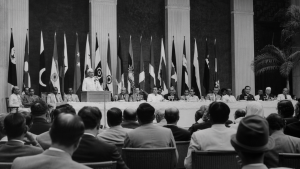
- Asian Relations Conference, 1947: Held in New Delhi under Jawaharlal Nehru before formal independence, it brought together representatives from 28 Asian countries and became an early platform for regional cooperation.
- Anti-colonial purpose: The conference reflected India’s broader foreign policy vision of solidarity among Asian nations emerging from colonial rule.
- Bandung Conference, 1955: Held in Indonesia, it consolidated Afro-Asian solidarity and gave shape to principles of sovereignty, non-intervention and peaceful coexistence.
- Non-Aligned Movement: The ideas associated with Bandung later culminated in the NAM at Belgrade in 1961.
- ASEAN, 1967: Formed through the Bangkok Declaration amid Cold War tensions, ASEAN developed into an important regional trade and economic bloc in Southeast Asia.
Legislative Decolonization and Criminal Law Reforms
- Bharatiya Nyaya Sanhita (BNS): Now in force, it replaced the British-era Indian Penal Code (IPC) of 1860.
- Shift in penal philosophy: The new law is presented as a move away from colonial penal concepts toward a modern justice system.
- Sedition removed: The colonial offence of sedition, earlier Section 124A of the IPC, has been removed.
- Section 152: The BNS includes provisions focused on safeguarding the sovereignty, unity and integrity of India.
- Other replacements: The Code of Criminal Procedure has been replaced by the Bharatiya Nagarik Suraksha Sanhita (BNSS), and the Indian Evidence Act, 1872 has been replaced by the Bharatiya Sakshya Adhiniyam (BSA).
Educational Transition and De-Macaulayisation
- Decolonization target, 2035: The government has set 2035 as a target year, marking 200 years since Thomas Macaulay’s 1835 Education Minute.
- Education Minute, 1835: It is associated with the promotion of English-medium instruction and colonial educational priorities.
- Policy objective: The stated aim is to remove residual colonial mindsets and institutional practices from education.
- NEP 2020: It replaces the traditional 10+2 structure with a 5+3+3+4 curriculum framework.
- National Curriculum Framework 2023: NCERT has updated school textbooks under this framework.
- Indian Knowledge Systems: The revised material seeks to integrate IKS and strengthen cultural identity in education.
- Textbook changes: Some titles have been renamed using Indian classical music concepts.
| Domain | Colonial / Traditional System | Modern Reformed System |
| Criminal law | Indian Penal Code (IPC), 1860 | Bharatiya Nyaya Sanhita (BNS) |
| Sedition | IPC Section 124A | Abolished; replaced by sovereignty protections |
| School structure | 10+2 framework | 5+3+3+4 curriculum under NEP 2020 |
| Schooling philosophy | Macaulay’s 1835 Education Minute | Indian Knowledge Systems in NCERT 2023 |
| School access | Historical class barriers | 25% EWS reservation under the RTE Act |
Academic Literacy and Judicial Equity Initiatives
- Academic campaign: A program launched in early 2026 includes 100 nationwide lectures and 21 monographs on decolonizing India’s historical and cultural systems.
- Purpose: The initiative seeks to promote academic literacy on decolonization.
- Supreme Court ruling, January 2026: In Dinesh Biwaji Ashtikar vs. State of Maharashtra, the Court reinforced the 25% reservation for economically weaker sections (EWS) under the Right to Education (RTE) Act.
- National mission: The Court described the EWS reservation as a national mission.
- Equity goal: The ruling supports access to quality school education and aims to reduce historical class barriers.
Key Prelims Takeaways
- 1947 Asian Relations Conference: New Delhi meeting that promoted early Asian cooperation and anti-colonial solidarity.
- Bandung Conference, 1955: Advanced Afro-Asian unity and principles of sovereignty, non-intervention and peaceful coexistence.
- NAM, 1961: Emerged from the Bandung spirit and was formally associated with Belgrade.
- ASEAN, 1967: Created through the Bangkok Declaration; now a major Southeast Asian economic bloc.
- BNS: Replaced the IPC and removed sedition as a colonial offence.
- NEP 2020: Introduced the 5+3+3+4 curriculum structure in place of 10+2.
- RTE and EWS: The 25% EWS reservation under the RTE Act was reaffirmed by the Supreme Court in 2026.
Current General Studies comprises current-affairs-based, General Studies-rich study material on policies, laws, institutions, economy, science, environment, governance, international relations, and other varied but important topics for UPSC and State PSC Prelims examinations.
Fortnightly PDF compilations: Available here
Originally written on
February 24, 2026
and last modified on
September 5, 2026.
| Related | |
|---|---|