FATF Recommendations and Grey-Black Lists
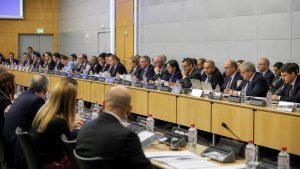
The Financial Action Task Force (FATF) is the global standard-setter on anti-money laundering and counter-terrorist financing. It assesses how countries build legal, regulatory and operational systems to protect the international financial system from abuse.
Overview and Institutional Structure
- Establishment: The FATF was created in 1989 at the G7 Summit in Paris.
- Secretariat: Its Secretariat is housed at the OECD headquarters in Paris, France.
- Core mandate: It began with money laundering, expanded in 2001 to cover terrorist financing, and in 2012 added financing of proliferation of weapons of mass destruction (WMD).
- Membership: The FATF has 40 members, including 38 member jurisdictions and two regional organisations: the European Commission and the Gulf Cooperation Council.
- India’s role: India is a member of the FATF and participates in its standard-setting and mutual evaluation process.
- Leadership: Giles Thomson of the United Kingdom is the FATF President for July 1, 2026 to June 30, 2028, succeeding Elisa de Anda Madrazo of Mexico. Vivek Aggarwal of India is the FATF Vice-President for July 1, 2026 to June 30, 2027.
The FATF Recommendations
- The 40 Recommendations: These are the core international standards for preventing, detecting and prosecuting money laundering and terrorist financing.
- Risk-based approach: The recommendations are meant to adapt to new technologies, cross-border financial flows and evolving criminal methods.
- Recommendation 6: It deals with targeted financial sanctions related to terrorism and includes humanitarian exemptions from UN Security Council Resolutions 2664 and 2761.
- Recommendation 15: It covers new technologies, including virtual assets and Virtual Asset Service Providers (VASPs), and requires licensing, registration and supervision to reduce money laundering risks.
- Recommendation 16: Known as the Travel Rule, it requires financial institutions to collect, verify and share originator and beneficiary information for wire transfers and virtual asset transfers.
- Implementation guidance: FATF periodically issues or updates guidance to help countries and institutions apply these standards in practice.
Grey List and Black List
- Grey List: Officially called Jurisdictions under Increased Monitoring, this list includes countries working with FATF to address strategic deficiencies in their AML/CFT systems.
- Black List: Officially called High-Risk Jurisdictions subject to a Call for Action, this list includes countries with severe strategic deficiencies.
- Grey List status: As of 2026, the Grey List has 22 jurisdictions.
- Black List status: The Black List has three countries: Iran, North Korea and Myanmar.
- Action on black-listed states: FATF asks members to apply enhanced due diligence and counter-measures to protect the financial system.
- Action on grey-listed states: These jurisdictions must implement an agreed action plan and are subject to regular monitoring.
| List | Official name | Current count | Key requirement |
| Grey List | Jurisdictions under Increased Monitoring | 22 | Work with FATF to remove strategic deficiencies through an action plan |
| Black List | High-Risk Jurisdictions subject to a Call for Action | 3 | Enhanced due diligence and counter-measures by member countries |
Recent Grey List Changes
- June 2026 additions: Bosnia and Herzegovina and Iraq were added to the Grey List.
- June 2026 removals: Algeria and Namibia were removed after addressing their strategic gaps.
- February 2026 additions: Kuwait and Papua New Guinea were placed under increased monitoring.
- Why it matters: Inclusion on these lists can reduce foreign direct investment, complicate access to international loans and raise transaction costs in trade.
- Institutional response: Countries on the Grey List are expected to work through a time-bound action plan with periodic review by FATF.
- Wider impact: Listing can affect a country’s banking relationships, financial credibility and international market access.
Recent Reports and Policy Priorities
- UK Presidency priorities: Under the 2026–2028 UK presidency, FATF has highlighted the global fraud epidemic, scam compounds, risk-based supervision and better information sharing.
- Public-private coordination: FATF is also stressing stronger cooperation between regulators, law enforcement and the private financial sector.
- DeFi report: In July 2026, FATF published a report on the regulatory challenges posed by decentralised finance (DeFi).
- DeFi risk focus: The report examines money laundering and terrorist financing risks from non-custodial financial platforms.
- Hawala report: In September 2026, FATF released a report on hawala networks and underground banking systems.
- Key concern: These informal channels remain attractive to professional money launderers because of their speed, reach and opacity.
Key Prelims Takeaways
- Founded: 1989 at the G7 Summit in Paris.
- Headquarters: OECD headquarters, Paris, France.
- Main role: Global watchdog for money laundering, terrorist financing and proliferation financing.
- Membership: 40 members, including India, the European Commission and the Gulf Cooperation Council.
- Travel Rule: Recommendation 16, dealing with transfer transparency.
- Grey List: Jurisdictions under Increased Monitoring.
- Black List: Iran, North Korea and Myanmar are the three high-risk jurisdictions subject to a call for action.
Current General Studies comprises current-affairs-based, General Studies-rich study material on policies, laws, institutions, economy, science, environment, governance, international relations, and other varied but important topics for UPSC and State PSC Prelims examinations.
Fortnightly PDF compilations: Available here
Originally written on
March 16, 2026
and last modified on
September 5, 2026.
| Related | |
|---|---|